Public-domain ebook
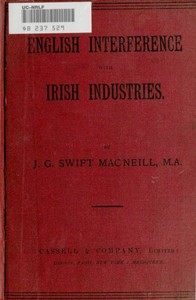
English Interference with Irish Industries
Language: en367 downloads on Project Gutenberg
Subjects
In: History - British·History - European·History - Modern (1750+)
Public-domain ebook sourced from Project Gutenberg #49419.
Public-domain ebook
Language: en367 downloads on Project Gutenberg
Subjects
In: History - British·History - European·History - Modern (1750+)
Public-domain ebook sourced from Project Gutenberg #49419.
The opening · free to read
CHAPTER VI. THE COMMERCIAL ARRANGEMENTS BETWEEN ENGLAND AND IRELAND, 1782-1800 91
CHAPTER VII. THE COMMERCIAL ARRANGEMENTS BETWEEN ENGLAND AND IRELAND EFFECTED BY THE ACT OF LEGISLATIVE UNION 104
ENGLISH INTERFERENCE WITH IRISH INDUSTRIES.
CHAPTER I. THE POLITICAL RELATIONS OF IRELAND TO GREAT BRITAIN.
The interference of the English Government with Irish trade before 1782 was twofold, direct and indirect. The direct interference arose from statutes passed in the English Parliament in restraint of Irish commerce. The indirect interference arose from the influence of the English Government over the legislation of the Irish Parliament, under the provisions of the statute known as Poynings' Act.
"From the admitted dependence," says Mr. Butt, "of the Crown of Ireland upon that of England, arose the claim of the English Parliament to legislate for Ireland. Over all the colonies and dependencies of the British Crown, the British Parliament had exercised the right of legislation. Over Ireland they asserted the same right. I need not tell you how fiercely it was contested, and that it was finally abandoned in 1782. But, up to 1782, the right was asserted, and occasionally exercised."[9]
These English statutes were chiefly aimed against the Irish manufactures, and were, of course, clear violations of Ireland's Parliamentary independence. The 6th Geo. I. passed by the English Parliament[10] claimed the power of British legislation over Ireland, a power which had been exercised long previously. "If that power," said Mr. O'Connell, "so claimed, had really existed, where was the necessity for passing that statute? and while this Act proclaims the slavery of Ireland, it admits the pre-existence of freedom."[11]
The nature and effects of Poynings' Act, and the control given to the English Government by its provisions over Irish legislation, are thus concisely stated by Mr. Butt: "To complete our view of the Irish Parliament, we must remember that by an Act of that Parliament itself a most important restriction was placed upon its legislative powers. By an Irish Act of Parliament, passed in the reign of Henry VII., in the year 1495, it was enacted that no bill should be presented to the Irish Parliament until the heads of it had been submitted to the English Privy Council, and certified as approved of under the Great Seal of England. This law is known as Poynings' Law, from the name of the person who was Lord Deputy when it was passed. This law was a matter entirely distinct from any claim of the English Parliament to legislate for Ireland; it was a law of the Irish Parliament itself, passed by the King, Lords, and Commons of Ireland, deriving its authority from a source entirely independent of the English claim, and continuing in force when that claim was abandoned. The original law required the assent of the English Privy Council to be given to the intended bill before Parliament met. In the reign of Queen Mary it was modified so as to admit of that assent being given while Parliament was sitting; but that assent was still necessary to authorise the introduction of the bill. With this modification the law of Poynings continued in force up to 1782."[12]
We see, accordingly, that England claimed or exercised direct legislative control in her own Parliament over Ireland; while no Irish bills could become law or, indeed, in strictness, be introduced into the Irish Parliament without the sanction of the English Privy Council.[13]
"Ireland," says Mr. Froude, "was regarded as a colony to be administered, not for her own benefit, but for the convenience of the mother country."[14]
[13] For further account of the constitution and powers of the Irish Parliament, see "The Irish Parliament: What it Was, and What it Did," by J. G. Swift MacNeill, published by Cassell & Company, Limited.
[14] "English in Ireland," vol. i., p. 178.
CHAPTER II. ENGLISH LEGISLATION IN RESTRAINT OF IRISH TRADE.
Persons familiar with the relative economic conditions of Great Britain and Ireland at the present time, will find it difficult to realise that at one period Ireland enjoyed natural advantages in no respect inferior to those of the sister country. This, before the development of steam-power, was undoubtedly the fact. This would be still the case were it not for the dearth of coal in Ireland.[15] The evidence of public men of the last century, who were well acquainted with the circumstances of both countries, is on this point conclusive. "Ireland," writes Edmund Burke in 1778, "is a country in the same climate and of the same natural qualities and productions with this (England)."[16] "In Ireland," writes Hely Hutchinson in 1779, "the climate, soil, growth, and productions are the same as in England."[17] Plunket, in his speech against the Union, delivered in the Irish Parliament on the 15th of January, 1800, draws a comparison between England and Ireland, in which he describes England as "another happy little island placed beside her (Ireland) in the bosom of the Atlantic, of little more than double her territory and population, and possessing resources not nearly so superior to her wants."[18] Mr. Froude's researches lead him to a similar conclusion: "Before the days of coal and steam, the unlimited water-power of Ireland gave her natural advantages in the race of manufactures, which, if she had received fair play, would have attracted thither thousands of skilled immigrants."[19]
I do not propose to furnish an exhaustive statement of the various laws passed by the English Parliament for the avowed purpose of destroying Irish trade and manufactures. I will deal only with the salient features of that system whose effects are, at the present day, sadly apparent.
Till the reign of Charles II., England placed no restriction on Irish commerce or manufactures. "Before the Restoration," says Lord North, in the British House of Commons, "they (the Irish) enjoyed every commercial advantage and benefit in common with England."[20] "Ireland," writes Hely Hutchinson, "was in possession of the English common law and of Magna Charta. The former secures the subject in the enjoyment of property of every kind, and by the latter the liberties of all the ports of the Kingdom are established."[21] "Our trade," says Mr. Gardiner in the Irish House of Commons, "was guaranteed by Magna Charta, our exports acknowledged by that venerable statute--no treaty was made in which we were not nominally or virtually included."[22] By one of the provisions of Poynings' Law, passed in 1495, all statutes hitherto in force in England were extended to Ireland. Before that enactment, however, Ireland is expressly mentioned in several English commercial statutes, in which clauses are inserted for the protection of her trade.[23] "At this period (1495)," says Hely Hutchinson, "the English commercial system and the Irish, so far as it depended on English statute law, was the same; and before this period, so far as it depended on the common law and Magna Charta, was also the same. From that time till the 15th of King Charles II., which takes in a period of 167 years, the commercial constitution of Ireland was as much favoured and protected as that of England."[24]
The first Navigation Act of 1660 put England and Ireland on exact terms of equality.[25] This community of rights was emphasised by an Act of the following year, which provided that foreign-built ships should not have the privilege of ships belonging to England and Ireland.[26] "But," as Mr. Froude observes, "the equality of privilege lasted only till the conclusion of the settlement and till the revenue had been assigned to the Crown."[27] In the amended Navigation Act of 1663, Ireland was left out. Lord North, on December 13, 1779, when Prime Minister of England, in introducing a bill to abrogate some of the restrictions on Irish trade, thus described the Act of 1663: "The first commercial restriction was laid on Ireland not directly, but by a side-wind and by deductive interpretation. When the Act (the Navigation Act of 1660) first passed there was a general governing clause for giving bonds to perform the conditions of the Act; but when the Act was amended in the 15 Car. II. the word 'Ireland' was omitted, whence a conclusion was drawn that the Acts of the two preceding Parliaments, 12 & 13 and 14 Car. II., were thereby repealed, though it was as clearly expressed in those Acts as it was possible for words to convey, that ships built in Ireland, navigated with the people thereof, were deemed British, and qualified to trade to and from British Plantations, and that ships built in Ireland and navigated with his Majesty's subjects of Ireland, were entitled to the same abatement and privileges to which imports and exports of goods in British-made ships were entitled by the book of rates. Ireland was, however, omitted in the manner he had already mentioned."[28]
This Act, which is entitled "An Act for the Encouragement of Trade," prohibited all exports from Ireland to the colonies.[29] It likewise prohibited the importation of Irish cattle into England. It states that "a very great part of the richest and best land of this kingdom (England) is, and cannot so well otherwise be employed and made use of as in the feeding and fattening of cattle, and that by the coming in of late in vast numbers of cattle already fatted such lands are in many places much fallen, and like daily to fall more in their rents and values, and in consequence other lands also, to the great prejudice, detriment, and impoverishment of this kingdom;"[30] and it imposes a penalty on every head of great cattle imported. A subsequent British Act declares the importation of Irish cattle into England to be "a publick and common nuisance."[31] It likewise forbids the importation of beef, pork, or bacon. Butter and cheese from Ireland were subsequently excluded, and the previous statute excluding cattle was made perpetual.[32] In 1670 the exportation to Ireland from the English Plantations of sugar, tobacco, cotton-wool, indigo, ginger, fustic or other dyeing wood, the growth of the said Plantations, was prohibited by statute. It is stated in the statute that this restraint was intended by the Act of 1663, but not effectively expressed.[33]
"There are," says Lord North, "anecdotes still extant relative to the real causes of those harsh and restrictive laws. They were supposed to have originated in a dislike or jealousy of the growing power of the then Duke of Ormonde, who, from his great estate and possessions in Ireland, was supposed to have a personal interest in the prosperity of that kingdom. Indeed, so far was this spirit carried, whether from personal enmity to the Duke of Ormonde, from narrow prejudices, or a blind policy, that the Parliament of England passed a law to prohibit the importation of Irish lean cattle."[34]
An extensive and profitable cattle trade which Ireland had established with Bristol, Milford, and Liverpool was annihilated by this legislation. With the restriction of her chief exports, her shipping trade suffered a simultaneous eclipse. Such direct trade as she retained was with France, Spain, and Portugal, as if England wished to force her, in spite of herself, to feel the Catholic countries to be her best friends.[35] Till 1663 the Irish had, according to Carte, no commerce but with England, and scarcely entertained a thought of trafficking with other countries.[36] This writer gives melancholy evidence as to the immediate effect of that restrictive legislation. "The people," he says, "had no money to pay the subsidies granted by Parliament, and their cattle was grown such a drug, that horses that used to be sold for 30s. were now sold for dogs' meat at 12d. apiece, and beeves that brought before 50s. were now sold for ten."[37]
The book keeps going
Reading is free forever. Sign up and watch scenes appear while you read.



Scenes Storieta drew for other classics.
New illustrated classics
Once or twice a month: the latest books to get full character casts, scene art, and free comic editions. No account needed.