Public-domain ebook
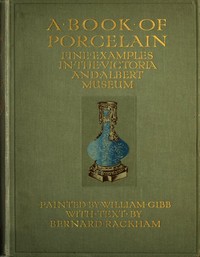
A Book of Porcelain: Fine examples in the Victoria & Albert Museum
English425 downloads on Project GutenbergDownload EPUB
Public-domain ebook sourced from Project Gutenberg #49439.
Public-domain ebook
English425 downloads on Project GutenbergDownload EPUB
Public-domain ebook sourced from Project Gutenberg #49439.
The book is a richly illustrated survey of porcelain held in the Victoria and Albert Museum, assembled by Bernard Rackham in 1910. It opens with a preface explaining that twenty‑eight water‑colour plates have been drawn from specimens, many unpublished or never before reproduced in colour, chosen for both market value and aesthetic appeal, as well as for their historical and documentary significance. Rackham makes clear that the work is not a comprehensive treatise on porcelain; instead, each drawing is accompanied by notes that highlight the particular aspects of the art each piece illuminates, drawing on a range of specialist sources from Dr Bushell to Mr William Burton. The contents are organized by national tradition, Chinese, Japanese, Italian, French, German, and English, providing a structured journey through the evolution of ceramic art as reflected in the museum’s collection.
Written in the scholarly yet accessible voice of an early‑twentieth‑century connoisseur, the text combines careful description with a narrative of the collector’s growing appreciation, moving from familiar English wares to the exotic origins of Chinese porcelain. Its measured, erudite style and extensive references will appeal to museum visitors, amateur collectors, and students of decorative arts who enjoy a methodical exploration of objects rather than a sweeping history. Readers who relish detailed visual documentation and enjoy tracing the cultural exchange between East and West will find Rackham’s focused, illustrated approach both informative and engaging.
The opening · free to read
The twenty-eight water-colour drawings reproduced in this volume have been made from specimens of porcelain in the collections of the Victoria and Albert Museum, South Kensington, many of which have never been published before, while others have not hitherto been reproduced in colours. The selection has been made not merely of those pieces in their several classes which have a high sale-room value; due consideration has been given to those which by their aesthetic qualities appealed to the sympathies of the artist, while at the same time an effort has been made to include objects having some particular historical or personal interest, or important as documents in the history of ceramics. In this connection it should be explained that the drawings were made before Mr. George Salting’s unrivalled collection of Oriental porcelain passed by his death into the hands of the nation.
The text does not pretend to be a general treatise on porcelain, or even an exhaustive summary of its history. The aim of the writer has been to record everything that is noteworthy with regard to the several pieces represented in the drawings, and at the same time to lay stress on the particular aspects of the subject which these examples serve to elucidate, taking them as the theme for a discussion of various phases in the evolution of the art.
Anything in the nature of a bibliography of works consulted by the author would be out of place in a publication of this kind, but acknowledgment must be made of his indebtedness, in the sphere of Oriental ceramics, to the writings of Dr. Bushell, Captain Brinkley, Dr. Otto Kümmel (in Geschichte des Kunstgewerbes), and Mr. R. L. Hobson. For English porcelain reference has been made, in addition to older authorities, to the works of Mr. William Burton; while the chief authorities consulted on the subject of Continental factories are Dr. Brinckmann, Dr. Berling, Dr. Bertold Pfeiffer, Signor Corona, M. le Baron Davillier, M. le Comte X. de Chavagnac, and M. Lechevallier-Chevignard. The author desires to express his gratefulness for various information and personal assistance afforded him by Mr. M. Yeats Brown, Mr. H. P. Mitchell, M. le Comte X. de Chavagnac, M. Émile Auscher, and the Friherrinna Julia Marks von Würtemberg. Thanks are also due to Mr. J. H. Fitzhenry for kind permission to reproduce a Ludwigsburg coffee-pot in his collection.
BERNARD RACKHAM.
LONDON, October 1910.
The book keeps going
Reading is free forever. Sign up and watch scenes appear while you read.



Scenes Storieta drew for other classics.
New illustrated classics
Once or twice a month: the latest books to get full character casts, scene art, and free comic editions. No account needed.