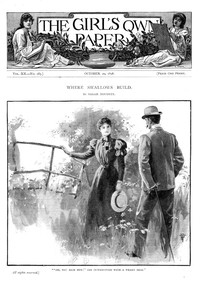
The next day was Sunday. Cardigan, who had learnt from his young hostess all that she could tell of her dressmaker, looked eagerly for Alice's face in the village church. But he could not find her there. She had gone away over the hills to a smaller church, to which the Monteagles never went, and was not to be seen with the Bowers in the seat allotted to the tenants of Swallow's Nest.
He was restless, and longed to secure a little time to himself in the afternoon. Somehow, without being observed, he contrived to slip away, out of the Hall, through the gardens, and then up to that high ground from whence he had first looked down upon the old farm.
There it lay in the still sunshine, asleep in a Sunday peace. He waited there, and watched until he saw the slender, upright figure of a young woman come out of the porch. She went down the little garden-path, opened the wicket, and then sauntered slowly across the grass to the lane.
She was in a very thoughtful mood as she paced deliberately under the shade of the old oaks. The sun, now getting low, burnished the brown hair, wound so simply around her uncovered head. Once she paused to reach a spray of late honeysuckle growing on the top of the hedge, and then stood still to tuck it into the front of her dress. When she moved again and lifted her eyes, she saw Cardigan standing before her under a tree.
"Miss Harper," he said, rather awkwardly, "it is a great pleasure to see you again. You have been hidden away so long!"
"I wanted to be hidden," she answered, as she gave him her hand. "Is it not very natural that I should hide myself, Mr. Cardigan? My life was darkened; it was best to live it all alone."
"I don't know if it was best," said he, reddening to the roots of his hair with the endeavour to speak his thought. "There were those who would have helped you to live it, if you would have let them."
"Ah, but I could not." Her face softly reflected the glow on his. "But, by the way," she added more lightly, "you have come to spoil the life I am leading here. I am told that you have bought Swallow's Nest, and mean to pull the old house down. Have you, by chance, given just a passing thought to those who are living under its roof?"
He flushed again.
"I confess I didn't," he said penitently. "But----"
"Oh, you rich men!" she interrupted, with a weary sigh. "With you to see is to desire, to desire is to have, to have is to leave others lacking. Shall I tell you what you were going to do?"
"Tell me anything you please," he answered eagerly.
"It is always much easier to pull down than to build up," she went on. "The old home yonder has been years in making. More than a century ago, when it was fresh and new, a young couple began there the serious business of life. They were poor in money, but very rich in love and faith. Their prayers are built into the walls; their angels have hallowed every humble room with holy ministry; their souls passed gently from that earthly dwelling to the Father's house on high. Children and children's children have filled the places that they left vacant, living just the same simple, God-fearing life. The old house is still sound and strong; there are no cracks anywhere; it keeps out the rough weather. But a rich man has decided that it is old-fashioned and ugly, therefore it must be pulled down."
Cardigan had grown pale. Her words had gone down right to the deeps of his heart, and moved him painfully.
"It shall not be pulled down!" he cried. "Miss Harper, I have been a stupid, selfish man. But it is not too late to begin again?"
"No, it is not too late," she said, with a very bright face. "And you will really let the house stand? Well, so much the better for us and the swallows. Dear birds, they are just going away. I wonder what they would have felt if they had come back to find their old nest in ruins. Mr. Cardigan, I think it is a good thing that I met you to-day. Now I must go back quickly and set some troubled hearts at rest."
"Do not go yet," he pleaded. "No one has ever given me such a straight talking to before. My money was making a selfish brute of me very fast. Hit me as hard as you can, Miss Harper. Every blow knocks some of the evil out."
She gave a soft little laugh.
"Why, it seems that I have found a new vocation," said she.
"I wish you had found it sooner!" he cried. "Can you not leave the nest to the swallows, and take me in hand? Is it too much to ask?"
There was a silence which only lasted for a moment, and yet seemed half a lifetime. The bright look faded from her face; she was perplexed and troubled.
"Mr. Cardigan," she said gravely, "you must take yourself in hand."
"That means that a man should not ask a woman to do for him what he ought to do for himself," said he, in a saddened tone. "Well, you are right. I have not given any proof of amendment."
"You have given a very plain proof of a kind heart," she said, with an earnestness that made her eyes glisten. "I thank you for it. But I must go now and carry the good news indoors."
He did not try to detain her again; but, just as she was turning away, he made a last request.
"Miss Harper, will you let me see you once more before I go away? Will you meet me here again, in this spot, next Sunday afternoon?"
"I will," she said quietly. And there was a very sweet look on her face as she made the promise.
Robert Cardigan went back across the fields with a great hunger in his heart.
He knew now that he loved her. He had begun to love her unconsciously when she was a girl in Park Lane, looking at life with serious eyes, and talking of the things that she would do some day.
How strange it was that wealth had been taken out of her hands, and put into his. Life is full of riddles like this. Strong, tender spirits are left to work hard for a pittance, suffering the heart-thrill of those who have nothing to give but prayers and love. Lazy men and women have their hands crammed with gold, and look round constantly for some new pleasure to buy for themselves. And yet there is One who is mindful of His own.
It was a very long week. Alice, busy with her work, was conscious of a dull ache when she called up a vision of Cardigan's face. The Bowers rejoiced with a great joy. They did not ask how it was that she knew Mr. Cardigan, and they promised not to speak of the matter. But they wondered silently why she, who had brought them gladness, should be sad herself.
Quite alone, in the stillness of another golden Sunday, Alice slowly took her way to the quiet lane. She knew that she should find him waiting there; and she knew, too, the answer that she would give him. Yet, in her innermost self, there was a deep regret that she could not give a different answer. A man must work out his own salvation, she thought. He must not put the tools into a woman's hand, and say, "Shape and fashion my life according to your will."
"So you have come. It is kind of you," he said.
Her face was a little paler than it had been last Sunday, and her lips slightly quivered.
"You have made us all so happy," she said, in a soft, hurried voice. "The Bowers are good people, and the old place feels like a home to me."
"Do you want to stay there always?" he asked with an impatient sigh.
"I have not lived there long," she said evasively. "You cannot realise what a rest it is. For two years I worked hard in London, learning my business; and I used to pine for fresh air, and the sight of fields and trees, as only working girls can. It was Miss de Vigny who found this home for me."
"She would not tell me anything about you," said he. "Do you know what I feel when I hear of all your sorrows and struggles? I feel mad to think that I have got so much money. It seems as if Providence were playing with us both. Don't look shocked. I have a bad habit of saying odd things when I am wrought upon."
She stood still. Her face was beautiful, but very pale.
"But I didn't bring you here to listen to my ravings," he went on. "I want to ask if you can give me any hope? Will there ever be a time when we shall work together? Only tell me this!"