Public-domain ebook
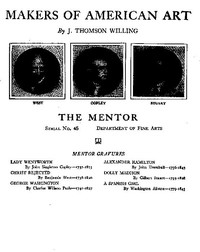
The Mentor: Makers of American Art, Vol. 1, Num. 45, Serial No. 45
Language: en295 downloads on Project Gutenberg
Subjects
In: The Mentor·History - American·Art
Public-domain ebook sourced from Project Gutenberg #49922.
Public-domain ebook
Language: en295 downloads on Project Gutenberg
Subjects
In: The Mentor·History - American·Art
Public-domain ebook sourced from Project Gutenberg #49922.
The opening · free to read
Perhaps West’s best contribution to the art development of America was the splendid generosity of his welcome to his young compatriots when they came to London to study. His was the hand that gave them greeting, his the studio and the home that were at their service, and his the mind that directed their work. To him came Matthew Pratt of Philadelphia, though his senior, and stayed four years, returning then to his native place and carrying on his profession there. The Peales, father and son, were indebted to him for their training. Dunlap and Trumbull and Stuart all studied under his tutelage. Allston sat at his feet as a devout disciple, becoming a veritable legatee of his mode of thought and of his manner. This manner was evolved from a contemplation of grand subjects, allegorical, religious, mythical, and historical. Neither he nor West was an observer of the life of their day; though West did a radical thing, a great service to natural art, when he painted the Death of Wolfe with all the figures therein clad in the regimentals they then wore, and not in classic garb, as historic happenings had hitherto been painted. His work had little beauty of color, little atmosphere, and no spontaneity. It has not held its appreciation as have other more natural paintings of that time. To Boston, in 1725, had come John Smybert, from London, a protégé of Bishop Berkeley. He there painted many portraits until his death in 1751; though his work had little merit. He was the forerunner of Copley, the first able native artist.
In his youth Copley had the slight advantage of some instruction from his stepfather, Peter Pelham, the engraver; but early acquired a style of his own. His technic was not very fluent; but his design was good, his drawing remarkably true, and his characterization unusual. A dignified formality pervaded his canvases, as befitted the sitters of his native Boston. It is said that a Copley portrait in a New England family is a certificate of aristocracy and social standing. He painted textures well, though somewhat laboriously. “Large ruffles, heavy silks, silver buckles, gold-embroidered vests, and powdered wigs are blent in our imagination with the memory of patriot zeal and matronly influence,” writes Tuckerman. But those adjuncts to the personality would not be so associated with the patrician Colonials had not Copley rendered them so well. None of the early painters so accurately gave the spirit of their time as he. As we can glean from Lely’s portraits of the beauties of the Carolean Court the free and easy manners that were its atmosphere, so from Copley’s portraits we get the moral atmosphere of that Colonial time, with the reserve and self-respect of its men and the virtue and propriety of its women. He did not go abroad until he was thirty-seven years old. In England he was well received, and had many commissions. He was made an A. R. A. in 1777, and a full academician in 1779. Shortly after this he was commissioned to paint “The Siege of Gibraltar.” His son, Baron Lyndhurst, became lord chancellor, and collected many of his father’s works.
By Matthew Pratt, in the Metropolitan Museum, New York.]
Charles Willson Peale’s fame is almost wholly derived from his portraits of Washington, of which he painted fourteen from life, extending in time from 1772 to 1795. His earliest shows Washington in the uniform of a British Colonial colonel, and is now in the possession of Washington and Lee University.
Washington is known to have sat forty-four times to various painters. Based on these comparatively few sittings have been more portrayals on canvas than have been accorded to any man in history, with the possible exception of Napoleon. A collection of engraved portraits of him has been made which included over four thousand plates. Rembrandt Peale, a son of Charles Willson Peale, contributed a cumulative fame to the name, as he also painted Washington, as well as Jefferson, Dolly Madison, and other political and social leaders. He, as well as his father and his uncle, James Peale, all worked at times in miniature. In the work of father and son there was little merit, little invention, but a creditable craftsmanship. They recorded the appearance of the people of their day with uninspired fluency.
By Benjamin West, in Boston Museum of Fine Arts.]
John Trumbull’s standing, like Peale’s, is attained largely on his renderings of Washington. He had much opportunity for observing the general, and this contributed much to the accuracy of his compositions, but little to the fineness of his art. He is fortunate in having many of his works gathered together in the Yale School of Fine Arts; for in the aggregation they are impressive, as being a dignified and graphic presentment of the important events of the Revolutionary period. These canvases are not large. Indeed, much of his work was in the nature of miniatures in oil. He made many careful studies from life of those persons he introduced into his historical compositions. His picture of the signing of the Declaration of Independence was painted in 1791, when most of the signers were yet living, and from all of these he obtained sittings. Claim has been made that he was the greatest of the early painters in America. He was, in the sense of having made the truest record. But in the sense of being the best according to our latterday conception of art, as being something other than a labored and literal rendering of a fact, he was inferior to both Copley and Stuart.
Portrait by the painter, in the Pennsylvania Academy.]
In Gilbert Stuart we had the most valuable art worker. His portraits, while good records, had also beauty and charm. His color was fresh and brilliant. He gave his subjects poise and personality. His pictures were vital. He had not the faculty for design and composition to the extent of the great Englishmen, Reynolds and Gainsborough; but he had a technic that was not inferior. Fortunate has been the nation that has known its heroic founders through the medium of Stuart’s picturing. Indeed, much of our modern regard for those heroes has been engendered by these dignified yet very human presentments. Of Philadelphia families he was the true historian, and of Boston society he was the splendid chronicler that outshone its own Copley. In England, after studying with West, he ranked high for several years in that, the greatest period of English art. He returned to America in 1792, and after spending two years in New York went to Philadelphia to paint Washington.
Apart from the several celebrated pictures of the first president, his best work was done in the decade in which he resided in that city. It has been the policy of the Pennsylvania Academy of Fine Arts to acquire as many of these works as possible. More than a score are now in its possession, including portraits of Presidents Monroe and Madison, and the famous Dolly Madison canvas. Stuart painted as many as three sets of the first five presidents, one of which was destroyed by fire in Washington. One set is now privately owned in Boston. What is known as the Lansdowne portrait is in the Philadelphia gallery. In design and general impressiveness, though not in features, it is one of the most satisfactory of all the presidential picturings. The Gibbs-Channing portrait, now in the Metropolitan Museum, New York, is the finest in facial modeling. Stuart made many replicas of the few Washingtons he painted from life--especially was this so of the Athenæum head. Much controversy has arisen as to which of the many Washington portraits is the most accurate. The fact of the absolute dimensions of any feature is of little moment to later generations. What is of greatest moment is the poise, the nobility, the grandeur, the serenity, the faith, the wisdom, the Homeric mold, of the man, and these a grateful people has come to think were intimated more fully by Stuart than by any of the other portrayers.
By Trumbull, in the Yale School of Fine Arts.]
Painted by himself.]
Stuart is quoted as saying “Houdon’s bust is the best, and after that, my portrait.” We can well be content to accept these as the two ideal renderings. It has been claimed that he was not very successful in portraying female beauty. This is a contention that is hard to controvert. He did not prettify his sitters in the way Lawrence did; but he surely made them humanly lovely. Rebecca Smith, Anne Bingham, Frances Cadwalader, Elizabeth Bordley, and Sallie McKean, all reputedly handsome in the written testimony of that period, have certainly not suffered in that repute by Stuart’s painting of them. And Betsy Patterson, she of the wilful temperament and romantic career, who married the brother of an emperor, lives for all time as a beauty because of the ability of Stuart. Of this handsome woman a contemporary writes, “Mme. Jerome Bonaparte is a model of fashion, and many of our belles strive to imitate her; but without equal éclat, as Madame has certainly the most beautiful back and shoulders that ever were seen,” and again, “To her mental gifts were added the beauty of a Greek, yet glowing, type, which not even the pencil of Stuart adequately portrayed in the exquisite portrait that he wished might be buried with him: not yet on his other canvas which, with its dainty head in triple pose of loveliness, still smiles in unfading witchery.” Whether or no he painted her as lovely as life, he produced a canvas that has great individuality and charm.
Washington Allston had a great reputation in his day; but his product was inconsiderable and not of a quality to justify the standing he then had. He had greater culture and a finer intellectuality than perhaps any other artist in the United States in its first century. His was a sensitive nature. He lived in the spirit. For the high, the lovely, the perfect, he strove all his days. Yet that high ideality and that earnest striving had little effect on the art of his time. He was honored by his literary contemporaries; but his work was not emulated to any extent by his fellow artists. His work was an intellectual expression. Its tradition was continued by Thomas Cole, who painted landscape as an allegorical message.
Allston was born near Charleston, South Carolina, spent his youth at Newport, where he became intimate with Malbone, and after graduating from Harvard went abroad to study. The Italians attracted him; but he found his way to London, where he associated with Coleridge and other literary celebrities. He was made an A. R. A.; but returned soon thereafter to Boston, working there from 1818 to his death in 1843. He laid much stress on his technical processes in painting. His pictures had none of the spontaneous quality of his sketches and studies. His was an art totally at variance with the mode of the present day. We feel in Copley’s canvases a very modern quality, and in most of Stuart’s, but not in Allston’s.
By Stuart.]
A more modern man, though not so celebrated, was John Vanderlyn, a native of Kingston, New York, who spent many years in Paris. He had aspiration after beauty for its own sake. His Ariadne, owned by the Pennsylvania Academy, was really the first important nude painted here. Such subjects in those days caused much protest. This artist’s life was a stern struggle against adverse conditions; though he greatly deserved success. In the rotunda of the Capitol at Washington is his Landing of Columbus, a work that does not well represent his ability. His portrait work carried through the traditions of the Revolutionary days to that period of the early half of the nineteenth century when Thomas Sully and Henry Inman were the leaders. The latter was born in Utica in 1801, and lived but forty-five years. His work was uneven, but at its best, as in the Henry Pratt portrait in the Pennsylvania Academy, is comparable to Raeburn. He painted Wordsworth, Macaulay, Dr. Chalmers, and other men of mark in England, on commissions from their American admirers. Though Sully was a pupil of Stuart, he entirely lacked the master’s authority of manner. His was a timid technic, without freshness of color or firm characterization. His life was a long and successful one, spent chiefly in Philadelphia, and he had many celebrities as sitters,--Queen Victoria, Fanny Kemble, and General Jackson are among his best known canvases. Of the work of Sully the Pennsylvania Academy has, besides several portraits of the artist himself, a large number of his canvases. This policy of the chief galleries of Boston, New York, and Philadelphia, of acquiring works of the several worthy artists of the older time, has become a more difficult one to follow as the years go on, and the ancestral portrait, the family heirloom, becomes precious beyond price.
The book keeps going
Reading is free forever. Sign up and watch scenes appear while you read.



Scenes Storieta drew for other classics.
New illustrated classics
Once or twice a month: the latest books to get full character casts, scene art, and free comic editions. No account needed.