Public-domain ebook
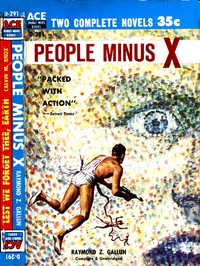
People Minus X
Language: en476 downloads on Project Gutenberg
Subjects
In: Science Fiction·Science-Fiction & Fantasy·Novels
Public-domain ebook sourced from Project Gutenberg #50063.
Public-domain ebook
Language: en476 downloads on Project Gutenberg
Subjects
In: Science Fiction·Science-Fiction & Fantasy·Novels
Public-domain ebook sourced from Project Gutenberg #50063.
The opening · free to read
Now Ed sat with his elbows on his table, that other, no longer quite blank, sheet of paper held lightly in his hands. He sat there, a stocky young man, his hair cut short like a hedge, the clues of his existence around him: student banners on the walls; a stereoptic picture of his track team--in color of course; ditto for his astrophysics class; his bookcase; his tiny sensipsych set; and the delicate instruments that any guy who hoped to reach the next human goal, the nearer stars, had to learn about.
His girl's picture, part of any youth's pattern of life for the last three centuries, smiled from beside him on the table. Dark. Strong as girls were apt to be, these days. Beautiful in a rough-hewn way. But even with all that strength to rely on, he was worried about her more than ever now. Times were strange. He glanced at her likeness once. Then his gaze bounced back to the paper in his hands.
His nerves tingled at the eerie thing that was happening there. He didn't know whether to feel afraid of it or hopeful. Man was stumbling toward ultimate mastery of his own flesh and the forces of the universe. But the distance remained enormous, though technical science was moving forward, perhaps too swiftly, on all fronts. Part of Ed's fear before the unknown was like the stage fright of an inexperienced actor. You never quite knew what was ahead or how to judge anything strange that you saw.
"_Nippe...._"
At the end of the line which made the "e" there was a tiny speck of blue ink. Almost imperceptibly, like the minute hand of a clock, it crept on, curving and looping to form another letter.
"_Nipper_" the word was now.
This could be somebody's funny gag, Ed thought. Somebody with a gadget. The world is full of gadgets these days. Maybe too full.
It occurred to him that a pal might be playing a joke with some simple device bought in a novelty store. But probability leaned toward something deeper and more costly. Who knew? Someone might have invented a way to make a man invisible. You didn't deny that anything could be, any more.
"Speak up!" he ordered softly.
But no answer came, and his wondering gaze found nothing unusual in the room around him. He froze. "_Nipper._" It could be part of a message, an honest attempt to convey vitally important information. Or it could be the forerunner of violence aimed in his direction. Through no fault of his own, he had had enemies for ten years. Tonight they might really act. To die was still possible. In spite of vitaplasm. Or the more tedious method that employed natural flesh. Or the tiny cylinders hidden away in vaults. Lives were now in danger again. Human, and almost human....
For a moment Ed wanted to give a warning and to call others into consultation. He wanted to shout, "Dad! Mom! Come here!"
He didn't do so. Between him and the precise, benign personality that he called Dad there was a gradually growing barrier. And for his mother, beautiful and young by art and science, he had that feeling of male protectiveness that takes the form of keeping possible dangers hidden.
Ed decided to work on his own. Being essentially careful and slow moving when it came to delicate processes, he had not touched that creeping droplet of ink. Its secret might thus be destroyed. No, he'd never do a thing so foolish.
Swiftly he folded the paper and fastened the writing under his microscope. The ink speck was almost dry now, and nothing was hidden in it. The line of the writing itself was odd under magnification. Here and there it showed tiny, irregular dots at spaced intervals, connected by fine, dragging marks. That was all.
Of course he realized that Nipper might be only the first cryptic word of a message and that he had only to wait and see what would follow.
Until he began to wait, however, the significance of the word itself eluded him. A child's nickname was all that it suggested.
But now his mind bore down on it. And he had the answer almost at once. A small boy climbing the wall of a pretty garden. And his casual christening by a pleasant stranger who met him thus for the first time. Among more vivid and significant details, the memory of the name itself had been mislaid. But Ed Dukas knew that in his boyhood one person had always called him Nipper: Uncle Mitch Prell, and nobody else. Now it seemed like a secret sign.
Ed gulped, his reaction suspended somewhere between shocked pleasure and a frosty sense of eeriness. To have a friend, whom he had loved as a child, vanish into space and into apparent nonexistence after becoming a fugitive, and then to have what seemed to be this friend try to communicate again after ten years, and in this weird manner--well--how would you say it? Ghosts, of course, were pure superstition. But in this age one could still react as if to the supernatural--with tingling hide and quickened heartbeats. In fact, with the vast growth of technology, more than ever was such a feeling possible.
"Uncle Mitch!" Ed Dukas called quietly.
Again there was no reply. The name on the paper still could be somebody else's trick. Granger's, maybe. There were ways for him to have learned a nickname. Many people might admire Granger as much as others despised him. And it was hard to say what he might do, or when. Or how, for that matter. He was clever. And wrong.
There was still another thing to remember. Ed did not altogether love the memory of his uncle, Dr. Mitchell Prell. For this famous scientist was marked with the stigma of responsibility for a terrific mishap. No, Prell did not bear the burden alone. There were other scientists, it was said, who had poked too roughly, and with too sharp a stick, into Nature's deepest lair. Nature had snarled back. Ed had grown up with the public hate that had resulted. He had fought against it, yet he had felt it, until sometimes he did not know where he himself stood.
Now he waited for more writing to be traced on the paper under the microscope. A minute passed, but there was nothing more. He did notice, however, that the letters of that one word matched roughly the austere handwriting of his uncle.
Once he glanced toward the window with some nervousness. Outside, the night was glorious. Never again would nights be hideous as they once had been. He saw lush gardens under silver light. If any devilish thing not known until recent months slithered through the shadows, it kept hidden. Ed saw other neighboring houses. New trees had grown to fair size in ten years. Older and larger trees remained lopsided and gnarled. But their burn scars had healed.
Otherwise there was nothing left to monument the past--except, perhaps, the sullen mutter of voices in nearby streets.
But Ed Dukas's mind, triggered by the name Nipper and by awareness of Mitchell Prell, slipped briefly away from the present. He had often explored memory to find understanding. At school, after the catastrophe, psychiatrists had made every kid do that. So that neuroses might be broken or lessened or avoided. So that animal terror would not draw a curtain over a mental record of an interlude. So that memory might not be lodged, like a red coal of hysteria, in the subconscious.
A birthday cake with two candles. A fountain splashing in the patio of this same house. A dachshund, Schnitz, which a little boy put in almost the same category as the flat, rubber-tired robots that cleaned the rooms. Where was the distinction between machines and animals?
Flowers, hummingbirds, and butterflies in the garden. The echoes of footsteps on stone floors. Toy space ships and star ships at Christmas. The star ships were things yet to become real.... There was endless interest in life then. But even in those days there were signs of cautious and puzzled guidance.
There was the sensipsych, of course. It was a wonderful box of dark wood in the living room. A soft couch folded down from it. There you lay, and for a moment strange golden light flickered into your eyes. You went to sleep, but you did not really go to sleep. For you became someone else. Maybe a cartoon character in a world where everything looked different. Funny things happened to you that frightened you at first; but then you laughed when you found that there was no harm in them.
Or, instead of being in such a crazy fairyland, you might be a real boy in space armor jumping across the surface of a huge chunk of rock called an asteroid, while stars and a blazing white sun stared at you from blackness. You were very busy helping others to roof the asteroid with crystal, and to put air underneath, and to build houses and factories where people might live and work. Always more and more people spreading out and out to populate the empty worlds of space.
But you were never on that sensipsych couch for very long, or too often. You would wake up, and there was Mom saying, "Enough, fella. A little of that sort of thing goes a great way, even when the experiences are rugged and educational and not just whimsical nonsense."
Ed Dukas would be angry and puzzled. For it had seemed that those visions, going on without end, could bring joy forever.
"You'll understand sometime, Eddie," his mother would say, consoling him. "What happens to you by sensipsych is just make-believe. What we call recorded sensory experience. Some of it really happened to other people. Some of it is just made up. It can teach you things. But too much is very bad. Not so long ago folks found out."
There was something tender and hard and even scared in his mother's words.
Ed's dad also had his comments. Dad was something called a minerals expert.
"Come on, Eddie, let's rassle," he'd say. "Stick your chin out, boy. Let's see how tough you can look. No, not mean-tough.... That's better. We've got to lick the times we live in. And something in ourselves. With machines doing so much for us, life can be soft. And sensipsych dreams are soft. Everything in moderation. Dreams can make you feel as helpless as an oyster. Until you despise yourself and the whole race. Yes, people found out. They were always meant to feel strong and proud, and they must have tasks equal to their increasing powers. Otherwise there's spiritual rot. We've got to be ready for anything, feel our way, try to be ready to keep our balance for whatever comes. Because life could be terrible, too, if the wonderful forces we control got out of hand. We've got to go on progressing--moving out to the planets, and then maybe the stars. Got to go either ahead or backward. Can't stand still. And it's easy to go backward nowadays. Got to fight that, Eddie, or else there might be a kind of death."
"What is death, Dad?"
Ed's father would answer his son's serious expression with a gay grin. "A kind of myth, now, boy. Just going to sleep and never waking up. We hope it's mostly finished, for everybody. Even the disease of old age turned out to be something like rust gathering in a pipe. Simple. It can be fixed up. Some people even let themselves get old. But they can be made young again. Always."
Eddie had other questions.
"You were born in the old way, Eddie," his mother said. "But so many people are needed now to populate the solar system. So everybody can't be born from his mother's body. There's another way; almost the same, really. Babies are born--they're made, really--in a laboratory. Then they live in a youth center, like the one on the hill."
The book keeps going
Reading is free forever. Sign up and watch scenes appear while you read.



Scenes Storieta drew for other classics.
New illustrated classics
Once or twice a month: the latest books to get full character casts, scene art, and free comic editions. No account needed.