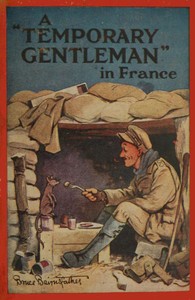
The writer has introduced this "Temporary Gentleman" to many good fellows in England, France, and Flanders, and is very anxious to introduce him on a really friendly footing to all his brothers-in-arms across the Atlantic; from New York to San Francisco, and from Quebec to Vancouver Island, also. But how best to do it? It really is no very easy matter, this, to present one simple, very human unit of the New Armies, to a hundred millions of people.
"Dear America: Herewith please find one slightly damaged but wholly decent 'Temporary Gentleman' who you will find repays consideration."
I think that is strictly true, and though, in a way, it covers the ground, it does not, somehow, seem wholly adequate; and I have an uncomfortable feeling that the critics might find in it ground for severe comments. But it is just what I mean; and I would be well content that all the kindly men and women of America should just find out about this "Temporary Gentleman" for themselves, and form their own opinion, rather than that I should set down things about him in advance. If these letters of his do not commend him to America's heart and judgment, I am very sure no words of mine would stand any chance of doing so. Yes, for my part, warmly anxious as I am for America to know him, and to feel towards him as folk do in France and Flanders and Britain, I am perfectly prepared to let him stand or fall upon his own letters, which certainly discover the man to you, whatever you may think of him.
Withal, in case it may interest any among the millions of American families from which some member has gone out to train and to fight, to save the Allied democracies of the world from being over-ridden by the murderous aggression of its remaining autocracies, I take pleasure in testifying here to the fact that among the officers now serving in Britain's New Armies (as among those who, whilst serving, have passed to their long rest) are very many thousands who are just for all the world like the writer of these letters. I have watched and spoken with whole cadet-training battalions of them, seen them march past in column of fours, chins well up, arms aswing, eyes front, and hearts beating high with glad determination and pride--just because their chance has nearly come for doing precisely what the writer of these letters did: for treading the exact track he blazed, away back there in 1915; for the right to offer the same sort of effort he made, for God and King and Country; to guard the Right, and avenge the Wrong, and to shield Christendom and its liberties from a menace more deadly than any that the world's admitted barbarians and heathens ever offered.
I know there are very many thousands of them who are just like this particular "Temporary Gentleman,"--even as there must be many thousands of his like in America,--because there have been so many among those with whom I have lived and worked and fought, in the trenches. And it does seem to me, after study of the letters, that this statement forms something of a tribute to the spirit, the efficiency, and the devotion to their duty, of the whole tribe of the Temporary Officers.
Their lost sense of humour (withered out of existence, I take it, by the poison gas of Prussian Kultur) would seem to have made the German nation literally incapable of forming an approximately correct estimate of the capacities of any people outside the confines of their own machine-made, despotically ordered State, in which public sentiment and opinion is manufactured from "sealed pattern" recipes kept under lock and key in Potsdam and the Wilhelmstrasse. Their blunders in psychology since July, 1914, would have formed an unparalleled comedy of errors, if they had not, instead, produced a tragedy unequalled in history. With regard to America alone, the record of their mistakes and misreadings would fill a stout volume. In the earlier days of the War, I read many German statements which purported (very solemnly) to prove:
(a) That in the beginning of the War they killed off all the British officers.
(b) That the British officer material had long since been exhausted.
(c) That, since it was impossible for the British to produce more officers, they could not by any effort place a really big Army in the field.
And the queer thing is that German machine-made illusions are of cast-iron. They "stay put"; permanently. During 1917 I read again precisely the same fatuous German statement regarding America and her inability to produce an army, that one read in 1914 and 1915 about Britain. The British New Armies (which Germany affirmed could never seriously count) have succeeded in capturing nearly three times as many prisoners as they have lost, and more than four times as many guns. From 1916 onward they steadily hammered back the greatest concentrations of German military might that Hindenburg could put up, and did not lose in the whole period as much ground as they have won in a single day from the Kaiser's legions. Yet still, in 1917, the same ostrich-like German scribes, who vowed that Britain could not put an army in the field because they could never officer it, were repeating precisely the same foolish talk about America and her New Armies.
Perhaps there is only one argument which Germany is now really able to appreciate. That argument has been pointedly, and very effectively, presented for some time past by the writer of these letters, and all his comrades. From this stage onward, it will further be pressed home upon the German by the armies of America, whose potentialities he has laboriously professed to ridicule. It is the argument of high explosive and cold steel; the only argument capable of bringing ultimate conviction to the Wilhelmstrasse that the English-speaking peoples, though they may know nothing of the goose-step, yet are not wont to cry "Kamerad," or to offer surrender to any other people on earth.
I know very well that the writer of these letters had no thought as he wrote--back there in 1916--of any kind of argument or reply to Potsdamed fantasies. But yet I would submit that, all unwittingly, he has furnished in these letters (on America's behalf, as well as Britain's) what should prove for unprejudiced readers outside Germany a singularly telling answer to the Boche's foolish boasts of the Anglo-Saxon inability to produce officers. As a correspondent in the Press recently wrote: "Why, for generations past the English-speaking peoples have been officering the world and all its waters--especially its waters!" And so they have, as all the world outside Germany knows, from the Yukon to Tierra del Fuego; from the Atlantic round through the Philippines to the golden gate and back.
It is a high sense of honour, horse sense, and sportsmanship, in our Anglo-Saxon sense, that lie at the root of successful leadership. And one of Prussia's craziest illusions was that with us, these qualities were the sole monopoly of the men who kept polo ponies and automobiles!
Only the guns of the Allies and the steel of their dauntless infantrymen can enlighten a people so hopelessly deluded as the Germans of to-day. But for the rest of the world I believe there is much in this little collection of the frank, unstudied writings of an average New Army officer, who, prior to the War, was a clerk in a suburban office, to show that sportsmanship and leadership are qualities characteristic of every single division of the Anglo-Saxon social systems; and that, perhaps more readily than any other race, we can produce from every class and every country in the English-speaking half of the world, men who make the finest possible kind of active service officers; men who, though their commissions may be "Temporary" and their names innocent of a "von," or any other prefix, are not only fine officers, but, permanently, and by nature, gentlemen and sportsmen.
Withal, it may be that I should be falling short of complete fulfilment of a duty which I am glad and proud to discharge, if I omitted to furnish any further information regarding the personality of the writer of these letters. And so, if the reader will excuse yet another page or two of wire entanglement between himself and the actual trenches--the letters, I mean--I will try to explain.
A. J. DAWSON, Captain.
LONDON, 1918.
THE GENESIS OF THE "TEMPORARY GENTLEMAN"
In the case of the Service Battalion officer of Britain's New Army who, with humorous modesty, signs himself "Your 'Temporary Gentleman,'" what is there behind that enigmatic signature that his letters do not tell us? The first of these homely epistles shows their writer arriving with his Battalion in France; and the visit is evidently his first to that fair land, since he writes: "I wonder if I should ever have seen it had there been no war!" That exclamation tells a good deal.
But of the man and his antecedents prior to that moment of landing with his unit in France, the letters tell us nothing; and if it be true that the war has meant being "born again" for very many Englishmen, that frequently quoted statement at all events points to the enjoyment of some definite status before the war.
Inquiry in this particular case speedily brings home to one the fact that one is investigating the antecedents of a well-recognised New Army type, a thoroughly representative type, as well as those of an individual. In his antecedents, as in the revolutionary development which the war has brought to him, this "Temporary Gentleman" is clearly one among very many thousands who have, so to say, passed through the same crucibles, been submitted to the same standard tests, and emerged in the trenches of France and Flanders, in Gallipoli and in Mesopotamia, in Africa, and in other places in which the common enemy has endeavoured to uphold his proposed substitution of Kultur for civilisation, as we understand it.
In the year 1896 there died, in a south-western suburb of London, a builder and contractor in a small, suburban way of business. An industrious, striving, kindly, and honourable man, he had had a number of different irons in the fire, as the saying goes, and some of them, it may be, would have provided a good reward for his industry if he had lived. As the event proved, however, the winding-up of his affairs produced for his widow a sum representing no more than maintenance upon a very modest scale of a period of perhaps three years. The widow was not alone in the world. She had a little daughter, aged five, and a sturdy son, aged eight years. Nineteen years later that boy, into whose youth and early training not even the mention of anything military ever crept, was writing letters home from fire trenches in France, and signing them "Your 'Temporary Gentleman.'"
For seven years after his father's death the boy attended a day school in Brixton. The tuition he there received was probably inferior in many ways to that which would have fallen to his lot in one of the big establishments presided over by the County Council. But his mother's severely straitened circumstances had rather strengthened than lowered her natural pride; and she preferred to enlarge the sphere of her necessary sacrifices, and by the practice of the extremest thrift and industry to provide for the teaching of her two children at private schools. The life of the fatherless little family was necessarily a narrow one; its horizon was severely restricted, but its respectability was unimpeachable; and within the close-set walls of the little Brixton home there never was seen any trace of baseness, of coarseness, or of what is called vulgarity. The boy grew up in an atmosphere of reticence and modesty, in which the dominant factors were thrift, duty, conscientiousness, and deep-rooted family affection.