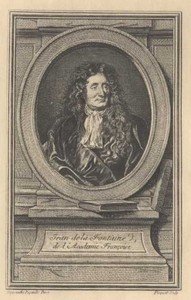
JEAN DE LA FONTAINE.
There are some writers the facts about whom can never be entirely told, because they are inexhaustible, and speaking of whom we do not fear to be blamed for repetition, because, though well known, they furnish topics which never weary. La Fontaine is one of this class. No poet has been praised oftener, or by more able critics, and of no poet has the biography been so frequently written, and with such affectionate minuteness. Nevertheless, it is certain that there will yet arise fresh critics and new biographers, who will be as regardless as ourselves of the fact that the subject has been so frequently enlarged upon. And why, indeed, should we refuse to ourselves, or forbid to others, the pleasure of speaking of an old friend of our childhood, whose memory is always fresh and always dear?
This truly worthy man was born in Château-Thierry, a little town of Champagne, where his father, Charles de la Fontaine, was a supervisor of woods and forests. His mother, Françoise Piloux, was the daughter of a mayor of Coulommiers. An amiable but careless child, he was lazy in his studies, and certainly did not display, by the direction of his earlier inclinations, the germs of his future genius. At twenty years of age, after the perusal of some religious works, he formed the idea that his vocation was the Church, and entered the seminary of Saint Magloire, where, however, he remained only one year. His example was followed by his brother Claude, with this difference, that the latter persevered to the end. On quitting the seminary, La Fontaine, in the paternal mansion, led that life of idleness and pleasure which so frequently, especially in the provinces, enervates young men of family. To bring him back to a more orderly course of life, his father procured him a wife, and gave him the reversion of his office. He was then twenty-six years of age, and the demon of poetry had not yet taken possession of him. La Fontaine never hurried himself about anything.
The accidental recitation in his presence of an ode by Malherbe aroused in his soul, which had hitherto been devoted to pleasure and idleness, a taste for poetry. He read the whole of Malherbe's writings with enthusiasm, and endeavoured to imitate him. Malherbe alone would have spoiled La Fontaine, had not Pintrel and Maucroix, two of his friends, led him to the study of the true models. La Fontaine himself has left a confession of these first flights of his muse. Plato and Plutarch, amongst the ancients, were his favourite authors; but he could read them only by the aid of translations, as he had never studied Greek. Horace, Virgil, and Terence, whose writings he could approach in the original, also charmed him. Of modern authors his favourites were Rabelais, Marot, De Periers, Mathurin, Régnier, and D'Urfé, whose "Astræa" was his especial delight.
Marriage had not by any means fixed his inconstant tastes. Marie Héricart, whom he had been induced to marry in 1647, was endowed with beauty and intellect, but was unsupplied with those solid qualities, love of order, industry, and that firmness of character which might have exercised a wholesome discipline over her husband. Whilst she was reading romances, La Fontaine sought amusement away from home, or brooded either over his own poems or those of his favourite authors. The natural consequence was, that the affairs of the young people soon fell into disorder; in addition to this, when La Fontaine's father died, he left our poet an inheritance encumbered with mortgages, which had been the only means of paying debts, and preserving the family estate intact; these became fresh sources of embarrassment to our poet, who being, as may well be supposed, anything but a man of business, incapable of self-denial, and unassisted by his wife, soon, as he himself gaily expressed it, devoured both capital and income, and in a few years found himself without either.
La Fontaine seems to have confined his duties, as supervisor of woods and waters, to simply taking long rambles under the venerable trees of the forests submitted to his care, or to enjoying prolonged slumbers on the verdant banks of murmuring brooks. And that this was the case we may reasonably suppose, since at sixty years of age he declared that he did not know what foresters meant by round timber, ornamental timber, or <i>bois de touche.</i>
His soul was wrapped up in poetry. His first poems were what might be called album verses, and could scarcely have been understood beyond Château-Thierry. These verses, however, obtained so favourable a reception, that at length he ventured to attempt a comedy. But, as the faculty of construction had been denied him, he only <i>adapted</i> one of Terence's plays, changing the names of the characters, and taking certain liberties with the situations. The piece which he had selected, the "Eunuchus," was very unsuited to the boards of the French stage, and he never attempted to get it produced; but he published it, and it was by means of this mediocre, although neatly versified work, that his name first became known to the public, when he had already entered his thirty-third year.
It was about this period that one of his relations, J. Jannart, a counsellor of the king, presented the poet to Fouquet, for whom Jannart acted as deputy in the Parliament of Paris. The Surintendant, partial to men of letters, gave La Fontaine a cordial reception, and bestowed upon him a liberal pension. La Fontaine became, not a mere accessory, but one of the most valued elements of the royal luxury of Fouquet's house, or, rather, court; and it was through his <i>protégé</i>, at a later period, that Fouquet received the only consolation that soothed his disgrace. La Fontaine, established as poet-in-ordinary to Fouquet, received a pension of a thousand livres, on condition that he furnished, once in every three months, a copy of laudatory verses. He was henceforth a guest at a perpetual round of fêtes; his eyes were dazzled, his heart was moved, and his mind at last awoke. The years which he passed in the midst of this voluptuous magnificence were years of enchantment, of which he has left traces in the "Songe de Vaux," the earliest indication of a talent which was to develop into genius. The first efforts of his muse at this period were laid at the shrine of <i>gratitude</i>, but <i>grief</i> more happily inspired him, for the "Elegy to the Nymphs of Vaux," the subject matter of which was the disgrace of the Surintendant, raised him to the front rank amongst the masters of his art. Up to this time La Fontaine had been only a pleasant, lively, and ingenious versifier; but on this occasion he proved himself a true poet, and the lines which we have just named are still regarded as amongst the choicest productions of the sort in the French language. "La Fontaine did not merely bewail, in the fall of Fouquet, the loss of his own hopes and pleasures, but the misfortunes of the one friend to whom he was gratefully attached, and of whose brilliant qualities he had the highest admiration. The emotion which he expressed was no fleeting one, for, some years afterwards, when passing by Amboise, the faithful friend desired to visit the apartment in which Fouquet had endured the first period of his imprisonment. He could not enter it, but paused on the threshold, weeping bitterly; and it was only at the approach of night that he could be induced to leave the spot."
Our poet's success amongst the crowd of brilliant men and distinguished women who formed Fouquet's court, could never be understood, if we gave full credence to those stories of odd eccentricities, simplicities, and blunders of which he has so frequently been made the hero. It cannot be denied that he was frequently a dreamer, absorbed in his own thoughts, and too apt to be credulous and absent in mind; but the greeting which was accorded to him, and the eagerness with which his acquaintance was courted in such a place, are sufficient evidences that he could be a charming companion when he pleased. He could be abstracted enough when surrounded by uncongenial spirits; he opened his heart only to those who pleased him: but on his friends he lavishly bestowed his joyous but refined wit, and his delightful <i>bonhomie.</i> The inborn carelessness of his nature rendered him averse to everything like effort; he was dumb to those who knew not how to touch the keynote of his soul; to such he was present, indeed, in the body, but his soul was cold and inharmonious. It may even be added, that reverie with him was a species of politeness by which he was wont to conceal his weariness. On such occasions he doubtless fled to the companionship of his fabulous beasts, although he refrained from saying so. Abstraction was to La Fontaine a means of becoming independent, and it is not, therefore, very surprising that he should have allowed people to attribute to him, in an exaggerated degree, a defect which he found so useful.
Fouquet's disgrace threw La Fontaine once more into that family life for the earnest and monotonous duties of which he had now grown more than ever unfitted. A son had been born to him, and this might have been supposed to attach him to his home; but the truth is, that children, whom he has for so many generations amused, were regarded by La Fontaine as his natural enemies, and he never let slip any occasion of expressing this opinion. "The little people," as he called them, were always obnoxious to him. It must be admitted that they are importunate, noisy, ever clamorous for small attentions, and they appear tyrannical to the last degree, in the eyes, at least, of those who have no warm affection for them. And it must also be admitted that La Fontaine was frequently their rival; for he always desired to be, and was, the spoilt child of the house, the child whose caprices were ever humoured, whose tastes were ever consulted. His life was, indeed, one long period of childhood. He arrived at manhood, became grey, and grew old, without ceasing to be a child; and to understand him rightly we must remember this fact. It is the key to, and some excuse for, that neglect of all serious duties which we should have to severely blame in him, if we applied to his case the rules of rigorous morality.
Constituted as he was, La Fontaine would naturally seize every opportunity of quitting his family and that Château-Thierry which he now regarded as a species of tomb. To distract himself from his grief, whilst apparently clinging to it more closely, he followed to Limoges his relation Jannart, who had been exiled by <i>lettre de cachet</i> with Madame Fouquet, to whom he served as secretary and steward. Our poet has written a narrative of this journey in a series of letters to his wife, interspersed with pretty verses, and abounding in vivacity. His stay at Limoges was short, and we soon after find him dividing his time between Paris and Château-Thierry, sometimes alone, and sometimes with Madame de La Fontaine, who at first frequently accompanied him in his excursions. The expense of these frequent journeys was naturally calculated to add to the disorder of his affairs; but he troubled himself little on this score, and it was some consolation that his own property alone was melting away, and that his wife would by-and-by be able to live by herself on property devoted to her own use. Let us also remark, in passing, that he did not altogether neglect that son of his who, at a later period, he describes as a charming boy, in that short and singular interview which has been so frequently discussed, and to whose education he attended until he was relieved of that duty by the generosity of the Procureur-General, De Harlay.