Public-domain ebook
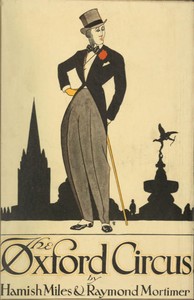
The Oxford Circus: A Novel of Oxford and Youth
by Miles, Hamish; Mortimer, Raymond
Language: en564 downloads on Project Gutenberg
Subjects
Public-domain ebook sourced from Project Gutenberg #50358.
Public-domain ebook
by Miles, Hamish; Mortimer, Raymond
Language: en564 downloads on Project Gutenberg
Subjects
Public-domain ebook sourced from Project Gutenberg #50358.
The opening · free to read
Entrusted with the literary remains of the late Alfred Budd, we think it fitting to provide the reading public, however briefly and inadequately, with some particulars of his life. They are, alas, only too few (Fate saw to that), but they may serve to indicate those forces of heredity and environment which worked to produce his remarkable novel, The Oxford Circus.
Alfred, as he was known to his intimates, was himself inclined to believe that, in some bygone age, a noble ancestor of his had founded the South Devon sea-side resort of Budleigh Salterton, where one summer he himself spent a happy fortnight. But our own researches[1] have disclosed no earlier trace of his family until Hosea Budd appears, in mid-Victorian days, as a general dealer in the pretty Flintshire village of Llwynphilly. He prospered, and his only son Albert, soon after taking Orders in the Church of England, took to wife Megan Meard, the daughter of a Shropshire corn-factor. The sole issue of this happy union was a boy, christened Alfred Hosea, after his two grandfathers--the future author of The Oxford Circus. The Meards, it is interesting to note, boasted a Huguenot origin, and from this strain perhaps was derived our author’s keen appreciation of the language and culture of France.
[1] We should like here to acknowledge the devoted help afforded us at the Public Records Office by Miss Agatha Anderleigh, B.Litt., than whom England has no more experienced genealogist.
Too delicate by far to be sent to boarding school, Alfred Budd was educated at home by his father, then and still the perpetual curate of Widdleswick, Salop. The boy’s mother unfortunately died while he was still but twelve summers old, but we understand that her influence lived after her, and that her son paid fitting tribute to her pious memory in his charming pen-portrait of Lady Julia Penhaligon.
The lad showed promise. Through the kindness of Sir Pontefract Gribble, the village Squire, he was enabled to browse in the well-stocked library of Widdleswick Manor. That he did not waste this splendid opportunity of reading both widely and wisely, not least in the domain of the contemporary novel, readers of his own, alas, posthumous, work of fiction will soon feel confident.
But how did Mr. Budd come to write the present volume? the reader may well be tempted to inquire. The circumstances have a melancholy interest all their own.
The Rev. Albert Budd had destined his only son to follow him into the ministry of the Church, and so, at the age of seventeen, the boy (for he was no more) was sent to Oxford to compete for an open exhibition at St. Edmund’s Hall. What happened? Perhaps his fragile health had handicapped him in the stern race; perhaps he had devoted too much attention to Sir Pontefract’s collection of modern fiction, and hardly enough to the more apposite writings of Aristotle and Euclid and Origen. Be that as it may, Alfred was unsuccessful in the examination, and, after three whole days in the University city, he left Oxford, as it turned out, for ever.
But those three days left an indelible impression upon his quick imagination.
The leaven worked, and while studying with a view to a second attempt in the next autumn, he devoted his leisure hours to the composition of The Oxford Circus. His incurable weakness in mathematics, however, asserted itself more and more during these months, and when the time came round he did not feel that his chances of success justified a second visit. The clerical career, then, was closed to him, and he had perforce to search for other employment.
His quest was soon rewarded. An advertisement inserted in The Times newspaper, under the appropriately chosen sobriquet of “Gaveston,” brought him an offer of work from a famous memory-training institute, which required the services of a representative in the Far East. Success seemed well within his grasp, and in due course he sailed from Cardiff to take up his post in Japan.
The rest is soon told.
To the quiet little vicarage at Widdleswick came a few short letters, bearing strange foreign stamps, and posted at Gibraltar, at Brindisi, at Port Said, and later handed over to us as his literary executors. They told, simply and modestly, of his hopes and fears, his ship mates and their ways, and in one he spoke of his plans for a sequel to The Oxford Circus, itself only completed a very few days before sailing. But it was not to be: dis, as he himself had said with reference to his University career, aliter visum.… For during the always trying passage of the Red Sea, poor Alfred disappeared. He supped, but did not take his place for breakfast. Neither his fellow-passengers nor the captain nor the crew could throw any light on his whereabouts, and it was presumed that he had fallen overboard in the darkness. They further presumed that his fall had been accidental.
Alfred Budd is dead. His readers will be at one with us in regarding his loss as a grave one to English letters. He despised coteries and disliked cliques. He was an honest workman of literature, using none but sound materials, none but well-established models. For its wit, its photographic realism and its daring originality, The Oxford Circus is a first novel of which any publisher might be proud. Its sparkling epigrams, and its vivid portrayal of life in many different strata of our modern society, seem almost unexpected from one who lived so quietly as Mr. Budd. Yet somehow his originality of invention leaves no room for doubt: Budd was perhaps the first novelist to introduce the London and North Western Railway station into a novel of Oxford life. Such a writer had no mean future.
Here and there, in preparing Alfred’s MSS. for the press, we have detected discrepancies which, had he lived, he might have adjusted, subtle touches which he might have amplified, luxuriances which he might have pruned. In respect to his memory, however, we have let these stand. If we have done wrong, we look for pardon from those who remember that, where an old and very deep friendship is concerned, the task of literary execution is no easy one.
H. M. R. M.
Behind the voice there were centuries of the best breeding, but the tone was perhaps a trifle querulous. From the crowded yard of the Oxford railway station there came no answer save the hoarse, insistent cries of porters and the importunate scuffling of cab-touts.
“Taxi, sir?”
“’ere y’are, sir. Taxi, sir?”
But Gaveston ffoulis knew his own mind.
“No,” he insisted, gazing with something like surprise round the cab-ranks. “I must have a hansom.”
“None ’ere, sir,” growled a surly-eyed taxi-driver.
“Then drive to the centre of the city,” ordered the young man, without hesitation, “and fetch me one--instantly!”
Instinctively the driver touched his cap. With a click the flag of his meter fell in symbolic surrender to this new arrival, and the motor, a throbbing anachronism, sped fussily away towards those rotund domes and soaring spires, whence, through the mellow streaming of October sunlight, came already the distant bombilation of crowding, multisonant bells.…
All impatience, Gaveston waited there for his chosen conveyance, and glanced coldly at the unimaginative battalions of undergraduates around him, who, callous to all appropriacy, were noisily flinging themselves and their golf-clubs into humdrum taxicabs. How pitiful, and how plebeian, was their lack of sensibility! To enter Oxford--the Oxford of Bacon and Pater, of Newman and Mackenzie--in these mechanical monstrosities! Rather than that, he had gone afoot.
“I’d as soon enter Paradise on stilts!” he reflected, and smiled at his witty conceit.…
And the smile had not faded from his full, attractive lips, when the bespoken hansom scampered up, guided by the taxi. Ordering the latter to collect his multitudinous luggage, he engaged the former to drive him to his destination.
“Wallace!” he cried, and leapt lightly into the graceful equipage.
With hooves gaily a-clatter over cobbles and causeway, the hansom wended its romantic way through the mazy purlieus which lead the traveller into the heart of this city that men call Oxford and the gods call Youth. Gaveston longed for a cockle-shell in his hat, to symbolize this mystic, dreamed-of wayfaring, and when at long last his driver reined in before a Gothic gateway darkly overhung by a stalwart, sky-crowned tower, he knew that his sense of the fitting had in all sooth been justified. He threw the fare to the jarvey, and crossed the threshold of his historic college, nodding kindly to the bewhiskered porter’s obsequious welcome.
“I must keep this up,” he murmured pensively in the vaulted porch.
Later that evening Gaveston gazed hungrily out over the Wallace quadrangle from the mullioned windows of the rooms allotted to him. “Staircase XVII … staircase XVII,” he kept repeating. What a place it was! Never had his utmost dreams envisaged this romantic reckoning by stairways.
And this was Wallace at last!
His eyes wandered over the beautiful accidents of its profile, clear-cut against the autumnal sky’s violaceous and crepuscular glory. With its myriad pointed turrets and ogive windows and frowning battlements, the college recalled to Gaveston ffoulis’s memory those vast baronial strongholds of Scotland and Touraine which he dimly remembered from the interminable travels of his picaresque infancy.…
“Dear Mums!” he whispered to the listening tree-tops, and a far-away look bedimmed his eyes. For with the memory of those other days came back the ever-fascinating, ever-elusive image of his mother, that dear whisp of frail, ethereal beauty who throughout his waking hours was scarcely ever absent from the gentle background of his thoughts. And, remembering her, he let Time slip silently by with fleet, inaudible steps until----
Why! it was nearly eight o’clock! Too late now to dine in Hall--but what matter? He turned to open the generous hamper which, only that morning, his mother had chosen for him at Fortnum’s. (How far-off already seemed the glittering clinquetis of Piccadilly!) And there, in the quietude of his own room, Gaveston dined simply off a dish of cold Bombay duck, garnished (a bon viveur, he preferred delicacies that were out of season) with some superb bottled peas.
Rising from his second meringue, Gaveston decided to resume his reverie, and walked over to the large cheval-glass that occupied an inglenook formed by a turret--he had ordered the awestruck scout to take it from its packing-case before any of his sixteen suit-cases were unlocked. He looked at himself with some satisfaction. Was it so, he wondered, that Oxford would see him--a svelte, willowy figure, with fair hair and fair skin and fair eyes, whose every trait bore the subtle handwriting of race and breeding, and on whose lips played the most infectious of enigmatic smiles.
“_Quel hors d’œuvre!_” he exclaimed in involuntary admiration. He was indeed a masterpiece.
But what was that?
Yes, a knock … a visitor already--was it possible? Quickly Gaveston tiptoed over to the Chappel concert grand which had been despatched as advance luggage, and in an instant his room was throbbing with the evanescent, moonlit melancholy of the Chopin nocturne in G-flat minor. He chose that (it was his mother’s favourite, too) because it always seemed to fill a room with just that warm sense of welcome and intimacy which a host should emanate. At the first bars of the scherzo the knocking was repeated, a little louder. He stopped short.
The book keeps going
Reading is free forever. Sign up and watch scenes appear while you read.



Scenes Storieta drew for other classics.
New illustrated classics
Once or twice a month: the latest books to get full character casts, scene art, and free comic editions. No account needed.