Public-domain ebook
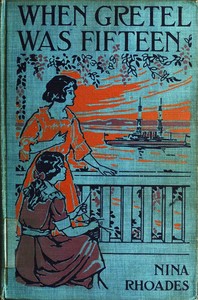
When Gretel Was Fifteen
by Nina Rhoades
Language: en351 downloads on Project Gutenberg
Subjects
In: Historical Novels·Children & Young Adult Reading·Novels
Public-domain ebook sourced from Project Gutenberg #50371.
Public-domain ebook
by Nina Rhoades
Language: en351 downloads on Project Gutenberg
Subjects
In: Historical Novels·Children & Young Adult Reading·Novels
Public-domain ebook sourced from Project Gutenberg #50371.
The opening · free to read
“War has been declared.”
Miss Minton’s hand trembled slightly, as she laid down the evening paper, but otherwise she showed no sign of unusual emotion. There was a moment of dead silence, and every face grew suddenly grave. They all knew what it meant, those twelve pupils, and five teachers, seated at Miss Minton’s long supper table. For nearly three years this terrible thing called war had been devastating Europe, bringing pain and misery to millions of once happy homes. And now their own country was to cast in her lot with the Allies, in the great fight for humanity. It was the first time in the twenty years and more, during which Miss Minton had been the mistress of her small school for girls, that that lady had ever been known to look at a newspaper at meal time, but to-night she had left instructions that the paper should be brought to her the moment it arrived. For weeks every one had been expecting the war cloud to burst, and yet now that it had happened, they were all conscious of a certain shock. Amy Bowring began to cry.
“My brother will have to go,” she sobbed; “he was at Plattsburg all last summer. Oh, it’s dreadful. I don’t see why the President didn’t prevent it.”
Ada Godfrey’s black eyes flashed indignantly. Her uncle had gone down on the Lusitania.
“I’m glad he didn’t prevent it,” she said. “We ought to have gone in two years ago. It’s time those Germans learned they don’t own the whole world.”
“Ada,” said Miss Minton, reprovingly, and she glanced down the long table to where little Fräulein Sieling, the German teacher, sat next to Gretel Schiller. Ada bit her lip, and she, too, glanced at the only two people among them all to whom Germany meant more than a name. Fräulein had grown very pale, and there was a frightened look in her blue eyes, but she was buttering a muffin with apparent calmness. Gretel Schiller had flushed, and her lips were quivering. Gretel’s father had been a famous German pianist, and although he had died several years before, and Gretel was living with an American half-brother and his wife, and was in every way quite as much an American herself as any of them, they all knew that she worshipped her father’s memory.
“You remember the Civil War, don’t you, Miss Minton?” Grace Moss asked, by way of steering the conversation into smoother waters. Grace was one of the oldest pupils in the school, and felt privileged to ask questions.
“Yes,” answered Miss Minton, with a sigh. “I was only a child, but I remember many things about that time. My eldest brother was killed at Gettysburg. Amy, if you can’t control yourself, you will have to leave the table.”
Miss Minton was always stern, but her tone was kinder than her words, and Amy made an effort to check her sobs, and go on with her supper.
“Do you remember the Civil War, too, Miss Laura?” Geraldine Barlow inquired of Miss Laura, Miss Minton’s younger sister, who sat at the other end of the table.
“No, dear, I was too young. My sister is ten years older than I. I think she is the only person here who has any memory of what real war is like. Of course there was the little war with Spain, twenty years ago, but that was so quickly over.”
“Perhaps this war will be over quickly, too, now that America has gone in,” said Angel Thayer, who always looked on the bright side of things. “I don’t believe the Germans can hold out much longer. Perhaps they will give in, and ask for peace before our boys get over.”
“Not much hope of that,” said Margaret May. “My father writes that Germany is terribly strong still. He ought to know something about it, for he has been working in the French hospitals for over a year.” Margaret spoke confidently. She was very proud of that father of hers, the poor country doctor, who had left his practice at home, and gone to tend the wounded boys in France.
At that moment Fräulein pushed back her chair from the table. “May I be pardoned if I go to my room?” she asked in her slow, careful English, and she cast an appealing glance at Miss Minton. “I have a very bad headache.”
“Certainly,” said Miss Minton, kindly, and as the little German teacher hurriedly left the room, she added in a reproachful tone to Ada:
“I am afraid you have hurt Fräulein’s feelings, Ada. It is not her fault that her country is at war with us.”
Gretel’s grave face brightened, and she gave Miss Minton a grateful glance.
“Fräulein is very unhappy,” she said, impulsively. “This dreadful war has almost broken her heart.”
“A pity it did not break it altogether,” muttered Madame, the French teacher, but she did not speak loud enough to be heard by either of the Mintons, for quarrels between different nationalities were strictly forbidden in the school.
Gretel saw Madame’s expression, even though she did not hear her words, and a shadow crept into her brown eyes. She was very fond of Fräulein, who, for more than a year now, had been the only person to whom she could talk freely of her father’s memory, and of her happy childhood, which had been spent in the big, shabby studio, among his German friends. Indeed, Fräulein was the only German she knew, for since she had gone to live with her American relatives, she had quite lost trace of all her father’s friends. Her brother and his wife were very good to her, and she loved them dearly, but those old memories were very tender ones, and so when, a year and a half ago, she had come to Miss Minton’s, a rather shy, quiet little girl of thirteen, it was not strange that her heart should have gone out to the sentimental little German teacher, who talked to her in her father’s language, and seemed to understand her as few people had done. Those were the early days of the war, when many Americans still tried to be neutral, and Gretel’s family had made no objections, when, in the holidays, she had asked to invite Fräulein to their home. She had even gone to tea with Fräulein, at her aunt’s apartment. But as the months passed, things changed; feeling against Germany grew stronger, and on her last visit Gretel had heard remarks made by Fräulein’s aunt, that had brought the hot, indignant blood into her cheeks. Still, she had remained faithful in her affection for her friend, arguing that, after all, if people were Germans it was natural they should refuse to believe evil of their country. She tried to picture herself in Fräulein’s place, a stranger in a strange land, and she felt sure that whatever people had said against America, she should still have loved her country, and been loyal to her.
And now America was actually at war with Germany, and things would necessarily grow more difficult. Gretel’s face was very grave and troubled when, some fifteen minutes later, they all rose from the supper table, and filed out of the dining-room. Her first thought was to go to Fräulein, and try to comfort her. It was Good Friday, and there would be no more lessons till the following Tuesday. The girls had the evening to themselves, and could do what they chose till bedtime.
As soon as they had left the dining-room Amy began to cry again, and Angel Thayer, too, who was her room-mate, and best friend, slipped an arm about her tenderly.
“Don’t cry, Amy,” she soothed. “Perhaps the war will be over before your brother gets there. Miss Minton says most of the boys will have to be trained in this country before they are sent overseas.”
“I only wish I had a brother to go,” proclaimed Ada Godfrey. “I would be proud to give him to my country.”
“You wouldn’t if he were the only brother you had in the world,” objected Amy, with a sob. “It’s all very well to talk when you haven’t any brothers, and your father’s dead. There isn’t a soul in your family to go.”
“It wouldn’t make any difference if I had only one man relative in the world,” declared Ada, heroically. “I should be proud to send him to the war, even if I knew positively he would be killed the next month. We ought to glory in making sacrifices. Think what the English and French have done. My aunt, who is doing war work in England, says there is scarcely a family that hasn’t lost at least one member. Oh, I wish those horrid Germans were all----” Ada checked herself abruptly, for Miss Minton was still within hearing distance.
Every face grew grave. This idea of sacrifice for their country was a new one to most of them. So far, Margaret May was the only girl at Miss Minton’s to whom war had meant anything more than a name. But now---- Even Angel’s bright smile faded, as she suddenly remembered that her father, whom she adored, was still a young man. Was it possible that fathers as well as brothers might be called upon to join the colors?
“I can’t help being glad my brothers are little boys,” said Molly Chester, with a catch in her voice. “Father’s nearly fifty, so of course he’s too old. I’m afraid I’m selfish, but it is a great comfort.”
“Both my brothers will go,” said Olive Gerard, quietly. “I am glad to have them, but of course it’s going to be hard for Mother and me.” Olive was seventeen; a tall girl, with a sweet face, and gentle gray eyes. She was a great favorite with the younger pupils, who all looked up to her and admired her very much, and instinctively both Amy and Angel drew a little closer to her, and Amy slipped a trembling hand into hers.
“I wish I could be brave,” she whispered, “but I know I am an awful coward. Jack always told me I was a coward, because I was afraid of snakes, and mice, and horrid creeping things, but, oh, it’s so terrible to think of having people we love go away to be killed or wounded! I’m afraid I can never be brave enough to bear it as I ought.”
“Oh, yes, you will,” said Olive, smiling; “we shall all learn to be brave. Think of how brave the English and French women have been. An English friend of my mother’s wrote that all her three boys were at the front, and that, hard as it was to part from them, there was one thing that would have been much harder, and that would have been if they hadn’t wanted to go.”
“Oh, Jack wants to go,” cried Amy, with shining eyes. “He’s been wanting to for more than a year.” And, suddenly she was conscious of a sensation of pride in her big, handsome brother, that, with all her love for him, she had never felt before.
“Where are you going, Gretel?” Geraldine Barlow inquired, as they all moved off in the direction of the big gymnasium.
“To Fräulein’s room,” Gretel answered. “I think I’ll see if there is anything I can do for her. She said she had a headache.”
Geraldine looked troubled. She was a year younger than Gretel, whom she liked very much, but she had never been quite able to understand her friend’s intimacy with the German teacher.
“Don’t you think perhaps she might prefer being by herself?” she suggested.
Gretel shook her head.
“I think she would like to see me,” she said, and turned resolutely in the direction of the staircase. More than one pair of eyes looked after her curiously.
“What can she see in that German woman to like so much?” said Kitty Sharp. “I can’t bear Fräulein myself, she’s so silly and sentimental, and did you see how she looked when Miss Minton told us war had been declared? I suppose she’s scared to death now we’ve gone into the war.”
The book keeps going
Reading is free forever. Sign up and watch scenes appear while you read.



Scenes Storieta drew for other classics.
New illustrated classics
Once or twice a month: the latest books to get full character casts, scene art, and free comic editions. No account needed.