ANCESTRY OF GEORGE WASHINGTON PARKE CUSTIS. George Washington Parke Custis was born April 30, 1781. His mother was Eleanor (Calvert) Custis, a granddaughter of the sixth Lord Baltimore; his father, John Parke Custis, the only son of Martha Washington by her first marriage. John Parke Custis grew to manhood at Mount Vernon, married Eleanor Calvert in 1774, and died of camp fever in 1781 while serving as aide to General Washington at Yorktown. His death left four children fatherless, so the two youngest, George Washington Parke Custis and his sister Eleanor, were adopted by the Washingtons and taken to Mount Vernon to be raised as their own.
HIS EARLY LIFE AT MOUNT VERNON. Only 6 months old when he was taken to live at Mount Vernon, it was a remarkable experience for a boy as sensitive and gifted as young Custis to grow up on terms of intimacy with General Washington, whose affection the fatherless lad reciprocated with the deepest love and respect. As far as public duties would allow, the General supervised the training and education of the boy, who acquired from him the interests and ideals which established the pattern of his life. “It is really an enjoyment to be here to witness the tranquil happiness that reigns throughout the house,” wrote a guest at Mount Vernon in 1799, “except when now and then a little bustle is occasioned by the young Squire Custis when he returns from hunting, bringing in a ‘valiant deer’, as he terms it, that Grandpa and the Colonel will devour: nice venison I assure you.”
GEORGE WASHINGTON PARKE CUSTIS MOVES TO ARLINGTON. Custis was 18 when the General died in 1799. Mrs. Washington did not long survive her husband, and when she died, early in 1802, Custis moved to “Mount Washington,” as he first called the Arlington estate. This was a tract of nearly 1,100 acres that Custis’ father had bought in 1778 with the intention of establishing a family seat convenient to Mount Vernon, but in 1802 the only tangible remains of his brief ownership were the flourishing willows he had planted along the Potomac.
“ARLINGTON HOUSE” BEGUN. When Custis moved into a cottage built by the former owners of the property, Arlington consisted mostly of woodland and virgin oak forests, with a few cleared fields near the river. His first concern was to get the fields under cultivation, using for the purpose the mules and farm equipment he had purchased at the sales held that year at Mount Vernon to settle the legacies of the several Washington heirs. Equally urgent was the need to build a house worthy of the furnishings and mementoes which he had inherited or bought at the Mount Vernon sales, some of which were deteriorating badly in their temporary quarters. To this end, he seems to have obtained building plans from George Hadfield, a gifted young architect, who had come from England in 1795 to take charge of the construction of the Capitol.
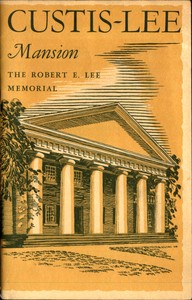
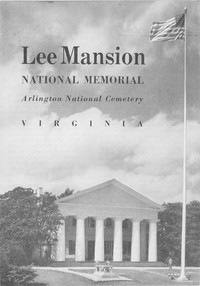
Influenced by the contemporary vogue for classical architecture, Custis wanted his house to be in the new style, and the architect’s finished design was a simplified Greek Doric portico balanced by extended wings, the whole of such sturdiness as to show to advantage when viewed from across the river. Since ornamentation would be lost at such a distance, the architect largely dispensed with it, relying on good proportions to give beauty to his creation. Rooms would be large and have high ceilings and tall windows, and their severely plain walls would be perfect for displaying the many portraits Custis possessed. Having the rooms open into each other would give extensive vistas, framed by pleasing semicircular arches.
Though clay for bricks and choice timber were at hand on his estate, Custis lacked the money necessary to build his house all at once. Therefore he followed the common practice of building the wings first, and the main section later. The north wing was built about 1803, and was evidently intended to be one great banquet room. By 1804, the south wing was completed, containing an office and a large room for entertaining. In that year Custis married Mary Lee Fitzhugh. To provide living quarters for himself and his bride he had the north wing partitioned into three small rooms. With a kitchen and laundry in the basement, the young couple had the essentials of living at “Arlington House,” as Custis named his new home, after the old family seat on the Eastern Shore. At this point, work seems to have been stopped. A visitor reported in 1811, “I was struck, on entering the grounds of Mr. Custis, at Arlington, ... with several of the most picturesque views. This seat is on a superb mount, and his buildings are begun in a stile of superior taste and elegance.”
ARLINGTON AND THE DEVELOPMENT OF AMERICAN AGRICULTURE. While building his house, Custis inaugurated an annual fair designed to improve agricultural practices in general, and particularly the breeding of fine-wooled sheep. Beginning in 1803, Custis invited the local gentry each spring to exhibit their best sheep and homespun cloth at Arlington Spring, near the edge of the river. After prizes had been awarded, the fair would close with patriotic speeches and a great dinner under the tent which had been used by Washington during the Revolution.
By breeding the native stock on his farms with the imported stock he had acquired from Mount Vernon, Custis himself developed a hardy race of fine-wooled sheep, known as the “Arlington Improved.” Because the wool of this breed could be woven into finer cloth than hitherto possible, the Arlington sheep were widely diffused throughout the country. Custis also sought to correct the primitive agricultural methods which had already caused much land in his State to be abandoned because of soil erosion. He advocated the establishment of a National Board of Agriculture with functions like those of the Department of Agriculture today, and he offered one of his outlying properties for use as an experimental breeding station. So popular was the Arlington Sheepshearing, as it was commonly called, that the idea was quickly adopted elsewhere. Though economic conditions forced Custis to discontinue the event after 1812, it was one of the primary sources of the great program of agricultural improvement in effect today.
BIRTH OF MARY ANNA RANDOLPH CUSTIS. Mary Anna Randolph Custis, born in 1808, was the only one of the four Custis children to survive the first year of infancy. Upon her the parents centered their affections and hopes. The mother’s natural piety and devotion to her family were deepened by the loss of her other children, while the father’s warm and generous nature was such that in later years she could not recall ever having received an unkind word from him.
CUSTIS AND THE WAR OF 1812. During the War of 1812, the British blockade of the Chesapeake deprived Custis of much of the income from his other estates, so it is doubtful if any building was done at Arlington at this time. Convinced that Napoleon threatened the liberties of mankind more than England, Custis strongly opposed the war. For this reason he was chosen to deliver the funeral oration for General Lingan, a veteran of the Revolution who was murdered by the same Baltimore mob which almost killed Robert E. Lee’s father, “Light-Horse Harry” Lee. Nevertheless, Custis followed the example set by George Washington during the American Revolution by forbidding the managers of his plantations to furnish supplies to the British; and when British troops approached the National Capital in 1814, Custis fought in the ranks at the battle of Bladensburg.
“ARLINGTON HOUSE” COMPLETED. After the war, Custis resumed work on his house, and the large center section and great portico were to have been finished in 1817. “A house that any one might see with half an eye,” as Robert E. Lee later described it, could not fail to attract attention, and “Custis’ Folly” is first mentioned by a traveler in 1818. Although the interior was never completed as planned and the rear was left unstuccoed, “Arlington House” was soon considered one of the handsomest residences about Washington. One early writer describes it as “a noble-looking place, having a portico of stately white columns, which, as the mansion stands high, with a back ground of dark woods, forms a beautiful object in the landscape.”
THE MEMORY OF GEORGE WASHINGTON KEPT ALIVE AT ARLINGTON. “Arlington House” now became the successor of Mount Vernon as the “Washington Treasury,” as Custis termed it. His collection of Washington relics was the largest in existence, and it filled the halls and rooms of the mansion. The owner of these relics welcomed all who wished to view them, and he never tired of entertaining his guests with tales of his early years at Mount Vernon. Many distinguished men visited Arlington at one time or other—Sam Houston, Daniel Webster, and Andrew Jackson, to name a few. One of the most notable was General Lafayette, who twice was a guest there when he toured the United States in 1824 and 1825. Custis spent much time with the venerable marquis, and used the wealth of reminiscenses he gained from the old soldier to write the delightful Conversations With Lafayette, which was published in a local newspaper in 1825. Encouraged by their favorable reception, he then began his own Recollections and Private Memoirs of Washington, which proved equally popular and were widely reprinted in the newspapers of the period.
Even more successful were the dramas Custis wrote at this time, based on heroic episodes in the Nation’s past or on inspiring contemporary achievements. The Indian Prophecy used an incident in Washington’s early life as its theme and established a vogue for Indian plays which lasted over 50 years; while the Rail Road was the first one written on that subject in America. Others dramatized such events as the battle of Baltimore and the launching of a new warship. For 10 years his dramatic pieces were staged from Boston to Charleston and did much to develop a distinctive American drama.
A man of culture, Custis used all of his abilities to perpetuate the memory of Washington. He erected the first monument on the President’s birthplace in 1816, wrote poems to celebrate his greatness, and painted colorful battle pictures in which the great General was the central figure. An accomplished orator, he was tireless in advocating the principles of freedom for which Washington had fought, and planned to do with his slaves as his foster father had done—free them after they had been prepared to shift for themselves. Although he never held an elective office, his influence was considerable and for the good.
HOME LIFE AT ARLINGTON. An equal source of inspiration at “Arlington House” was the religious atmosphere of its home life. Mrs. Custis was a devout Episcopalian, noted for her simplicity and piety. It was she who influenced Robert E. Lee’s Sunday school teacher, Bishop William Meade, to enter the ministry. Diligent where her husband was inclined to be easy-going, Mrs. Custis was one with him in making Arlington free from ostentation.