Public-domain ebook
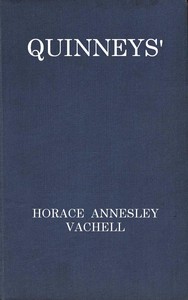
Quinneys'
Language: en531 downloads on Project Gutenberg
Subjects
Public-domain ebook sourced from Project Gutenberg #50596.
Public-domain ebook
Language: en531 downloads on Project Gutenberg
Subjects
Public-domain ebook sourced from Project Gutenberg #50596.
The opening · free to read
"Good-evening, Mr. Quinney!"
"Good-evening!" Quinney replied, as he passed a stout red-faced fellow-townsman.
With his back to the man, Quinney smiled. He could remember the day, not so long ago, when Pinker, the grocer, called him "My lad." Then his whimsical face grew solemn, as he remembered that a smile might be misinterpreted by others whose eyes were fixed upon him with sympathy and interest. He walked more slowly, as befitted a chief mourner returning from his father's funeral, but he was queerly sensible of a desire to run and shout and laugh. He wanted to run from a drab past into a rosy future; he wanted to shout aloud that he was free--free! He wanted to laugh, because it seemed so utterly absurd to pull a long face because a tyrant was dead and buried. The fact that the old man was buried made a vast difference.
Suddenly he was confronted by a burly foot-passenger, who held out a huge hand and spoke in a deep, muffled voice.
"So, Old Joe is dead, and Young Joe reigns in his stead?"
"Right you are," replied Quinney.
Despite his efforts, a note of triumph escaped him.
"Left you everything?" continued the burly man. Quinney nodded, and after a pause the other continued huskily: "Old Joe had something snug to leave--hey?"
"Right again," replied Young Joe.
"More'n you thought for, I'll be bound?"
"Maybe."
"Well, my boy, hold on to it--as he did. It's a damned sight easier to make money than to keep it."
"I made some of it," said Quinney.
"Not much."
Quinney shrugged his shoulders and passed on, slightly exasperated because a butcher had stopped him in Mel Street, Melchester, with the obvious intention of pumping details out of him. The butcher walked on, chuckling to himself.
"Young Joe," he reflected, "is a-goin' to be like Old Joe. Rare old skinflint he was, to be sure!"
Quinney, meantime, had reached the dingy shop known to all Melchester as "Quinney's." The shutters were up--stout oak boards sadly in need of a coat of paint. Quinney opened a side door, and entered his own house--his--his! He could think of nothing else. Quinney's, and all it contained, belonged to him. Immediately after the funeral, when the house was full of people, the young man was dazed. And when the will was opened, and he learned that Old Joe had saved nearly ten thousand pounds, he felt positively giddy, replying vaguely to discreet whispers of congratulation with jerky sentences such as "By Gum, this is a surprise!" or, with nervous twitchings of the mouth and eyes, "Rum go, isn't it, that I should be rich?"
Later, Young Joe had gone for a walk alone, seeking the high downs above the ancient town. The keen air blew the fog out of his brain, and presently he exclaimed aloud:
"Yes; I am Quinney's."
After a pause he burst out again, speaking with such vehemence that a fat sheep who was staring at him ran away.
"Gosh! I'm jolly glad that I gave him a tip-top funeral. He'd have pinched something awful over mine."
After this explosion--silence, broken intermittently by whistling.
Upon entering the house, Quinney went into the shop, and disdainfully surveyed the stock-in-trade. Everything lay higgledy-piggledy. The big window was full of faked brass-work which seemed to gleam derisively at a dirty card upon which was inscribed the legend, "Genuine Antiques." Among the brass-work were bits of pottery and some framed mezzo-tints. Inside the shop, upon an unswept floor, old furniture was piled ceiling high. Some of it was really good, for mahogany was just then coming into fashion again, but in such matters Old Joe had always been behind his times. He preferred oak, the more solid the better, buying everything at country sales that happened to go cheap; assorted lots allured him irresistibly. He was incapable of arranging his wares, laughing scornfully at his son's suggestions. In the same spirit he refused to remove dust and dirt, being of the opinion that they lent a tone to antiques which were not quite genuine. He had never bought really good stuff to sell to customers outside the trade.
When, as frequently happened, he came across a valuable piece of furniture or a bit of fine china, he would communicate at once with a dealer, and in particular with a certain Thomas Tomlin, who invariably paid ten per cent advance on the bargain, which might be regarded as a handsome profit. To the visitors, especially Americans, who dropped in to Quinney's on their way to and from the Cathedral, Old Joe would sell at a huge profit what he contemptuously stigmatized as rubbish. A few of his regular customers were well aware that Old Joe knew nothing of the real value of some of his wares. He bought engravings and prints in colour, and these he sold at a price about double of what he had paid, chuckling as he did so.
Porcelain he understood, but not pottery; and even in porcelain he refused obstinately to pay a high price, unless he was quite sure of his turnover. Young Joe had always despised these primitive methods, and nothing pleased him so much as when he was able to rub well into his sire the mortifying fact that ignorance and funk had prevented him from securing a prize.
As the young man gazed derisively at his possessions, the roustabout boy told him that Mr. Tomlin had called, promising to return after the funeral; and half an hour later the dealer arrived, to find Young Joe staring devoutly at two figures of Bow and a plate of Early Worcester. Tomlin greeted the young man with a certain deference never exhibited before.
"Sorry to disturb you, Joe, on such a sad occasion."
"'Tain't sad!" snapped joe. "You know as well as I do that the old man gave me a hell of a time. Now he's gone, and that's all there is about it."
"I came about them," Tomlin indicated the china. "Last thing your pore father wrote to me about."
"Nice bits, eh?"
Tomlin examined them. As he did so, a keen observer might have noticed that Young Joe's eyes were sparkling with what might have been excitement or resentment, but not gratification.
"How much?" said Tomlin.
"They're not for sale."
"What?"
"I should say that I'm keepin' 'em for a party I know."
"Anything else to show me?" grunted Tomlin, caressing the Bow glaze with a dirty but loving finger. "Your father mentioned a mirror-black jar, K'ang He period."
"Keepin' that too," replied Quinney quietly.
"Sold it?"
"Not yet."
Quinney smiled mysteriously.
The book keeps going
Reading is free forever. Sign up and watch scenes appear while you read.



Scenes Storieta drew for other classics.
New illustrated classics
Once or twice a month: the latest books to get full character casts, scene art, and free comic editions. No account needed.