Public-domain ebook
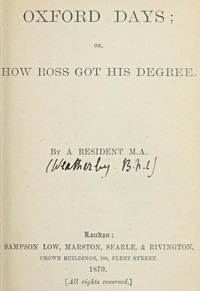
Oxford Days; or, How Ross Got His Degree
Language: en332 downloads on Project Gutenberg
Subjects
In: Novels·British Literature·History - Schools & Universities
Public-domain ebook sourced from Project Gutenberg #50618.
Public-domain ebook
Language: en332 downloads on Project Gutenberg
Subjects
In: Novels·British Literature·History - Schools & Universities
Public-domain ebook sourced from Project Gutenberg #50618.
The opening · free to read
“DEAR ROSS,--My boy is going to Brasenose: at least, he goes up in May to try for a close scholarship. I can give you no advice, as I know nothing about the place. I sent him to the Hereford Cathedral School by a fluke some years ago; and as there are scholarships and exhibitions from the school to Brasenose, I am saved the difficulty of choosing a college.
“Yours truly,
“W. RICKARDS.”
The vicar explained that a “close” scholarship was, like other scholarships, a sum of money paid annually for four or five years as a prize, but differed from them in being confined to competition among boys from certain schools; and that the value of them varied from 45_l._ to 80_l._ per annum, part being paid in money, and part made up in allowances in the way of diminished fees. The letter from the “coach” was more valuable:--
“DEAR MR. ROSS,--So much depends on your son’s abilities, your own means and wishes, that I cannot answer your question as to the best college, off-hand. I think I may assume that you do not want him to spend more money than is absolutely necessary; and possibly that you would wish him to ‘go in for honours’ instead of taking a Pass Degree, that is, offering the smallest possible number of subjects for examination. I need hardly say that a high degree in honours opens the way to a Fellowship, or at any rate to good masterships in schools; and is, in fact, a distinct help, directly and indirectly, not only in educational, but in all professions.
“It is far better for a lad to go to a good college, even though he is unable to obtain a scholarship or any other college endowment, than to go to an inferior college, where he may succeed in getting pecuniary assistance. To illustrate what I mean: I believe, in the long run, it would be wiser to send your son as a commoner to Balliol than as a scholar to Wadham. If, from a pecuniary point of view, you do not care for him to get a scholarship, nor want him to read for honours, and are not particular as to whether he spends 300_l._ or 500_l._ a year (or even more), I should send him to Christ-Church, Brasenose, Exeter, or University. The first two especially were in my day emphatically popular colleges, and I believe are so still. But I would not send him to either unless you are fully prepared for the amount of expenditure which I have named. Possibly you might like our only denominational college--Keble. He would be most carefully looked after in every way, and his expenses kept within a fixed limit. The Warden and Tutors devote their whole energies to their men, and the men themselves speak in the most affectionate terms of them--a most exceptional fact, I assure you. But I must warn you that the religious tone of the college is distinctly pronounced, and inclines to ritualistic rather than to evangelical doctrines.
“If your son’s college life will be a pinch to you (you will allow me to speak thus plainly on such a question), send him as an Unattached Student. But here, again, you and he should clearly understand that the life of an unattached student is isolated, and quite unlike the life of the college undergraduate. The only exception to this statement is when an undergraduate migrates, as for various reasons sometimes he is obliged, from his college to the body of the Unattached. His society, being already formed, remains unbroken. I should fancy your choice will lie between New College, Corpus, Paul’s, and Balliol. A scholarship at either means that the scholar is capable, with industry, of gaining the highest honours in his future University examinations. On the whole, I think, I incline to Paul’s. Unfortunately, you have just missed the examination for scholarships. There is, however, an ordinary matriculation examination for commoners in about three weeks’ time. If your son holds a good position in his school, he ought to have no difficulty in passing even at this short notice, for the subjects are those which are read in forms lower than the highest at all schools. I shall be happy to do anything further in the matter for you that I can. He should come prepared for residence, in the event of his passing. The examination begins on the Wednesday after Easter, and will be over in time for successful candidates to ‘come into residence’ with the other men on the following Saturday. You should send an application to the Master of Paul’s at once. I enclose a list of subjects and fees, and am
“Yours truly,
“PHILIP WODEHOUSE.”
“SUBJECTS FOR MATRICULATION AT PAUL’S.[1]
“1. Translation from English into Latin prose.
“2. Translation into English of an unprepared passage of Attic Greek.
“3. Translation of some portion of a Greek and Latin author (to be selected by the candidate), with parsing and general grammar questions.
“4. Arithmetic, including Vulgar and Decimal Fractions and Interest.
“5. Euclid, Books I. and II.; or Algebra, to Simple Equations.
“FEES.
“(a) To the University at Matriculation 2_l._ 10_s._
“(b) To the College, as caution-money 30_l._[2]
“Room-rent varies from 10_l._ to 16_l._ per annum. This does not include furniture, which must be taken at a valuation from the previous tenant; 25_l._ is an average valuation-price. China, glass, linen, plate, and household necessaries must all be procured. It is wiser to bring plate and linen. The rest may be purchased from the ‘scout’ (servant) apportioned to the rooms. For this, say 10_l._ The immediate payments, therefore, amount to 2_l._ 10_s._ + 30_l._ + 10_l._ = 42_l._ 10_s._ The payment for the furniture must be made early in term; and the establishment charges, tuition fees, expenses of board and rent, are paid terminally.”[3]
So Paul’s was chosen, and a letter of application forwarded to the Master;[4] and Frank, who was then at home for the Easter vacation, commenced polishing up his work in view of the approaching examination. On Easter Tuesday he left home by an early train, with a note to Mr. Wodehouse in his pocket. That gentleman entertained him at dinner with a long list of examination stories, and about nine o’clock marched him off to the Clarendon Hotel, where, with a word to the landlady, he left him, nervous at the thought of the morrow, but conscious of his own dignity and the near approach of the manhood which is supposed to date from matriculation.
It was with some difficulty that Frank preserved his self-composure in the presence of the waiters, as he sat at breakfast in the “Clarendon” coffee-room. He did not particularly enjoy his meal, and, in obedience to Mr. Wodehouse’s injunctions, left at half-past nine to make his way to Paul’s. After one or two mistakes, he succeeded in finding the college gates. His anxiety as to his next step was set at rest by the sight that met him. About a dozen boys (to be called men after matriculation) were hanging about the Lodge, in various typical conditions of mind and body--some completely at their ease, chatting unconcernedly; others standing nervously alone. Most wore black coats and chimney-pot hats--the costume that only a few years ago was rigorously insisted on. A few through ignorance, or in obedience to the spirit of the day, wore defiantly light suits and bowler hats. Frank, to his great delight, found a school-fellow whose coming up had, like his own, been hurriedly decided in the vacation. The two friends had not much time for conversation, for in a few minutes a respectable middle-aged man, whom they knew afterwards to be the Porter, said, “You are to walk this way, gentlemen, please,” and conducted them to the College-Hall. It is a fine old place, with dark oak panels, coloured windows, portraits, and coats-of-arms; and to the boy up in Oxford for his first visit, and that visit so solemn a one as matriculation, there is an unspeakable charm, and a novelty sobered into grandeur, about everything. How the grave faces of the college founders and celebrities looked down upon the wondering eyes! Bishop and knight, king and duchess--there they stared! How the light streamed through the coloured windows! Who could tell? Perhaps one day, Frank thought, when he was a rich man, he might have that one vacant window filled, or some of his descendants might present to the college a portrait of Sir Francis Ross, attired in wig and gown, one of Her Majesty’s--or rather, perhaps, His Majesty’s--judges, if not Lord Chancellor.
He started abruptly from his dreams, and came back to the first rung on the ladder that was leading to such prospective fame. There before him stretched three lines of tables and benches down the length of the hall. Across the end, on a slightly-raised daïs, ran another table, where the handsome chairs indicated beings superior to undergraduates. It was, in fact, the High table, where the Master and Fellows dined, and any resident Masters of Arts who cared to do so.
This morning it was devoted to the more serious purposes of examination. Ten ink-bottles, fifteen blotting-pads, fifteen sheets of white paper printed, with a few sheets of blue paper and two or three quill pens lying by each: that was the fare this morning--“the feast of reason” that was in such strong contrast to the “flow of soul” that would grace the table at six o’clock that evening.
One of the junior Fellows was in charge of the examination. He was reading the Times as Frank and his companions entered, sitting on the table, with his legs dangling in a graceful attitude of studied negligence. He took no notice of the victims, till the Porter had conducted them to the table and motioned them to take seats. Then he looked up from his newspaper and said,--
“You will have till half-past twelve. Write your names clearly; and please bear in mind that we expect answers from both books of Euclid.”
Then he resumed his newspaper and adopted a more dignified attitude.
Frank looked at his questions. Eleven in all; some definitions, six propositions from the first book, and four from the second. He wrote his name at the head of his paper, and made a great blot in doing so. His hand grew hot. He dashed at the first definition,--
“_A circle is a plane figure contained in one straight line._”
His pen spluttered warningly at the word straight. A blot fell, and fell luckily on the fatal word. He tore up the paper and commenced again.
Making a good start, his hands grew cool, his head calm; and with the old portraits beaming upon him, away he wrote. He completed the six propositions of the first book; then, pausing for breath, saw that almost everybody else had his watch on the table. Frank pulled out his. A quarter to twelve! He had blundered, he knew. He ought to have timed himself, and left more time for the second book. However, his success had put him at his ease, for he knew all the propositions well so far; and he buckled-to vigorously. By hard writing he managed to do three propositions. The last was the thirteenth. He knew he could not do it in five minutes, and he must allow himself time to read over his work. He had barely done even this when the papers were collected, and they were dismissed, with instructions to appear again at two.
The book keeps going
Reading is free forever. Sign up and watch scenes appear while you read.



Scenes Storieta drew for other classics.
New illustrated classics
Once or twice a month: the latest books to get full character casts, scene art, and free comic editions. No account needed.