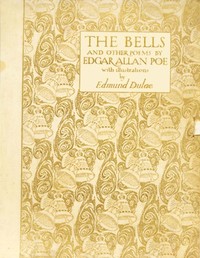
Public-domain ebook
The Bells, and Other Poems
English1,156 downloads on Project GutenbergDownload EPUB
Public-domain ebook sourced from Project Gutenberg #50852.
Public-domain ebook
English1,156 downloads on Project GutenbergDownload EPUB
Public-domain ebook sourced from Project Gutenberg #50852.
The volume gathers Edgar Allan Poe’s most celebrated poems, beginning with the four‑part “The Bells,” a progressive meditation on sound that moves from silver‑toned merriment through golden wedding chimes, to the shrill alarm of brass and finally the solemn toll of iron. Each section is introduced by a brief illustration and a rhythmic, almost musical description that sets the tone for the poem’s shifting moods. After this opening, the collection proceeds to familiar pieces such as “Eulalie, A Song,” “Annabel Lee,” “The Raven,” and “To One in Paradise,” each presented in full with accompanying engravings that echo the original 19th‑century publications. The arrangement offers a panoramic view of Poe’s lyrical range, from tender love verses to haunting, gothic narratives, all anchored by the recurring theme of loss and the uncanny.
Poe’s voice is unmistakably Romantic, marked by lush alliteration, vivid imagery, and a preoccupation with death, memory, and the supernatural. The language is formal yet intensely emotional, reflecting the mid‑1800s American literary climate that prized both lyrical beauty and macabre intrigue. Readers who appreciate richly textured verse, atmospheric storytelling, and the dark elegance of early American poetry will find this collection compelling, especially those drawn to the interplay of sound and feeling that defines Poe’s poetic craft.
The opening · free to read
Hear the sledges with the bells-- Silver bells! What a world of merriment their melody foretells! How they tinkle, tinkle, tinkle, In the icy air of night! While the stars, that oversprinkle All the heavens, seem to twinkle With a crystalline delight; Keeping time, time, time, In a sort if Runic rhyme, To the tintinabulation that so musically wells From the bells, bells, bells, bells, Bells, bells, bells,-- From the jingling and the tinkling of the bells.
II.
Hear the mellow wedding bells, Golden bells! What a world of happiness their harmony foretells! Through the balmy air of night How they ring out their delight! From the molten golden-notes, And all in tune, What a liquid ditty floats To the turtle-dove that listens, while she gloats On the moon! Oh, from out the sounding cells, What a gush of euphony voluminously wells! How it swells! How it dwells On the Future! how it tells Of the rapture that impels To the swinging and the ringing Of the bells, bells, bells, Of the bells, bells, bells, bells, Bells, bells, bells-- To the rhyming and the chiming of the bells!
III.
Hear the loud alarum bells-- Brazen bells! What a tale of terror, now, their turbulency tells! In the startled ear of night How they scream out their affright! Too much horrified to speak They can only shriek, shriek, Out of tune, In a clamorous appealing to the mercy of the fire, In a mad expostulation with the deaf and frantic fire, Leaping higher, higher, higher, With a desperate desire, And a resolute endeavour. Now--now to sit or never, By the side of the pale-faced moon. Oh, the bells, bells, bells! What a tale their terror tells Of Despair! How they clang, and clash, and roar! What a horror they outpour On the bosom of the palpitating air! Yet the ear it fully knows, By the twanging, And the clanging, How the danger ebbs and flows: Yet the ear distinctly tells, In the jangling, And the wrangling, How the danger sinks and swells, By the sinking or the swelling in the anger of the bells-- Of the bells-- Of the bells, bells, bells, bells, Bells, bells, bells-- In the clamour and the clangour of the bells!
IV.
Hear the tolling of the bells-- Iron bells! What a world of solemn thought their monody compels! In the silence of the night, How we shiver with affright At the melancholy menace of their tone! For every sound that floats From the rust within their throats Is a groan. And the people--ah, the people-- They that dwell up in the steeple, All alone, And who, tolling, tolling, tolling, In that muffled monotone, Feel a glory in so rolling On the human heart a stone-- They are neither man nor woman-- They are neither brute nor human-- They are Ghouls: And their king it is who tolls; And he rolls, rolls, rolls, Rolls A paean from the bells! And his merry bosom swells With the paean of the bells! And he dances, and he yells; Keeping time, time, time, In a sort of Runic rhyme, To the paean of the bells-- Of the bells: Keeping time, time, time, In a sort of Runic rhyme, To the throbbing of the bells Of the bells, bells, bells-- To the sobbing of the bells; Keeping time, time, time, As he knells, knells, knells, In a happy Runic rhyme, To the rolling of the bells-- Of the bells, bells, bells: To the tolling of the bells, Of the bells, bells, bells, bells-- Bells, bells, bells-- To the moaning and the groaning of the bells.
I dwelt alone In a world of moan, And my soul was a stagnant tide, Till the fair and gentle Eulalie became my blushing bride-- Till the yellow-haired young Eulalie became my smiling bride.
Ah, less--less bright The stars of the night Than the eyes of the radiant girl! And never a flake That the vapour can make With the moon-tints of purple and pearl, Can vie with the modest Eulalie's most unregarded curl-- Can compare with the bright-eyed Eulalie’s most humble and careless curl.
Now doubt--now Pain Come never again, For her soul gives me sigh for sigh, And all day long Shines, bright and strong, Astarté within the sky, While ever to her dear Eulalie upturns her matron eye-- While ever to her young Eulalie upturns her violet eye.
It was many and many a year ago, In a kingdom by the sea, That a maiden there lived whom you may know By the name of ANNABEL LEE; And this maiden she lived with no other thought Than to love and be loved by me.
I was a child and she was a child, In this kingdom by the sea; But we loved with a love which was more than love-- I and my Annabel Lee; With a love that the wingèd seraphs of heaven Coveted her and me.
And this was the reason that, long ago, In this kingdom by the sea, A wind blew out of a cloud, chilling My beautiful Annabel Lee; So that her highborn kinsmen came And bore her away from me, To shut her up in a sepulchre In this kingdom by the sea.
The angels, not half so happy in heaven, Went envying her and me-- Yes!--that was the reason (as all men know, In this kingdom by the sea) That the wind came out of the cloud by night, Chilling and killing my Annabel Lee.
But our love it was stronger by far than the love Of those who were older than we-- Of many far wiser than we-- And neither the angels in heaven above, Nor the demons down under the sea, Can ever dissever my soul from the soul Of the beautiful Annabel Lee.
For the moon never beams without bringing me dreams Of the beautiful Annabel Lee; And the stars never rise but I feel the bright eyes Of the beautiful Annabel Lee; And so, all the night-tide, I lie down by the side Of my darling--my darling--my life and my bride, In her sepulchre there by the sea, In her tomb by the sounding sea.
There are some qualities--some incorporate things, That have a double life, which thus is made A type of that twin entity which springs From matter and light, evinced in solid and shade. There is a two-fold _Silence_--sea and shore-- Body and soul. One dwells in lonely places, Newly with grass o'ergrown; some solemn graces, Some human memories and tearful lore, Render him terrorless: his name's "No More." He is the corporate Silence: dread him not! No power hath he of evil in himself; But should some urgent fate (untimely lot!) Bring thee to meet his shadow (nameless elf, That haunteth the lone regions where hath trod No foot of man), commend thyself to God!
Once upon a midnight dreary, while I pondered, weak and weary, Over many a quaint and curious volume of forgotten lore, While I nodded, nearly napping, suddenly there came a tapping, As of some one gently rapping, rapping at my chamber door. "'Tis some visitor," I muttered, "tapping at my chamber door-- Only this, and nothing more."
Ah, distinctly I remember it was in the bleak December, And each separate dying ember wrought its ghost upon the floor. Eagerly I wished the morrow;--vainly I had sought to borrow From my books surcease of sorrow--sorrow for the lost Lenore-- For the rare and radiant maiden whom the angels name Lenore-- Nameless here for evermore.
And the silken sad uncertain rustling of each purple curtain Thrilled me--filled me with fantastic terrors never felt before; So that now, to still the beating of my heart, I stood repeating, "'Tis some visitor entreating entrance at my chamber door-- Some late visitor entreating entrance at my chamber door;-- This it is, and nothing more."
Presently my soul grew stronger; hesitating then no longer, "Sir," said I, "or Madam, truly your forgiveness I implore; But the fact is I was napping, and so gently you came rapping, And so faintly you came tapping, tapping at my chamber door, That I scarce was sure I heard you,"--here I opened wide the door;-- Darkness there, and nothing more.
Deep into that darkness peering, long I stood there wondering, fearing, Doubting, dreaming dreams no mortals ever dared to dream before; But the silence was unbroken, and the stillness gave no token, And the only word there spoken was the whispered word, "Lenore!" This I whispered, and an echo murmured back the word, "Lenore!"-- Merely this, and nothing more.
Back into the chamber turning, all my soul within me burning, Soon again I heard a tapping somewhat louder than before. "Surely," said I, "surely that is something at my window lattice: Let me see, then, what thereat is, and this mystery explore-- Let my heart be still a moment and this mystery explore;-- 'Tis the wind and nothing more."
Open here I flung the shutter, when, with many a flirt and flutter, In there stepped a stately raven of the saintly days of yore; Not the least obeisance made he; not a minute stopped or stayed he; But, with mien of lord or lady, perched above my chamber door-- Perched upon a bust of Pallas just above my chamber door-- Perched, and sat, and nothing more.
Then this ebony bird beguiling my sad fancy into smiling, By the grave and stern decorum of the countenance it wore, "Though thy crest be shorn and shaven, thou," I said, "art sure no craven, Ghastly grim and ancient raven wandering from the Nightly shore-- Tell me what thy lordly name is on the Night's Plutonian shore!" Quoth the Raven, "Nevermore."
Much I marvelled this ungainly fowl to hear discourse so plainly, Though its answer little meaning--little relevancy bore; For we cannot help agreeing that no living human being Ever yet was blest with seeing bird above his chamber door-- Bird or beast upon the sculptured bust above his chamber door, With such name as "Nevermore."
But the raven, sitting lonely on the placid bust, spoke only That one word, as if his soul in that one word he did outpour. Nothing further then he uttered--not a feather then he fluttered-- Till I scarcely more than muttered, "other friends have flown before-- On the morrow he will leave me, as my hopes have flown before." Then the bird said, "Nevermore."
Startled at the stillness broken by reply so aptly spoken, "Doubtless," said I, "what it utters is its only stock and store, Caught from some unhappy master whom unmerciful Disaster Followed fast and followed faster till his songs one burden bore-- Till the dirges of his Hope that melancholy burden bore Of 'Never--nevermore'."
But the Raven still beguiling all my fancy into smiling, Straight I wheeled a cushioned seat in front of bird, and bust and door; Then upon the velvet sinking, I betook myself to linking Fancy unto fancy, thinking what this ominous bird of yore-- What this grim, ungainly, ghastly, gaunt and ominous bird of yore Meant in croaking "Nevermore."
This I sat engaged in guessing, but no syllable expressing To the fowl whose fiery eyes now burned into my bosom's core; This and more I sat divining, with my head at ease reclining On the cushion's velvet lining that the lamplight gloated o'er, But whose velvet violet lining with the lamplight gloating o'er, She shall press, ah, nevermore!
Then methought the air grew denser, perfumed from an unseen censer Swung by Seraphim whose footfalls tinkled on the tufted floor. "Wretch," I cried, "thy God hath lent thee--by these angels he hath sent thee Respite--respite and nepenthe, from thy memories of Lenore! Quaff, oh quaff this kind nepenthe and forget this lost Lenore!" Quoth the Raven, "Nevermore."
The book keeps going
Reading is free forever. Sign up and watch scenes appear while you read.



Scenes Storieta drew for other classics.
New illustrated classics
Once or twice a month: the latest books to get full character casts, scene art, and free comic editions. No account needed.