Public-domain ebook
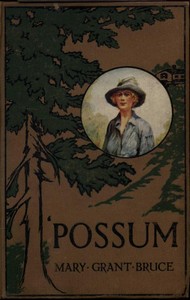
'Possum
Language: en699 downloads on Project Gutenberg
Subjects
In: Novels
Public-domain ebook sourced from Project Gutenberg #50881.
Public-domain ebook
Language: en699 downloads on Project Gutenberg
Subjects
In: Novels
Public-domain ebook sourced from Project Gutenberg #50881.
The opening · free to read
The trim suburban garden blazed with flowers. Over the porch at the gate mandevillea hung in a curtain of fragrant white, and an archway over the path that wound through the close-shaven lawn was a miracle of Fortune's yellow roses--gold and rose and copper blended gloriously. There were beds aflame with "bonfire" salvia, and others gay with many-hued annuals. Gaudy tulips reared splendid heads near a great clump of arum lilies that fringed a tiny pool where little Garth Macleod's solitary goldfish swam in lonely state. Everywhere there were roses; in standards in the smooth, well-kept beds, or trained along the wide verandas, forming a screen of exquisite blossom. Their sweetness lay like a charm over the garden.
It was a hot spring afternoon. Tom Macleod, digging busily in a corner, pushed his Panama back from his flushed face, and stood erect for a moment to ease his aching back. As he did so a motor whirred to the gate, stopped, and a stout little man hurried up the path, waving a capable hand towards the shirt-sleeved worker across the lawn.
"Hullo, Doctor!" Macleod called.
"See you presently, Tom," was all the doctor vouchsafed him. He disappeared behind the roses on the veranda, and Macleod returned to his work with a furrow between his eyes that had not been there before. From time to time he cast half-impatient glances towards the house, whence no sound issued. Finally, with a hasty movement, he plunged his spade into the soil, and went with long strides across the grass--meeting, at the step, the doctor, who plunged out of the house like a plump Jack-in-the-box.
"Oh!" said Macleod vaguely. "How's the kid?"
"The kid? why, going on first-rate," said the doctor, laughing. "Can't a man stay five minutes talking to his patient's mother without your making up your mind that the kid must be dying?"
Tom Macleod grinned a little shamefacedly.
"The last three weeks have rather unsettled my nervous system, I believe," he said. "I didn't know I had one until Garth took to trying to die. You needn't be so superior, old man. I believe the little beggar shook up yours, too!"
"Well--it hasn't been too jolly a time," admitted the doctor. "One doesn't like to see a nice kid suffering: and Garth and I are old chums. Anyhow, he's better. Come and sit down; it's an extraordinary thing, but I have time for a cigarette."
He went with quick, short steps towards a bench under a drooping pepper tree, Macleod following with his long, easy stride. No two men could have been a greater contrast: the short, plump doctor, with his humorous, ugly face, which every child loved at the first glance, and the tall, lean Australian, clean-limbed and handsome--almost boyish, but for a certain worn expression, and for the lines of anxiety which his boy's illness had graven round his eyes and mouth. They lit their cigarettes and stared at each other.
"On the rare occasions when you announce that you've time to smoke, I have noticed that you generally have something to communicate--probably unpleasant," said Macleod. "What is it, old man?"
"I wish you weren't so observant," said the doctor; "it's disconcerting. Well, I have something. It isn't exactly new: I hinted at it to you six months ago. Now I've got to speak plainly."
"You mean----?"
"I mean that if I had a boy like Garth I wouldn't run the risk of trying to bring him up in a city," the doctor answered. "I haven't been satisfied with the little chap for a long time. His constitution's all right--there's nothing radically the matter. But he doesn't thrive. You've seen that for yourself, Tom."
"Yes--I've seen it," said the father heavily. "Of course, we've kept hoping he would grow stronger. As you say, there seemed nothing really wrong, and he's pretty wiry----"
"If he hadn't been wiry I could not have pulled him through the last three weeks," Dr. Metcalf said. "You may thank your stars he's wiry."
"If he hadn't picked up this unlucky illness----"
"Well--I don't know," said the doctor. "I'm inclined to think you may yet consider it a blessing in disguise. You might have gone on pouring tonics and patent messes into him, and hoping he'd improve. You can't do it now. It's up to you and Aileen to give him every chance, if you want a strong son instead of a weakling."
"That's final?" Macleod asked.
"That's my considered opinion. I know your difficulties, old man. But I know you don't value anything in the world beyond Garth. Take him to the country; let him live out of doors, and run as wild as a rabbit; give him unlimited fresh milk--not the stuff you buy out of a can--country food, and pure air: let him wear old clothes all the time and sleep out of doors--and in a year I'd stake my professional reputation you won't know him. Keep him in a Melbourne suburb, and I won't be answerable for the consequences."
"That's pretty straight, anyhow," said Macleod.
"I mean it to be straight. I haven't known you since you were at school to mince matters with you now. And I'm fond of the kid: I want to see him grow into a decent man, with all the best that is in him given a fair chance."
"We've tried to do that," Macleod said. He looked round the glowing garden. "It's such a jolly home, and he does love it."
"It's one of the jolliest little homes I've ever seen, and it's going to hurt both of you badly to leave it," the doctor rejoined. "The trouble is, it is too jolly. You have made yourself a little Paradise inside the tallest paling fence you could build, and you've shut out all that lies outside that fence--miles on miles of teeming streets, packed and jammed with people. You're in the midst of grass and roses and things, with a sprinkler going on your tulips, or whatever those rainbow affairs are--and you don't think about the street outside, dry and baking, with a hot wind swirling the germ-laden dust about--blowing it probably upon the meat and fruit and milk you'll buy to-morrow. The air comes to you over thousands of houses, clean and dirty, and thousands of people breathe it. You've got to get where there's no second-hand air."
"Great Scott!" ejaculated Macleod. "Will you tell me how any children manage to live at all?"
"It's a special dispensation of Providence that most youngsters don't die from germs," said the doctor, laughing. "I'm aware that the infantile population of Melbourne is pretty healthy, but it's always a mystery to me how children in any big city survive their surroundings. After all, Melbourne's cleaner than most places. However, there is only one among its hordes of kids that is interesting you and me at the moment, and that's Garth. You've got to get him out of it, Tom."
"When?"
"As soon as you can make your arrangements. I know you can't do that in a moment, but, of course, he could not be moved just yet. When he is strong enough Aileen could take him somewhere until you were ready. But get him to the country. His poor little head is full of stories and make-believes: let him forget what a book looks like, and introduce him to a pony. By the way, it's going to be enormously good for you and Aileen, too."
"Is it?" Macleod asked, smiling grimly. "I'll worry along somehow, though I know mighty little of anything outside a city. But it's rough on her, poor girl. She just loathes the country--hasn't any use for scrub and bad roads, and discomfort generally. I'll never be able to get her a servant--there aren't any, I believe, once you get more than a mile from a picture theatre. And she has never had to work."
"Don't you worry your head about Aileen," said the little doctor, rising. "She has her head screwed on the right way--and women have a way of doing what they've got to do. She can imagine herself her own grandmother, fresh out from England, and tackling the Bush as all our plucky little grandmothers did. Pity there are not more like them now: we live too softly nowadays, and our backbones don't stiffen. But you'll find Aileen will come out all right. In a year you'll all be blessing me. When you come to think of it, I'm the only one to be pitied. I'm going to miss you badly." There was a twisted smile on his lips as he wrung his friend's hand. "Good-bye: my patients will be calling down maledictions on my head if I don't hurry."
Macleod saw him into his dusty motor and watched it glide down the hot street. Then he turned and went back through the scent of the garden, instinctively making his footsteps noiseless as he crossed the veranda and entered the house.
It was a trim house of one story, with a square hall where tall palms gave an effect of green coolness. An embroidered curtain screened a turn into a passage where, through an open door, could be heard the sound of a low voice reading. A childish call cut across the soft tones.
"Is that you, Daddy?"
"That's me," said Macleod cheerfully, if ungrammatically. "Are you sure you ought not to be asleep?" He entered the room and smiled down at his little son.
"A fellow can't sleep all day," Garth said. "'Sides, I needn't sleep so much now. Doctor says I'm nearly well, Daddy."
"That's good news," said his father heartily. "We'll have you out in the garden soon, and getting fat. The tulips are blossoming, Garth, and your poor old goldfish is awfully lonesome. He says even Bran doesn't go near him now."
"Bran is too busy nursing his master," said Garth's mother, looking at the rough head of the Irish terrier curled up on a chair beside the boy's bed. "We'll all get out together in a few days, and find out all the beautiful things that have happened in the garden since we were there. Won't it be lovely, Tom?"
She leaned back until her head touched her husband--a tall, pale girl, with lovely features and a mass of fair hair that glinted like Garth's when the sunlight fell on it, and eyes as blue as violets. Her long hands, blue-veined and delicate, lay idly in her lap, one finger keeping open the book from which she had been reading. She was like an exquisite piece of china--fragile, to all outward appearance, and dainty; graceful in every line. Tom Macleod looking down at her, felt as he had felt ten year' ago, before they married, that he must let no wind blow upon her roughly.
Now he had to tell her that they must go away, away from the ordered comfort of city life, which was all that she had ever known, to whatever the country had in store for them. Even for himself, always a townsman, the prospect carried something of dread, as do all unfamiliar prospects. But he knew that, whatever hardships the Bush holds for a man, it is hardest on a woman.
Garth was chattering away, oblivious of his father's grave face.
The book keeps going
Reading is free forever. Sign up and watch scenes appear while you read.



Scenes Storieta drew for other classics.
New illustrated classics
Once or twice a month: the latest books to get full character casts, scene art, and free comic editions. No account needed.