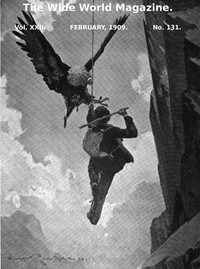
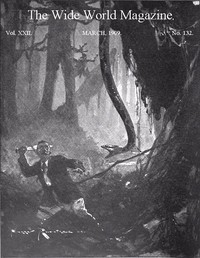
Another instalment of a fascinating budget of adventure narratives. This month we publish accounts of a fight to the death between a whale and a school of thresher sharks; a nest-robber’s terrible battle with an infuriated mother-eagle; and the nerve-trying experience which befell a Surrey cyclist while out for a Saturday afternoon spin.
WHALE v. SHARKS.
BY VICTOR PITT-KETHLEY.
Early on the morning of August 14th last, while engaged in building new quarters for the lighthouse-keeper at Breaksea Island, near Rottnest, Western Australia, the contractor and his men noticed a bull whale, with a cow and calf, passing the island some distance off. They watched them with interest for awhile, noting the immense size of the two parents and the methodical regularity with which columns of water rose from their blowholes, and then resumed their labours.
An hour or so later--about nine o’clock, to be exact--the men were startled by an extraordinary noise, apparently coming from the eastern end of the island, a noise unlike anything they had ever heard before. Dropping their tools and staring towards the east, they beheld such a sight as it falls to the lot of few people to witness. There, not five hundred yards from the shore, was being waged a battle to the death--a fight between the great cow whale previously seen and a school of thresher sharks. The calf was swimming about distractedly, but the old bull had disappeared, having basely deserted his family at the first approach of danger.
The sharks, as though acting in accordance with some preconcerted plan, had completely surrounded the two whales, and, apparently realizing that nothing was to be feared from the calf, concentrated all their efforts upon the cow. Again and again they charged in upon her, their jaws snapping, tearing at her mighty sides until the sea was red with blood. Meanwhile the cow lashed her tail furiously, hurling up sheets of reddened water and occasionally crashing down with terrific force upon one of her voracious opponents. Maddened with pain and rage, she dashed this way and that, but the sharks hung to her side with a persistency and ferocity that made the fascinated onlookers shudder. Now and again the wildly-lashing tail would catch one of the assailants, driving it beneath the waves--no doubt killed or disabled--but the remainder rushed in undismayed, tearing viciously at the mammal’s bleeding flanks or butting her with the force of battering-rams.
Presently the spellbound spectators realized two facts--firstly, that the calf had disappeared in the mêlée, and secondly, that, the tortured whale was undoubtedly becoming weaker. It was obvious that the unequal struggle could have only one ending. Still, however, she fought on doggedly, winning admiration and sympathy by her exhibition of hopeless courage. Altering her tactics, by a supreme effort she hurled her whole great bulk clear of the water for a moment, and the fascinated onlookers beheld the sharks hanging from various parts of her gleaming body by their serrated teeth. Then down she went again, with a crash like thunder, and for an instant whale and sharks were buried amidst masses of foam, heavily coloured with the poor mammal’s life-blood. Rising again, she essayed another change of plan, making for the rocks and desperately striving to rub off the clinging sharks against their edges. But the threshers were equal to the occasion; while those on the outside maintained their grip, the others dived under their enemy and charged her anew, tearing at the whale’s side in an ecstasy of ferocity that was bloodcurdling to witness.
WHALE KILLED BY THRASHER SHARKS.
A THREE HOURS’ FIGHT.
A SEA OF BLOOD.
(By An Eye Witness.)
Much has been written about fights between the larger denizens of the sea, but it has fallen to the lot of very few to witness such a battle as one which took place off Breaksea Island on Friday, the 14th inst., between a school of thrasher sharks and a cow
A CUTTING FROM THE “WEST AUSTRALIAN,” OF PERTH, W.A., REFERRING TO THE BATTLE BETWEEN A WHALE AND THRESHER SHARKS.]
More and more feeble grew the whale’s struggles, and at last--to the heartfelt relief of the spectators, for her death-fight had been terrible to behold--the great body turned over and sank beneath the red-tinted water. The unequal battle was over, having lasted from nine o’clock until noon--as awe-inspiring a contest as man was ever privileged to witness. It is a thousand pities that there was no camera on the island to make a pictorial record of the struggle. The men went back to their work greatly impressed by the unique spectacle, and expressions of sympathy for the whale were heard on every side.
Forty-eight hours afterwards the whale’s carcass, which had in the meantime become distended with gas, rose to the surface, and exploded with a roar like a miniature powder-magazine, causing the startled people to flock to the shore to discover what had happened. On examination of the remains it was discovered that every shred of the outer flesh of the whale had been torn off by the sharks, who had now, doubtless, gone off to repeat their tactics upon some other hapless leviathan.
A BATTLE IN MID-AIR.
BY T. R. PORTER.
Swinging like a pendulum at the end of a two-hundred-and-fifty-foot rope against the side of a five-hundred-foot cliff, with jagged rocks far below, and nothing but one bare hand with which to fight off the fierce onslaught of an immense eagle, whose nest he was attempting to rob--this was the awful predicament in which Arthur Williams, a young man of Riverton, Wyoming, found himself one day early in June last year. With the welfare of her nestlings at stake, the great bird attacked the despoiler of her home with inconceivable fury, and only to a lucky chance does Williams owe his life.
Riverton is a new town on that portion of the Cheyenne and Arapahoe Indian reservation which was opened to settlement last year, and in the country thereabouts mountain lions, timber wolves, coyotes, eagles, bears, etc., are still to be found. The principal industry is sheep-raising, and continual warfare exists between the flockmasters and the wild things, especially the eagles, which annually kill and carry off hundreds of young lambs. Because of this heavy drain on their flocks, every shepherd and owner of sheep in Wyoming takes great pains to kill the birds and to destroy their nests whenever they are discovered.
Before the Indian reservation was formally opened to the whites for settlement, the flockmasters were permitted to graze their sheep over the country, and it gradually became known among the sheepmen that over in Lost Well Canyon there were a pair of eagles who made a speciality of devouring young lambs. Try as they might, however, the shepherds were unable to get a shot at either of these great birds, and for several years they were the terrors of the district.
It was discovered that the old birds made their nest in a cleft in the face of a five hundred-foot perpendicular wall, which formed one side of the canyon. Here they safely raised brood after brood of young ones, which were turned loose in due course to prey on the community.
Hunters, with their Winchester rifles, often lay in wait for the big birds, hoping to get a shot at them, but, with the proverbial keen eyesight of such creatures, the eagles detected the Nimrods and never came within gun-shot when the nest was being watched.
During the spring of 1908 the two old eagles were more successful than ever in raiding the flocks of the sheepmen, and accordingly a special effort was made to exterminate them. To that effort Arthur Williams owes the appalling adventure which befell him.
Williams and two friends made a trip out to Lost Well Canyon to investigate the chances of trapping the eagles in their nest. A ride of eight miles, over rough mountain trails, brought them to the canyon, half-way up the perpendicular side of which they saw the horizontal cleft in which the wise old birds had built their nest. At the foot of the cliff, directly under the cleft, was a pile of bones--the remains of lambs, thrown out of the nest by the eagles after they had been picked clean.
“We ain’t any nearer that nest down here than when we were at home,” remarked Williams to his comrades. “Nothing but a balloon or an airship can help us from down here. Let us go up to the top of the cliff and see what we can do from there.”
For two hours the three young men struggled to reach the top of the mountains. A wide détour was necessary, but at last this was accomplished and they stood on the brink of the cliff, half-way down which the eagles’ nest had been built.
“There’s nothing to be done from here, either,” said one of the men, despondently. “We might just as well go back home; we shall never reach that nest.”
While the men stood and talked, from far down below them there arose the shrill piping call of young birds.
“Young ones!” said Williams. “I wish we could get them alive; they would be worth money to us.”
“No use to bother; you’ll have to take it out in wishing,” said the third member of the party. “Come on; let’s go home.”
The next day found the three young men back at the cliff. They had mapped out a scheme whereby they hoped to get the young birds, and had brought with them seven hundred and fifty feet of stout rope, far more than enough to reach from the top of the cliff down to the bottom of the canyon. To make quite sure of this, however, they first lowered the rope, weighted with a stone, down the face of the rock, and saw that, while there yet remained a big coil at their feet, the weighted end of the rope rested on the floor of the canyon.
Then the rope was hauled back and a tight loop made in one end. This was paid out over the edge of the cliff until it hung directly in front of the eagles’ nest. The other end of the rope was hitched round a convenient tree.
During all this time the men kept close watch for the old eagles, but saw nothing of them.
“Off hunting lambs, I suppose,” said one of the young fellows.
Then Williams stepped forward, laid hold of the rope, and quickly disappeared over the side, sliding slowly downward, using one leg, around which the line was wrapped, as a brake to keep himself from going too fast.
Across his shoulders was slung a stout bag, in which he intended placing the little eagles when he secured them. In one hand he carried a stout stick for use in an emergency: the other hand grasped the rope.
Down, down he went until just in front of the eyrie. Then he slipped one leg through the loop at the end of the cord and turned to look into the dark hole, where he could hear the eaglets “talking.”
Slowly he swung round, bracing his foot against the rocky wall, until he faced the cleft and could give his attention to the nest.
Suddenly, screaming wildly with rage and fright, out from the dark cleft came the old mother-bird. Like a stone from a catapult she flung herself at Williams’s face.
Dismayed by the suddenness of the attack, Williams recoiled; his foot slipped from the wall, and his body spun round and out of reach as the huge bird went past him. He did not escape altogether scathless, for one claw, like a knife blade, cut across his cheek, and in an instant the blood was flowing from a cut half an inch deep.