Public-domain ebook
Spacemen Die at Home
Language: en244 downloads on Project Gutenberg
Subjects
In: Science Fiction·Science-Fiction & Fantasy·Novels
Public-domain ebook sourced from Project Gutenberg #51249.
Public-domain ebook
Language: en244 downloads on Project Gutenberg
Subjects
In: Science Fiction·Science-Fiction & Fantasy·Novels
Public-domain ebook sourced from Project Gutenberg #51249.
The opening · free to read
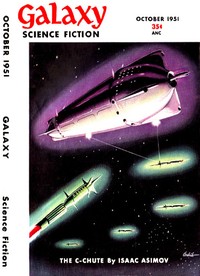
[Transcriber's Note: This etext was produced from Galaxy Science Fiction October 1951. Extensive research did not uncover any evidence that the U.S. copyright on this publication was renewed.]
One man's retreat is another's prison ... and it takes a heap of flying to make a hulk a home!
Forty days of heaven and forty nights of hell. That's the way it's been, Laura. But how can I make you understand? How can I tell you what it's like to be young and a man and to dream of reaching the stars? And yet, at the same time, to be filled with a terrible, gnawing fear--a fear locked in my mind during the day and bursting out like an evil jack-in-the-box at night. I must tell you, Laura.
Perhaps if I start at the beginning, the very beginning....
It was the Big Day. All the examinations, the physicals and psychos, were over. The Academy, with its great halls and classrooms and laboratories, lay hollow and silent, an exhausted thing at sleep after spawning its first-born.
For it was June in this year of 1995, and we were the graduating class of the U. S. Academy of Interplanetary Flight.
The first graduating class, Laura. That's why it was so important, because we were the first.
We sat on a little platform, twenty-five of us. Below us was a beach of faces, most of them strange, shining like pebbles in the warm New Mexican sunlight. They were the faces of mothers and fathers and grandparents and kid brothers and sisters--the people who a short time ago had been only scrawled names on letters from home or words spoken wistfully at Christmas. They were the memory-people who, to me, had never really existed.
But today they had become real, and they were here and looking at us with pride in their eyes.
A voice was speaking, deep, sure, resonant. "... these boys have worked hard for six years, and now they're going to do a lot of big things. They're going to bring us the metals and minerals that we desperately need. They're going to find new land for our colonists, good rich land that will bear food and be a home for our children. And perhaps most important of all, they'll make other men think of the stars and look up at them and feel humility--for mankind needs humility."
The speaker was Robert Chandler, who'd brought the first rocket down on Mars just five years ago, who'd established the first colony there, and who had just returned from his second hop to Venus.
Instead of listening to his words, I was staring at his broad shoulders and his dark, crew-cut hair and his white uniform which was silk-smooth and skin-tight. I was worshiping him and hating him at the same time, for I was thinking:
He's already reached Mars and Venus. Let him leave Jupiter and the others alone! Let us be the first to land somewhere! Let us be the first!
Mickey Cameron, sitting next to me, dug an elbow into my ribs. "I don't see 'em, Ben," he whispered. "Where do you suppose they are?"
I blinked. "Who?"
"My folks."
That was something I didn't have to worry about. My parents had died in a strato-jet crash when I was four, so I hadn't needed many of those "You are cordially invited" cards. Just one, which I'd sent to Charlie Taggart.
Stardust Charlie, we called him, although I never knew why. He was a veteran of Everson's first trip to the Moon nearly twenty-five years ago, and he was still at it. He was Chief Jetman now on the Lunar Lady, a commercial ore ship on a shuttle between Luna City and White Sands.
I remembered how, as a kid, I'd pestered him in the Long Island Spaceport, tagging after him like a puppy, and how he'd grown to like me until he became father, mother, and buddy all in one to me. And I remembered, too, how his recommendation had finally made me a cadet.
My gaze wandered over the faces, but I couldn't find Charlie's. It wasn't surprising. The Lunar Lady was in White Sands now, but liberties, as Charlie said, were as scarce as water on Mars.
It doesn't matter, I told myself.
Then Mickey stiffened. "I see 'em, Ben! There in the fifth row!"
Usually Mickey was the same whether in a furnace-hot engine room or a garden party, smiling, accepting whatever the world offered. But now a tenseness and an excitement had gripped even him. I was grateful that he was beside me; we'd been a good team during those final months at the Academy and I knew we'd be a good team in space. The Universe was mighty big, but with two of us to face it together, it would be only half as big.
And then it seemed that all the proud faces were looking at us as if we were gods. A shiver went through my body. Though it was daytime, I saw the stars in my mind's vision, the great shining balls of silver, each like a voice crying out and pleading to be explored, to be touched by the sons of Earth.
They expect a lot from us. They expect us to make a new kind of civilization and a better place out of Earth. They expect all this and a hell of a lot more. They think there's nothing we can't do.
I felt very small and very humble. I was scared. Damned scared.
His wizened little body was shuffling down an aisle, his eyes shining like a child's. He'd been sandwiched, evidently, in one of the rear rows.
But he wasn't the Charlie I'd seen a year ago. He'd become gaunt and old, and he walked with an unnatural stiffness. He looked so old that it was hard to believe he'd once been young.
He scratched his mop of steel-gray hair and grinned.
"You made it, boy," he chortled, "and by Jupiter, we'll celebrate tonight. Yes, siree, I got twenty-four hours, and we'll celebrate as good spacemen should!"
Then Mickey strode up to us. He was his normal, boyish self again, walking lightly, his blond, curly-haired skull swaying as if in rhythm with some silent melody.
And you, Laura, were with him.
"Meet the Brat," he said. "My sister Laura."
I stared almost rudely. You were like a doll lost in the immensity of your fluffy pink dress. Your hair was long and transformed into a golden froth where sunlight touched it. But your eyes were the eyes of a woman, glowing like dark stars and reflecting a softness, a gentleness that I'd never seen in eyes before.
"I'm happy to meet you, Ben," you said. "I've heard of no one else for the past year."
A tide of heat crept up from my collar. I stuttered through an introduction of Charlie.
You and Mickey looked strangely at Charlie, and I realized that old Stardust was not a cadet's notion of the ideal spaceman. Charlie scorned the skin-tight uniforms of the government service and wore a shiny black suit that was a relic of Everson's early-day Moon Patrol. His tie was clumsily knotted, and a button on his coat was missing.
And the left side of his face was streaked with dark scar tissue, the result of an atomic blowup on one of the old Moon ships. I was so accustomed to the scars, I was seldom aware of them; but others, I knew, would find them ugly.
You were kind. You shook hands and said, softly: "It's a privilege to meet you, Charlie. Just think--one of Everson's men, one of the first to reach the Moon!"
Charlie gulped helplessly, and Mickey said: "Still going to spend the weekend with us, aren't you, Ben?"
The book keeps going
Reading is free forever. Sign up and watch scenes appear while you read.



Scenes Storieta drew for other classics.
New illustrated classics
Once or twice a month: the latest books to get full character casts, scene art, and free comic editions. No account needed.