Public-domain ebook
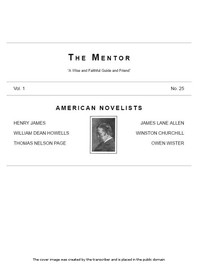
The Mentor: American Novelists, Vol. 1, No. 25
Language: en340 downloads on Project Gutenberg
Subjects
In: The Mentor·Essays, Letters & Speeches·American Literature
Public-domain ebook sourced from Project Gutenberg #51560.
Public-domain ebook
Language: en340 downloads on Project Gutenberg
Subjects
In: The Mentor·Essays, Letters & Speeches·American Literature
Public-domain ebook sourced from Project Gutenberg #51560.
The opening · free to read
This group of distinguished novelists may be divided into four smaller groups, not only in time, but in selection and treatment of subjects. Mr. James and Mr. Howells are now the senior members of the literary fraternity in this country, and have not only American but European reputations. Only three novelists before them attained this distinction. The earliest of these, Cooper, is still read in many parts of the world, and in little German villages boys call themselves “Cooper Indians,” and play at oldtime savage warfare. The author of the “Leatherstocking Tales” wrote the first original American novel, and Hawthorne wrote the first American romance. The first described the manners and customs of a people whom he knew at first hand, but whom Europe knew only by hearsay; the second analyzed the motives and described the workings of the Puritan spirit, and showed how the consciousness of sin worked itself out in the Puritan character. The theme was new, and the manner of treating it was both effective and beautiful--and Hawthorne remains the most artistic writer this country has produced.
The next novelist to whom Europe paid attention was Mrs. Stowe. “Uncle Tom’s Cabin” was like a great torch held up over a fiercely disputed field; it showed men and women living under all conditions of slavery, paternal and humane on one hand, and commercial and cruel on the other. It made a drama of a political issue, and was read with bated breath by a million people. It interested Europe because it was a powerful story dealing with a situation that had attracted the attention of the whole Western world; it was at once translated into several languages, and could be found from London to Constantinople.
When Mr. James began writing a generation ago there had been no American fiction of a high order for twenty years or more, and the country had grown rapidly in experience and knowledge. Mr. James showed this more cosmopolitan attitude toward the world, and his style had a quality which was new in our fiction. It was clear in those days; it had great flexibility and capacity for conveying fine distinctions and delicate shadings of thought; it had a tone of maturity which was lacking in the earlier writers, and it was the medium of expression of a thoroughly trained man to whom writing was a fine art. The early short stories, of which “The Passionate Pilgrim” may serve as an example, arrested attention by reason of their insight into character and their fine workmanship. There was an air of romance about them; but it was the romance of human temperament, not of incident. The early novels were not popular in the sense of running into large editions; but “The American” found many readers who were quick to appreciate its penetrating and searching analysis of character, its sharp contrasts of American and European traits, and the refinement of a style which is both rich and restrained.
All novelists reveal character; but those in whom the dramatic instinct is strong show it chiefly in action. Mr. James brings out character largely by means of analysis and description, and for this reason he is often classed among the psychological novelists. In his later years the habit of analysis grew on him to such an extent that the movement of his stories was impeded and his style became complex and at times obscure. In a time when social relations between America and Europe were becoming more intimate, Mr. James found a rare opportunity of studying American character against a European background, and in the whole range of fiction there have been few writers of more acute penetration, of greater delicacy of stroke and line in painting character, than he. He was one of the small group of American authors to whom the word “distinction” may be applied.
Mr. James was a student of men and women in society, using that word in its narrower sense; Mr. Howells, who is also a keen observer, has dealt with less sophisticated men and women, and has given us American types unmodified by other influences. A man of deep sympathy with his fellows and sharing in his heart the sorrow and pain of the common lot, a lover of Tolstoi and a professed realist, with a strong leaning toward constructive socialism, Mr. Howells has kept his fiction free from any kind of preaching. He has understood his vocation as an artist, and has not made his novels serve his social and political doctrines. Although a man of strong convictions, he is a writer whose touch is notably light, and whose humor is delightfully unforced and happy.
Born in the Central West, Mr. Howells has kept its democracy of spirit and reinforced it by familiarity with modern languages and literature. In his lighter work he has made studies of the whims and foibles of certain feminine types in this country, of such fidelity that they have disturbed those who believe that Americans should tell the truth about themselves only to themselves, and that to take Europe into the national confidence is a kind of petty treason. But if Mr. Howells has seemed sometimes to draw American women with too light a hand, no one so well as he has conveyed a sense of the purity of American women, and the wholesome tone of American social life outside the very limited circle of what is known as the “Fast Set,”--a group of men and women who are representative not of a nation, but of the attitude toward life so strikingly defined in “The House of Mirth.” In his graver mood Mr. Howells has given us “The Rise of Silas Lapham,” one of the lasting achievements of American fiction, and “A Hazard of New Fortunes,” both original studies of American life during the age of great fortune-making. The charm of Mr. Howells’ art and the refinement of his humor have not given him the popularity of the more dramatic novelists; but he has made a place of high importance for himself in American literature, and in the hearts of a host of readers who have discerned in him a singularly pure and lovable nature.
The aftermath of the war between the States was an idealization of the old social order in the South. Mr. Page and Mr. Allen found in the tradition and habit of the Old South elements of a romance founded on reality. Society in the South before the war received its tone from men and women bred in habits of deference and courtesy, sensitive to any slight put upon honor, and prodigal of hospitality. It had rested on an unstable basis; but it had those delightful qualities which came with leisure, easy conditions, and the absence of commercial spirit. This vanishing order found in Mr. Page’s earliest stories a record true to life and yet enveloped in the air of romance. “Marse Chan,” “Unc’ Edinburg,” and “Meh Lady” gave the country a thrill of pleasure, so sure was their appeal to sentiment, so refreshingly human and unforced, a rich and picturesque life of its own, a fresh field for the romance of spiritual adventure and social habit.
_Oakland Plantation, Hanover County, Virginia._]
In these moving tales, told with unobstrusive artistic skill, the long-suspended literary tradition of Virginia received an impulse which has since given the country a group of stories of original quality.
Never did pioneers carry into a new country a finer blending of the daring which moves the frontier farther from the old centers, and the chivalry of romance for women and idealization of emotion and experience, than went into the fertile and beautiful Kentucky country in the days which followed Boone’s adventurous career, and produced the types of character which appear in James Lane Allen’s “The Choir Invisible.” The Blue Grass country found in him a lover who was also an artist, and the background of his stories is sketched with exquisite skill. “The Kentucky Cardinal,” “Aftermath,” and the stories in “Flute and Violin” have not been surpassed in beauty of diction in our fiction. If one might venture to predict long life for any contemporary writing, he would not hesitate to put the short stories of these two Southern writers among American classics.
Mr. Page and Mr. Allen have written long stories as well; in several instances dealing with contemporary life and manners. Mr. Allen has kept in the field of character study with increasing emphasis on the influence of environment. The title of one of his later stories, “The Mettle of the Pasture,” suggests the relation of the actors in the drama to the soil on which they live, while the lifelike study of the horse-breeder in “The Doctor’s Christmas Eve” is a portrait which could not have been drawn outside the boundaries of Kentucky. Mr. Page in his later stories has dealt with the spread of the commercial spirit, the conditions in which women work, political corruption, and social changes.
Mr. Wister and Mr. Churchill have one great interest in common,--they are deeply concerned with American character and experience. Mr. Churchill has dramatized our history in a series of works, beginning with “Richard Carvel” of the Colonial period; continued in “The Crossing,” of the period of the first great westward emigration through the passes of the Alleghenies; in “The Crisis,” a picture of struggles between the old North and the old South, between 1861 and 1865, localized in St. Louis; and in “Mr. Crewe’s Career,” a study of the “machine” in politics and the beginnings of the struggle for popular government which has become a national movement. Mr. Churchill draws with a free hand on a large canvas, and his works have epic quality, emphasizing large and significant movements and defining the place of individuals in them, rather than presenting delicately sketched portraits of men and women in the narrower range of personal experience.
Mr. Wister has the gift of picturing real, vital characters, and his stories are full of a brilliant and moving life. His people are not only alive, but intensely and actively alive. A man bred in the best social traditions, a graduate of the oldest American university, Mr. Wister was fortunate enough to know the frontier at the very moment when the forces of business and the second great Western movement were about to destroy it. Most men who wrote about the old frontier, either in fiction or in plays, were concerned with its melodramatic aspects,--its guns, and shirts, sombreros, and bucking broncos. Mr. Wister saw the character behind these stage costumes; he recognized the fiber of the men,--their courage, their spirit of comradeship, their rough but genuine humor, their passion for wide horizons and the freedom of the life of the plains. In “The Virginian,” and the short stories from the same hand, our fiction has a series of studies of types of character now almost extinct, and of a stage of life which has disappeared. When “Lady Baltimore” appeared, Mr. Wister had passed from society in an elemental stage to a Southern community which has preserved its oldtime qualities of refinement of manner, dignity of habit, and a hospitality which is the very flower of high breeding and ease of condition. And Mr. Wister was as much at home in Charleston as on the old frontier; a fact highly significant of the quality and fiber of the man. Among American novelists he will hold a place of his own by reason of the vitality and artistic skill of his work.
The book keeps going
Reading is free forever. Sign up and watch scenes appear while you read.



Scenes Storieta drew for other classics.
New illustrated classics
Once or twice a month: the latest books to get full character casts, scene art, and free comic editions. No account needed.