Public-domain ebook
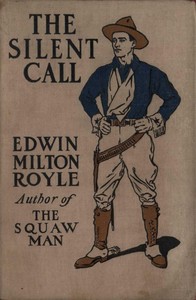
The Silent Call
Language: en512 downloads on Project Gutenberg
Subjects
In: Novels
Public-domain ebook sourced from Project Gutenberg #51611.
Public-domain ebook
Language: en512 downloads on Project Gutenberg
Subjects
In: Novels
Public-domain ebook sourced from Project Gutenberg #51611.
The opening · free to read
Not even snow is as white as these great masses of congealed foam floating in a deep blue sky, six thousand feet above the sea, and yet somewhere out of this deep cool infinity flamed a sun that searched the mesa until it blistered and cracked. The alkali plain quivered and burst into spirals of heat that were visible to the eye. A cloud of dust hung like white smoke above the fiery trail over which a band of Indian police was slowly and painfully crawling. This dust is very penetrating and very irritating. The reins hung limp on the ponies' necks and their heads swung low as though they looked for a place to sink down.
As far as the eye could see you would have known that they were Indians. The uniform furnished them by the government is a dark purplish blue with a red piping down the trousers. It's a plain affair, but each Indian wears it with a difference and adds a decorative touch that is his own, and that is always pictorial and Indian. One had encircled his broad-brimmed black hat with a wide purple ribbon, lapped by a narrow pink ribbon. A yellow neckerchief rested on his green silk shirt, and about his waist was a sash braided of many colored worsteds, and, strange to say, the result was pleasing if rather brilliant. Another had a pink feather apparently plucked from the tail of the domestic duster tied loosely to his hat, which lent to the changing airs a graceful note of color. Some wore cowboy boots, yellow and elaborately stitched in fancy designs; others adhered to the ever beautiful moccasins. Most of them wore brown or drab cowboy hats, but made them their own by beautifully beaded hat-bands. Here and there gleamed gauntlets heavy with a stiff beaded deer which seemed trying to jump away from the cuffs, but couldn't because it was so obviously and eternally stiff and beaded. Some had beaded sleeve bands and all sported guns hung in holsters elaborately outlined in brass. No one wore a coat except a tall elderly man with glasses who, in spite of the torture, felt that his out-of-date captain's uniform enhanced his straight unbending dignity.
The police had no prisoner in charge, nor even an air of expectancy, or remote or possible interest. Horse and man were as near sleep as it was possible to be in the quivering heat. The pack animals were loaded with surveyors' instruments, and there was evidently nothing more warlike or strenuous on foot than to creep across the table-land and reach the Agency. To the close observer even at a distance there was a difference in the figures as they straggled through the sage-brush. The man who rode behind was well set up and sat his horse like a cavalryman. He wore khaki that fitted well his close-knit and athletic figure, and he carried the suggestion of authority. He was the chief of Indian police. "Calthorpe," as he called himself, hadn't explained himself and nothing had as yet explained him. He had been from the first a mild mystery to his neighbors, in a country where neighbors were few and far between, and as he had a gift for silence, and it did not appear to be any one's business in particular to unravel him, a task which might, too, involve risk as well as trouble, he had remained a mystery. Oscar Wilde once expressed great astonishment at finding a miner in Leadville reading Darwin's "Origin of Species," but in this Western country one ought to be surprised at nothing.
On closer observation, there was a certain resemblance between the leader and his men. He might have been one of them with his swarthy skin and coarse black hair, but that a startling pair of frank blue eyes flashed out from their dark surroundings. They were friendly eyes set in a strong, immobile face. He glanced at his companions, at the burning plateau, then at his companions again.
"And they expect the hunter and warrior to turn farmer in a country like this," he thought. A horned toad startled by the intrusion darted across the trail from the shelter of one sage-brush to another--"In a country that raises sage-brush, horned toads, and hell," and he laughed softly to himself. "The Indian only gets the land the white man wouldn't have." Then his eyes fell on the pack mules, and again the blue eyes gleamed with amusement. "And sometimes valuable minerals are found on land the white man refused, and then he wants even the God-forsaken remnant he promised by solemn treaty never to take from the red man and his children's children." "God-forsaken" was a stock phrase for that country and Calthorpe reflected, "And it is the last word in desolation, the last word, but I like it. Yes, I like it." And he was amused with himself.
He didn't understand it or try to, but something in him responded to the crimson and yellow glory of the cactus flower, the purple of the thistle, the dull red of the "Indian's paintbrush," or, as the mountain children call them, "bloody noses." He knew a secret joy when the pale greens of the sage-brush and greasewood, and the live shimmer of the scrub oak were relieved by the larkspur, wild roses, the white columbine and sago lillies, and the flashing black and white of the magpie's wing, and somehow he knew that these things were more appealing because set in wide spaces and in silence and desolation.
By chance or telepathy something like this was passing through the mind of another, a man in middle life who sat in front of a tent pitched on the bank of a clear mountain stream that separated the Agency from the rest of the Reservation. He was a big framed man, stoop shouldered, with the face of a scholar and a saint. His clothes hung loosely on him, and he sat as though it would be an exertion for him to rise. Near by was the blasted trunk of a hollow tree. It had been fired by the cigarette of some careless smoker, and it was afire within and smouldering. A look at the man's pensive eyes showed that he too was afire within and smouldering.
"Fine boy, strange boy," he mused. Then he caught the vibration of the thought of the young chief of police who was riding toward him on the dusty trail.
"Some sins," he thought, "are magnificent. Milton's villain is superb, but"--and his eyes rested on the rather pretty cottage of the agent nestling in a grove of trees below--"small sins are really inexcusable." Rather an unusual reflection for a clergyman, who ought surely to be irreconcilable to sin in any form. But then he was unusual, the Rev. Dr. John McCloud. "We send these wild children to our great cities, and show them how hopeless it would be to resist our countless millions, but we never show them righteousness. We only make the Indian hopeless. And who of the countless millions knows or cares what happens to this bewildered anachronism, this forlorn child of a day that is gone? With really generous and noble purposes we hand him over to the spoiler, and so a great people becomes particeps criminis in petty larcenies and other pitiful and ignoble wrongs. I wish I could awaken our people to their privileges, their divine opportunities--not so much for the sake of the Indian, but for our own sakes." And he coughed and sank deeper into his camp chair. "Why should a great, mighty, enlightened people stoop to crush such obviously harmless and helpless ones? Is it because they have no votes, no lobby in Washington, are unorganized, obscure, and ignorant?" And his eyes drooped to the book open on his lap and rested on these figures: "7,000,000 families on a medium wage of $436 a year, and 5,000,000 farmers with an average income of $350 a year. Which means that 60,000,000 people must think before buying a penny newspaper, that they must save and plan for months to get a yearly holiday, that sickness means debt or charity, that things that make for comfort or beauty in a home are out of the question."
"Yes, yes," he reflected, "that is it. Why should we trouble to save the Indian? We are not even troubled to save our own. At least the Red Man has the fresh air, the light, the sun," and his mind wandered back to the crowded cities, with their gaunt men, slatternly women, and pallid children.
Between this middle-aged man sitting under the flap of his tent and the young man riding across the desert there had been from the first, quick, instantaneous sympathy and understanding. And now the thought of each jumped from the general to the particular.
"She's a fine woman," clicked the instrument in the elder man's head. "It's very tragic, her situation. I wonder if the boy realizes its full significance? I wonder if he knows his own peril?"
"She's a fine woman," was the response in the younger man's consciousness. "I must speak to the agent about her. I've given her such protection as I could, but he is the man; it is his duty. Duty isn't Ladd's strong point, but perhaps I can ram it gently down his throat. If he doesn't do it, it will lead to trouble," and he looked grim and his teeth set.
He reined in his horse for a moment to take in the beauties of the view. His men had already descended from the mesa into the huge basin that opened out suddenly at their feet, disclosing a dreary waste that was beautiful and absolute, for not a dwarfed tree or a sage-brush or a twig lived there. The wind and rain had cut and carved the hills and mounds into strange and sometimes grotesque shapes, and merged and blended the colored sands, so that they presented versions of the spectrum, sand rainbows, giving brilliancy and color to this dead desolation.
The Bad Lands were buttressed by a ring of sandstone battlements, twisted, tortured, pock-marked, broken away here and there in huge masses, weird and fantastic. Time had painted them the Indian colors--a dull red at the top blending into a faded yellow, then half-way to the valley the dirty drab of earth, looking as if it had been polished with sandpaper, escarped to the plain. He had crossed this trail many times, but never failed to pause on this brink to wonder and admire. It was lucky for the chief of police that just at that moment he raised his hat to wipe his dripping brow, for the report of a rifle rang out, and reverberated again and again among the hills, pockets, and gullies of the Bad Lands. Instantly every policeman sat erect, unslung his rifle from the pommel of his saddle, but with unanimity that told of unusual discipline, they turned and waited for their commander's orders. The latter made a gesture which in the sign language meant "Wait." The men deployed and waited, their eyes sweeping the broken ground before them. Calthorpe looked at his hat, and laughed as he replaced it on his head.
"By Jove," he muttered; "he picked his place. What a mark I was on this sky-line! Don't know how he could have missed me!"
When he had rejoined his men in the valley below, he called to his interpreter:
"Chavanaugh, I think these boys savey my English pretty well by now, but you make sure; explain it again to them when I am not by. You savey Wah-na-gi?"
Chavanaugh signified that he did.
"Well, I want some of my men always near her, pretty close by. Good woman, Wah-na-gi. Pretty bad men all time round loose. No father, no mother, Wah-na-gi! No harm come to Wah-na-gi, savey? Bad come to Wah-na-gi? Well, you kill 'em, kill 'em; anybody; me too! I do wrong, me too. You savey me?"
The book keeps going
Reading is free forever. Sign up and watch scenes appear while you read.



Scenes Storieta drew for other classics.
New illustrated classics
Once or twice a month: the latest books to get full character casts, scene art, and free comic editions. No account needed.