The opening · free to read
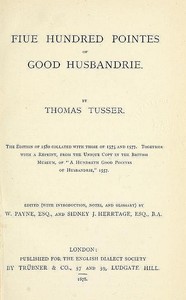
With regard to the preparation of this Edition a few words may be necessary. As the Members of the Society are aware, the task was originally undertaken by Mr. W. Payne. Ill-health unfortunately prevented him from carrying the work to a completion, but to him the Society is indebted for the supervision of the reprint of the Edition of 1580, which he collated most carefully with the editions of 1557 and 1577, and to which he added several pieces from those editions, thus making the present reprint more complete than any yet published. Mr. Payne also compiled a very complete Index of Words, which has been of great assistance to me for purposes of reference, and in preparing the Glossary. The notes also from Tusser Redivivus (marked T.R.) were for the most part extracted by Mr. Payne.
A reprint of the First Edition of 1557 was not included in the original programme, but after the work came into my hands an opportunity was presented through the kindness of Mr. F. J. Furnivall, who lent for the purpose his copy of the reprint of 1810, of exhibiting the work in its original form of "One hundreth Points" side by side with the extended edition of 1580, the last which had the benefit of the author's supervision. The proof-sheets have been collated with the unique copy in the British Museum by Miss Toulmin-Smith, to whom I return my thanks for her kindness, and the correctness of the reprint may consequently be relied on. From Mr. F. J. Furnivall I have received numerous hints, and much valuable help, while to Mr. J. Britten, F.L.S., I am indebted for his kindness in revising and supplementing the notes on the Plants named in Tusser. But my chief obligations are due to the Rev. W. W. Skeat, whose uniform kindness has considerably lightened my labours, and from whom both directly and indirectly (through the notes in his numerous publications), but more particularly in his noble edition of Piers Plowman, I have derived the greatest assistance.
S. J. H.
May 14th, 1878.
[Transcriber's note: The original print edition has both page footnotes and an end section of 'Notes and Illustrations.' In this digital edition, the page footnotes are grouped at the end of each chapter and renumbered accordingly: [1], [[2], etc. References to the endnotes are numbered [E1], [E2], etc. The html version also links words in the main text to their reference points in the Glossary.
The 'Erratum' on p. xxxii of the print edition has been silently corrected within the text, and the 'Additional Notes' on p. 317 are now incorporated within the preceding 'Notes and Illustrations.']
CONTENTS.
The book keeps going
Keep reading, and see it illustrated
Reading is free forever. Sign up and watch scenes appear while you read.
Scenes Storieta drew for other classics.