Public-domain ebook
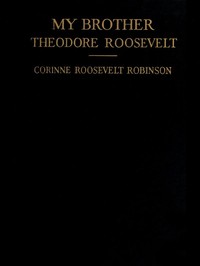
My Brother, Theodore Roosevelt
Language: en879 downloads on Project Gutenberg
Subjects
In: Biographies·History - American
Public-domain ebook sourced from Project Gutenberg #51831.
Public-domain ebook
Language: en879 downloads on Project Gutenberg
Subjects
In: Biographies·History - American
Public-domain ebook sourced from Project Gutenberg #51831.
The opening · free to read
The first recollections of a child are dim and hazy, and so the nursery at 28 East 20th Street, in New York City, does not stand out as clearly to me as I wish it did--but the personality of my brother overshadowed the room, as his personality all through life dominated his environment.
I suppose I must have been about four, and he about seven, when my first memory takes definite form. My older sister, Anna, though only four years older than my brother Theodore, was always mysteriously classed with the “grown people,” and the “nursery” consisted of my brother Theodore, my brother Elliott, a year and a half younger than Theodore, and myself, still a year and a half younger than Elliott.
In those days we were “Teedie,” “Ellie,” and “Conie,” and we had the most lovely mother, the most manly, able, and delightful father, and the most charming aunt, Anna Bulloch, the sister of my Southern mother, with whom children were ever blessed.
Theodore Roosevelt, whose name later became the synonym of virile health and vigor, was a fragile, patient sufferer in those early days of the nursery in 20th Street. I can see him now struggling with the effort to breathe--for his enemy was that terrible trouble, asthma--but always ready to give the turbulent “little ones” the drink of water, book, or plaything which they vociferously demanded, or equally ready to weave for us long stories of animal life--stories closely resembling the jungle stories of Kipling--for Mowgli had his precursor in the brain of the little boy of seven or eight, whose knowledge of natural history even at that early age was strangely accurate, and whose imagination gave to the creatures of forest and field impersonations as vivid as those which Rudyard Kipling has made immortal for all time.
We used to sit, Elliott and I, on two little chairs, near the higher chair which was his, and drink in these tales of endless variety, and which always were “to be continued in our next”--a serial story which never flagged in interest for us, though sometimes it continued from week to week, or even from month to month.
It was in the nursery that he wrote, at the age of seven, the famous essay on “The Foregoing Ant.” He had read in Wood’s “Natural History” many descriptions of various species of ant, and in one instance on turning the page the author continued: “The foregoing ant has such and such characteristics.” The young naturalist, thinking that this particular ant was unique, and being specially interested in its forthgoing character, decided to write a thesis on “The Foregoing Ant,” to the reading of which essay he called in conclave “the grown people.” One can well imagine the tender amusement over the little author, an amusement, however, which those wise “grown people” of 28 East 20th Street never let degenerate into ridicule.
No memories of my brother could be accurate without an analysis of the personalities who formed so big a part of our environment in childhood, and I feel that my father, the first Theodore Roosevelt, has never been adequately described.
He was the son of Cornelius Van Shaack and Margaret Barnhill Roosevelt, whose old home on the corner of 14th Street and Broadway was long a landmark in New York City. Cornelius Van Shaack Roosevelt was a typical merchant of his day, fine and true and loyal, but ultraconservative in many ways; and his lovely wife, to whom he addressed, later, such exquisite poems that I have always felt that they should have been given more than private circulation, was a Pennsylvanian of Quaker blood.
The first Theodore Roosevelt was the youngest of five sons, and I remember my mother used to tell me how friends of her mother-in-law once told her that Mrs. Cornelius Van Shaack Roosevelt was always spoken of as “that lovely Mrs. Roosevelt” with those “_five horrid boys_.”
As far as I can see, the unpleasant adjective “horrid” was only adaptable to the five little boys from the usual standpoint of boyish mischief, untidiness, and general youthful irrepressibleness.
The youngest, my father, Theodore Roosevelt, often told us himself how he deplored the fate of being the “fifth wheel to the coach,” and of how many a mortification he had to endure by wearing clothes cut down from the different shapes of his older brothers, and much depleted shoes about which, once, on overhearing his mother say, “These were Robert’s, but will be a good change for Theodore,” he protested vigorously, crying out that he was “tired of changes.”
As the first Theodore grew older he developed into one of the most enchanting characters with whom I, personally, have ever come in contact; sunny, gay, dominant, unselfish, forceful, and versatile, he yet had the extraordinary power of being a focussed individual, although an “all-round” man. Nothing is as difficult as to achieve results in this world if one is filled full of great tolerance and the milk of human kindness. The person who achieves must generally be a one-ideaed individual, concentrated entirely on that one idea, and ruthless in his aspect toward other men and other ideas.
My father, in his brief life of forty-six years, achieved almost everything he undertook, and he undertook many things, but, although able to give the concentration which is necessary to achievement, he had the power of interesting himself in many things outside of his own special interests, and by the most delicate and comprehending sympathy made himself a factor in the lives of any number of other human beings.
My brother’s great love for his humankind was a direct inheritance from the man who was one of the founders in his city of nearly every patriotic, humanitarian, and educational endeavor. I think, perhaps, the combination of the stern old Dutch blood with the Irish blood, of which my brother always boasted, made my father what he was--unswerving in duty, impeccable in honesty and uprightness, and yet responsive to the joy of life to such an extent that he would dance all night, and drive his “four-in-hand” coach so fast that the old tradition was “that his grooms frequently fell out at the corners”!
I remember that he always gave up one day of every week (and he was a very busy merchant and then banker) to the personal visiting of the poor in their homes. He was not satisfied with doing active work on many organizations, although he did the most extraordinary amount of active organization work, being one of the founders of the Children’s Aid Society, of the State Aid Society, of the Sanitary Commission and Allotment Commission in the time of the Civil War, and of the Orthopædic Hospital, not to mention the Museum of Natural History and the Museum of Art--but he felt that even more than this organized effort must be the effort to get close to the hearts and homes of those who were less fortunately situated than he.
My older sister suffered from spinal trouble, and my father was determined to leave no stone unturned to make her body fit for life’s joys and life’s labors, and it was because of his efforts to give his little girl health--successful efforts--that in co-operation with his friends Howard Potter and James M. Brown and several others he started the great work of the New York Orthopædic Hospital, having become imbued with belief in the methods of a young doctor, Charles Fayette Taylor. Nobody at that time believed in treating such diseases in quite the way in which modern orthopædy treats them now, but my father, like his son, had the vision of things to be, and was a leader in his way, as was my brother in his.
He could not at first influence sufficient people to start the building of a hospital, and he decided that if the New York public could only see what the new instruments would do for the stricken children, that it could be aroused to assist the enterprise.
And so, one beautiful spring afternoon, my mother gave what was supposed to be a purely social reception at our second home, at 6 West 57th Street, and my father saw to it that the little sufferers in whom he was interested were brought from their poverty-stricken homes to ours and laid upon our dining-room table, with the steel appliances which could help them back to normal limbs on their backs and legs, thus ready to visualize to New York citizens how these stricken little people might be cured. He placed me by the table where the children lay, and explained to me how I could show the appliances, and what they were supposed to achieve; and I can still hear the voice of the first Mrs. John Jacob Astor, as she leaned over one fragile-looking child and, turning to my father, said: “Theodore, you are right; these children must be restored and made into active citizens again, and I for one will help you in your work.”
That very day enough money was donated to start the first Orthopædic Hospital, in East 59th Street. Many business friends of my father used to tell me that they feared his sudden visits when, with a certain expression in his eyes, he would approach them, for then before he could say anything at all they would feel obliged to take out their pocketbooks and ask: “How much this time, Theodore?”
One of his most devoted interests was the newsboys’ lodging-house in West 18th Street, and later in 35th Street, under the auspices of the Children’s Aid Society. Every Sunday evening of his life he went to that lodging-house, after our early hospitable Sunday supper, to which many a forlorn relation or stranded stranger in New York was always invited, and there he would talk to the boys, giving them just such ideas of patriotism, good citizenship, and manly morality as were the themes of his son in later years.
The foundational scheme of the Children’s Aid Society was, and is, to place little city waifs in country homes, and thus give them the chance of health and individual care, and a very dramatic incident occurred many years after my father’s death, when my brother, as governor of New York State and candidate for the vice-presidency in 1900, had gone to the Far West to make the great campaign for the second election of William McKinley. The governors of many Western States decided to meet in the city of Portland, Ore., to give a dinner and do honor to the governor of the Empire State, and as Governor Roosevelt entered the room they each in turn presented themselves to him. The last one to come forward was Governor Brady, of Alaska, and as he shook hands with Governor Roosevelt he said: “Governor Roosevelt, the other governors have greeted you with interest, simply as a fellow governor and a great American, but I greet you with infinitely more interest, as the son of your father, the first Theodore Roosevelt.”
My brother smiled and shook him warmly by the hand, and asked in what special way he had been interested in our father, and he replied: “Your father picked me up from the streets in New York, a waif and an orphan, and sent me to a Western family, paying for my transportation and early care. Years passed and I was able to repay the money which had given me my start in life, but I can never repay what he did for me, for it was through that early care and by giving me such a foster mother and father that I gradually rose in the world, until today I can greet his son as a fellow governor of a part of our great country.”
The book keeps going
Reading is free forever. Sign up and watch scenes appear while you read.



Scenes Storieta drew for other classics.
New illustrated classics
Once or twice a month: the latest books to get full character casts, scene art, and free comic editions. No account needed.