Public-domain ebook
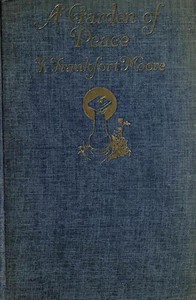
A Garden of Peace: A Medley in Quietude
Language: en579 downloads on Project Gutenberg
Subjects
Public-domain ebook sourced from Project Gutenberg #51940.
Public-domain ebook
Language: en579 downloads on Project Gutenberg
Subjects
Public-domain ebook sourced from Project Gutenberg #51940.
The opening · free to read
Dorothy frowns slightly, but slightingly, at the title; but when challenged to put her frown into words she has nothing worse to say about it than that it has a certain catchpenny click--the world is talking about The Peace and she has an impression that to introduce the word even without the very definite article is an attempt to derive profit from a topic of the hour--something like backing a horse with a trusty friend for a race which you have secret information it has won five minutes earlier--a method of amassing wealth resorted to every day, I am told by some one who has tried it more than once, but always just five minutes too late.
I don't like Dorothy's rooted objection to my literary schemes, because I know it to be so confoundedly well rooted; so I argue with her, assuring her that literary men of the highest rank have never shown any marked reluctance to catch the pennies that are thrown to them by the public when they hit upon a title that jingles with the jingle of the hour. To descend to an abject pleasantry I tell her that a taking title is not always the same as a take-in title; but, for my part, even if it were----
And then I recall how the late R. D. Blackmore (whose works, by the way, 1 saw in a bookseller's at Twickenham with a notice over them--“by a local author”) accounted for the popularity of Lorna Doone: people bought it believing that it had something to do with the extremely popular engagement--“a Real German Defeat,” Tenniel called it in his Punch cartoon--of the Marquis of Lorne and the Princess Louise. And yet so far from feeling any remorse at arriving at the Temple of Fame by the tradesman's entrance, he tried to get upon the same track again a little later, calling his new novel Alice Lorraine: people were talking a lot about Alsace-Lorraine at the time, as they have been doing ever since, though never quite so loudly as at the present moment (I trust that the publishers of the novel are hurrying on with that new edition).
But Dorothy's reply comes pat: If Mr. Blackmore did that, all she can say is that she doesn't think any the better of him for it; just what the Sabbatarian Scotswoman said when the act of Christ in plucking the ears of corn on the Sabbath Day was brought under her ken.
“My dear,” I cry, “you shouldn't say that about Mr. Blackmore: you seem to forget that his second name was Doddridge, and I think he was fully justified in refusing to change the attractive name of his heroine of the South Downs because it happened to catch the ears (and the pence) of people interested in the French provinces which were pinched by the Germans, who added insult to injury by transforming Alsace-Lorraine to Elsass-Lothringen. And so far as my own conscience is concerned----”
“Your own what?” cried Dorothy.
“My own conscience--_literary_ conscience, of course.”
“Oh, that one? Well?”
“I say, that so far as--as--as I am concerned, I would not have shrunk from calling a book A Garden in Tipperary if I had written it a few years ago when all England and a third of France were ringing with the name Tipperary.
“Only then it would have been a Garden of War, but now it suits you--your fancy, to make it a Garden of Peace.”
“It's not too late yet; if you go on like this, I think I could manage to introduce a note of warfare into it and to make people see the appropriateness of it as well; so don't provoke me.”
“I will not,” said Dorothy, with one of her perplexing smiles.
And then she became interesting; for she was ready to affirm that every garden is a battlefield, even when it is not run by a husband and his wife--a dual system which led to the most notorious horticultural fiasco on record. War, according to Milton, originated in heaven, but it has been carried on with great energy ever since on earth, and the first garden of which there is a literary record maintained the heavenly tradition. So does the last, which has brought forth fruit and flowers in abundance through the slaughter of slugs, the crushing of snails, the immolation of leather-jackets, the annihilation of 'earwigs, and is now to be alluded to as a Garden of Peace, if you please.
Dorothy con be very provoking when she pleases and is wearing the right sort of dress; and when she has done proving that the most ancient tradition of a garden points to a dispute not yet settled, between the man and his wife who were running it, she begins to talk about the awful scenes that have taken place in gardens. We have been together in a number of gardens in various parts of the world: from those of the Borgias, where, in the cool of the evening, Lucrezia and her relations communed on the strides that the science and art of toxicology was making, on to the little Trianon where the diamond necklace sparkled in the moonlight on the eve of the rising of the people against such folk as Queens and Cardinals--on to the gardens of the Temple, where the roses were plucked before the worst of the Civil Wars of England devastated the country--on to Cherry' Orchard, near Kingston in the island of Jamaica, where the half-breed Gordon concocted his patriotic treason which would have meant the letting loose of a jungle of savages upon a community of civilisation, and was only stamped out by the firm foot of the white man on whose shoulders the white man's burden was laid, and who snatched his fellow-countrymen from massacre at the sacrifice of his own career; for party government, which has been the curse of England, was not to be defrauded of its prey because Governor Eyre had saved a colony from annihilation. These are only a few of the gardens in which we have stood together, and Dorothy's memory for their associations is really disconcerting. I am disconcerted; but I wait, for the wisdom of the serpent of the Garden comes to me at times--I wait, and when I have the chance of that edgeways word which sometimes I can't get in, I say,--
“Oh, yes, those were pleasant days in Italy among the cypresses and myrtles, and in Jamaica with its palms. I think we must soon have another ramble together.”
“If it weren't for those children--but where should we go?” she cried.
“I'm not sure,” I said, as if revolving many memories, “but I think some part of the Pacific Slope----”
“Gracious, why the Pacific Slope, my man?”
“Because a Pacific Garden must surely be a Garden of Peace; and that's where we are going now with the title-page of a book that is to catch the pennies of the public, and resemble as nearly as I can make it--consistent with my natural propensity to quarrel with things that do not matter in the least--one of the shadiest of the slopes of the Island Valley of Avilion--
Where falls not hall, or rain, or any snow,
Luckily I recollected the quotation, for I had not been letter-perfect I should have had a poor chance of a bright future with Dorothy.
As it was, however, she only felt if the big tomato was as ripe as it seemed, and said,--
“'Orchard-lawns.' H'm, I wonder if Tennyson, with all his 'careful-robin' observation of the little things of Nature was aware that you should never let grass grow in an apple orchard.”
“I wonder, indeed,” I said, with what I considered a graceful acquiescence. “But at the same time I think I should tell you that there are no little things in Nature.”
“I suppose there are not,” said she. “Anyhow, you will have the biggest tomato in Nature in your salad with the cold lamb. Is that the bell?”
“It is the ghost-tinkle of the bell of the bell-wedder who was the father of the lamb,” said I poetically.
“So long as you do not mention the mother of the lamb when you come to the underdone stratum, I shall be satisfied,” said she.
PS.--(1.30)--And I didn't.
PFS.--(1.35)--But I might have.
This town of ours is none other than Yardley Parva. Every one is supposed to know that the name means “The Little Sheltered Garden,” and that it was given this name by a mixed commission of Normans and Romans. The Normans, who spoke a sort of French, gave it the first syllable, which is the root of what became jardin, and which still survives in the “backyard” of American literature; meaning not the backyard of an English home, where broken china and glass and other incidental rubbish are thrown to work their way into the bowels of the earth, but a place of flowers and beans and pumpkins. The surname, Parva, represents the influence of the Romans, who spoke a sort of Latin. Philologists are not wholehearted about the “ley,” but the general impression is that it had a narrow escape from being “leigh,” an open meadow; ley, however, is simply “lee,” or a sheltered quarter, the opposite to “windward.” Whatever foundation there may be for this philology--whether it is derived from post hoc evidence or not--every one who knows the place intimately will admit that if it is not literally exact, it should be made so by the Town Council; for it is a town of sheltered little gardens. It has its High Street: and this name, a really industrious philologist will tell you, is derived, not from its occupying any elevated position, but from the fact that the people living on either side were accustomed to converse across the street, and any one wishing to chat with an opposite neighbour, tried to attract his attention with the usual hail of “hie there!”; and as there was much crossquestioning and answering, there was a constant chorus of “hie, hie!” so that it was really the gibe of strangers that gave it its name, only some fool of a purist seven or eight hundred years ago acquired the absurd notion that the word was “High” instead of “Hie!” So it was that Minnesingers' Lane drifted into Mincing Lane, I have been told. It had really nothing to do with the Min Sing district of China, where the tea sold in that street of tea-brokers came from. Philology is a wonderful study; and no one who has made any progress in its by-paths should ever be taken aback or forced to look silly.
The houses on each side of the High Street are many of them just as they were four or five hundred years ago. Some of them are shops with bow fronts that were once the windows of parlours in the days when honest householders drank small ale for breakfast and the industrious apprentices took down the shutters from their masters' shops and began their day's work somewhere about five o'clock in midsummer, graduating to seven in midwinter. There are now some noble plate-glass fronts to the shops, but there are no apprentices, and certainly no masters. Scores of old, red-tiled roofs remain, but they are no more red than the red man of America is red. The roofs and the red man are of the same hue. Sixty years ago, when slate roofs became popular, they found their way to Yardley Parva, and were reckoned a guarantee of a certain social standing. If you saw a slate roof and a cemented brick front you might be sure that there was a gig in the stable at the back. You can now tell what houses had once been tiled by the pitch of the roofs. This was not altered on the introduction of the slates.
But with the innovations of plate-glass shop-fronts and slate roofs there has happily been no change in the gardens at the back of the two rows of the houses of the High Street. Almost every house has still its garden, and they remain gay with what were called in my young days “old-fashioned flowers,” through the summer, and the pear-trees that sprawl across the high dividing walls in Laocoon writhings--the quinces that point derisive, gnarled fingers at the old crabs that give way to soundless snarls against the trained branches of the Orange Pippins--the mulberries that are isolated on a patch of grass--all are to-day what they were meant to be when they were planted in the chalk which may have supplied Roman children with marbles when they had civilized themselves beyond the knuckle-bones of their ancestors' games.
The book keeps going
Reading is free forever. Sign up and watch scenes appear while you read.



Scenes Storieta drew for other classics.
New illustrated classics
Once or twice a month: the latest books to get full character casts, scene art, and free comic editions. No account needed.