Public-domain ebook
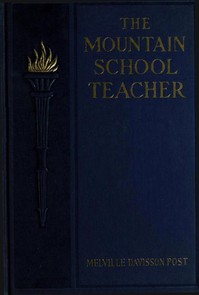
The Mountain School-Teacher
Language: en407 downloads on Project Gutenberg
Subjects
In: Novels·American Literature
Public-domain ebook sourced from Project Gutenberg #51958.
Public-domain ebook
Language: en407 downloads on Project Gutenberg
Subjects
In: Novels·American Literature
Public-domain ebook sourced from Project Gutenberg #51958.
The opening · free to read
|THERE had once been a path along the backbone of the mountain, but the wilderness had undertaken to remove it, and had almost succeeded. The wind had gathered bits of moss, twigs and dead stuff into the slight depression. The great hickories had covered it with leaves. The rain had packed it. There was no longer a path, only an open way between the trees running down the gentle slope of the ridge to the mountain road. The ridge was heavily wooded. The primeval forest was there. Great hickories shot up sixty feet without a limb, and so close that a man putting out his hand could reach from one tree to another. A gigantic poplar now and then arose, a sugar maple, an oak--huge at the butt, deep rooted in the good soil.
The afternoon sun, excluded of the forest, seemed to pack itself into this abandoned path.
The leaves fallen from the hickories, under the touch of waning summer, took on now, by the magic of this sun, golden tones of red and yellow. Woodpeckers hammered on the great trees along this path. Insects moved between the branches, the wild bee, the hornet, the yellow butterfly, as though the aerial life of the woods had been drawn here to the sun.
A man was coming through the forest along this abandoned path. He walked slowly, his hands behind him, his head bare. He was a very young man--at that period of life when, within a day, as by the crossing of some unmarked line, the boy becomes a man. There was about him the vigor, the freshness, the joy of youth, under a certain maturity. He was not above middle height, his face was oval, his eyes gray-blue, his hair of that soft rich brown which a touch of the sun burnishes into a living yellow; the mouth was sensitive and mobile.
There was a marked contrast between the man and the wild, rugged, primitive country in which he appeared. His hands were firm and white, and his skin was not in the least discolored by sun or weather.
Now and then the man stopped and looked up at the dappled woodpeckers, and the swarms of yellow butterflies, gathered here along this sunlit path as though to welcome his arrival, and his mouth relaxed into an eager, luminous smile, as though, despite his maturity, he retained a child's sense of some universal kinship with all living things. He came down the long ridge toward the place where the mountain road crossed the low gap.
Half a mile below him a patriarchal ox was plodding slowly up the mountain road. The ox was old. His red hair was worn away in a variety of places, by long labors at the sled and the plow. His ancient horns were capped with brass knobs. Astride the ox sat a small boy on a sack of corn, perhaps a bushel and a half shelled from the cob. Under the sack was a strip of homemade carpet dyed yellow with copperas. The little boy guided the ox with a piece of old rope tied to the left horn below the brass knob, precisely as the driver of a four-horse team directs it with a single line. When he wished the ox to go to the right, he jerked the rope and shouted, “Gee, Berry,” when to the left, he pulled on the rope and shouted, “Haw, Berry.”
But the ox no longer required these elaborate directions.
“Gee,”
“Haw,” accompanied by a kicking of the rider's naked heels, were enough for the patriarch, or the soft heels alone on the broad iron ribs.
The boy could not have been above six years old. He wore two garments, a little blue shirt of the material called “hickory,” and short trousers, with tiny hand-knitted woolen “galluses.”
He was now engaged with an extreme difficulty.
For more than a mile, under the ox's rolling gait, the corn had been moving over to one end of the sack. To keep the bag from falling, the boy had added his weight to the decreasing end. As the corn moved, he shifted his seat a little farther out on the sack. He sat now, well over the ox's side on the very end of the sack. His little mouth was contracted.
It had been a long, painful struggle--this fight against the corn. Every inch, every fraction of an inch, contested.
The grains had crept slowly over, and the child had considered and estimated the change, and moved with it. He had attributed to the corn a certain malicious intent, a certain insidious hostility, and he had resisted with dogged courage. It was all in the set of his little mouth, in the clutch of his tiny brown hand.
For the sack to fall was a calamity which the child well understood.
He could not lift the sack. He could not leave the ox and go for aid, because Berry, although a member of the family, was an eyeservant and not above making his dinner on the corn when the master's back was turned.
Neither could he leave the corn lying in the road and return with the ox. Some one might carry it away and, besides, it was his bale of stuffs, the cargo with which he had been intrusted, and he could not leave it.
The mountain road was deserted and the evening sun was beginning to descend.
The child's whole energies were centered on his desperate struggle with the corn, and the ox traveled on leisurely as he liked. Presently, as he neared the top, the ox stepped on the root of a tree remaining in the road, and his shoulder went down. The sack slipped forward and fell, carrying with it the boy and the piece of carpet.
The ox instantly stopped, the boy rose and sat down on the sack, resting his elbows on his knees and his chin in the hollow of his tiny brown hands. His features retained their set, dogged expression, but presently big tears began to trickle slowly down over his determined little face. He sat with his back toward the mountain gap, locking out over the vast wilderness of tree tops below him. The ox stood before him in the road, a figure of unending patience.
The day waned, long shadows crossed the road, the sun withdrew to the high places. Far away through the deep wooded gorges night began to enter the mountains.
|WHEN the man came out into the mountain road, he saw the little boy sitting on the sack of corn beside the red ox, and he smiled as he had smiled at the hammering birds, at the yellow butterflies. He turned down toward the tragic picture, lengthening his steps. The sun, by some trick of the moving world, seemed to follow him out of the abandoned path.
The little boy did not see the man approaching, but he observed that the ox, apparently resigned to passing the night on the mountain, was making ready to lie down, knees first, after the manner of cattle. And the comfortable assurance of Berry in this, the hour of their misfortune, was more than he could bear. He arose and began to beat the ox with his little fists.
“Git up, Berry!” he cried. “You ole dog! You ole scalawag! Git up!”
The ox slowly arose, and the child turned to find the man beside him.
“Poor Berry!” said the man, smiling. “Is he a very bad ox?”
“He's a lazy ole pup,” replied the little hoy, his wet eyes catching and reflecting the stranger's smile. “He's spilt!” Then he crowded his little fists into his eyes to remove the traces of weakness with which he had been taken unawares.
“Do you reckon,” he said, “that both of us could put the corn on him if we lifted together?”
“I think so,” replied the man; “at least we will try.”
He took up the piece of yellow carpet and laid it over the ox's back. Then he stooped down, put his arms around the sack, linking his fingers together under it. The little hoy took hold of the corner. The man raised the sack with scarcely an effort, the child contributing his tiny might. Then, as though the child's help were essential to the task, he nodded.
“Now,” he said, and with a swing lifted the sack onto the ox's back.
The hoy straightened up, and put both little hands on his hips. His face was now radiant.
“We got it up all right, didn't we?” he said, “both a-liftin'; an' now,” he paused and regarded the ox with some concern, “I've got to git on somehow-er-nuther.” The ordinary man would then have lifted the child and set him on the ox, but this man did not. He seemed to know and regard that self-reliance which was so dear a thing to this child. He stood back and looked over the patriarch.
“Berry is a big ox,” he said. “We will lead him up to the bank.”
The little boy walked across the road, with a bit of a swagger.
“Yes,” he said, “Berry's a big ox.”
He liked this strange man who understood and considered him.
The man led the ox to the roadside, and standing by the beast's shoulder, set his knee against the bank. The little boy put his foot on the man's knee, caught hold of the ox's shoulder, and climbed up onto the sack of corn. He panted with the effort.
“Berry's everlastin' big,” he observed in comment. Then he set himself squarely on the sack.
The book keeps going
Reading is free forever. Sign up and watch scenes appear while you read.



Scenes Storieta drew for other classics.
New illustrated classics
Once or twice a month: the latest books to get full character casts, scene art, and free comic editions. No account needed.