Public-domain ebook
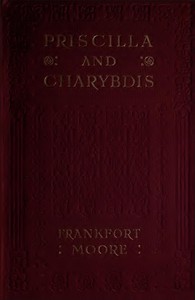
Priscilla and Charybdis: A Story of Alternatives
Language: en538 downloads on Project Gutenberg
Subjects
Public-domain ebook sourced from Project Gutenberg #51972.
Public-domain ebook
Language: en538 downloads on Project Gutenberg
Subjects
Public-domain ebook sourced from Project Gutenberg #51972.
The opening · free to read
WHAT Morley Quorn could not understand was why people made such a fuss over that fellow Kelton. Who was Kelton anyway that he should give himself airs, he enquired with some insistence of the five “bassi”--they were labelled “bassi” in the programme--who were lounging about the door of the schoolroom where the rehearsal for the concert was being held.
“He does give himself airs, doesn’t he?” growled another of the same division of the chorus.
The rest shook their heads gloomily. It was denied to them to express themselves adequately on this point, the fact being that the Reverend Edwin Tucknott, the curate of St. Joan of Arc, was standing hard by with his flute. The proximity of the clergyman checked complete freedom of speech, including “language,” among the young men, for they failed to recollect that in the due performance of that portion of his sacred office known as the Commination Service he went much further than the most highly qualified basso could go even when he found it necessary to describe the absurdities of another and more popular vocalist.
Mr. Tucknott smiled his olive branch smile in the direction of the “bassi.”
“I suppose it is natural for a tenor to give himself airs,” he remarked. The instant he had spoken he glanced around in rather a shaky way. He had a feeling that he had gone a little too far. He hoped that no one would fancy he had been unable to resist a play upon the words. He had no need, however, to have any misgiving on this point. It was plain that his daring had hurt the susceptibilities of none.
“Oh, I don’t say that we’re not prepared for a good bit of side from a--a chap that fancies he sings tenor,” said Morley Quorn; “but that fellow Kelton goes just too far. Now what is he up to this time? Cheeking Mozart Tutt! I wonder that Mr. Tutt stands his impudence.”
But in a second it became plain that Mr. Mozart Tutt was doing nothing of the sort. He had been playing the pianoforte accompaniment to Mr. Kelton’s song, but not in a way that was met with the unqualified approval of Mr. Kelton.
“I must ask you to try to play pianissimo when I am doing my shake on the high note,” said he; and Mr. Tutt had accordingly played pianissimo when the thing was repeated.
But Mr. Kelton did not attempt to ascend to the high notes. He stopped short, and let his page of music flap down in a movement suggestive of a disappointment that was practically hopeless.
“If you don’t throw some life into the passage you had better let me sing without any accompaniment,” he said in a pained way.
“I will play in any way you suggest, Mr. Kelton,” said Mr. Tutt. “Will you kindly sit down to the piano and play the accompaniment as you wish it to be played?”
But this invitation the tenor felt it to be his duty to decline. He was no musician. He could not play a passage from the musical score to save his life, and of this fact Mr. Tutt was well aware.
“I don’t ask very much--only that you should give me a little support,” said Mr. Kelton with a suggestion of long-suffering in his voice. “I take it that the accompaniment to a song--a tenor song--should be played as if it were nothing more than a background, so to speak, and the vocalization supplies the colour. I don’t wish to discourage you, Mr. Tutt; you play quite well sometimes--quite well enough for the people about here; but we must have light and shade, Mr. Tutt. Now let us try again.”
If Mr. Kelton sang with expression, Mr. Tutt played with expressions--he was almost audible at the door. But still he attacked the air with spirit. He was a very competent man; he had composed a Magnificat which Miss Caffyn, the Rector’s daughter, said took a deal of beating, like a dusty carpet.
Down went Mr. Kelton’s page of music once more, after he had strained up to a very shaky G, and up jumped Mr. Mozart Tutt, before the vocalist had time to formulate his latest complaint.
“I’ve done my best, and if that isn’t good enough for Mr. Kelton he would do well to play his own accompaniment, or get some one to play it who will submit to his insults,” said the musician.
He walked with dignity to the door leading off the platform, and was enthusiastically greeted by the five “bassi.” Mr. Tucknott, flute and all, ran away; he was fearful lest some people should associate him with the intrepid step taken by Mr. Tutt.
It was the Rector’s wife who took command of the situation. She knew that the singing of Mr. Kelton increased to an appreciable extent the attractiveness of the concert, inasmuch as the Honourable Mrs. Bowlby-Sutherst had a passion for listening to tenor music, and Mrs. Bowlby-Sutherst lived at the Hall, and, her husband being patron of the living, she duly patronized the people who lived by it. It would never do, Mrs. Caffyn, the Rector’s wife, perceived, to induce the patroness to attend the concert and then find that there was no tenor solo. That was why she approached Mr. Kelton with a smile that was meant to suggest a great deal, and that certainly assured Mr. Kelton that the Church was on his side.
“We mustn’t be too hard on poor Mr. Tutt,” she said soothingly.
“I’m not,” cried the tenor quickly. “But it’s a little too bad that a man in my position should be subjected to the caprice of such a person. I have a great mind to throw up the whole business.”
He had turned a cold shoulder to the lady, as if he meant to leave the platform that very instant.
“Oh, no, Mr. Kelton, you would never desert us in such a fashion; it would not be like you to do so,” said Mrs. Cafifyn. “Mrs. Bowlby-Sutherst is, I know, coming to our concert solely to hear you sing ‘In the Land of Sleep.’”
“I cannot help that, Mrs. Cafifyn. I do not expect a great deal when I come to sing at a country concert, but I look for common civility, Mrs. Cafifyn--common civility.”
“We are all so sorry. I would not for anything that this--this little difference should arise. You will make allowance for the strain upon poor Mr. Tutt--I know you will.”
“Not unless he apologizes--I have a certain amount of self-respect, Mrs. Caffyn. I have no idea of allowing a person in the position of Mr. Tutt to presume----”
“Oh, mother, I have just been talking to Priscilla, and she says she will be delighted to play the accompaniment to ‘The Land of Sleep,’” said Rosa Caffyn, who came up hastily to the platform at that moment. She was a girl who was alluded to in a friendly spirit as healthy--in an unhealthy spirit as blowsy. She had a good eye, critics of beauty affirmed, and a straightforward voice, Mr. Tutt had more than once announced to the schoolmistress.
“How sweet of Priscilla!” cried Mrs. Caffyn. “Oh, Mr. Kelton, you will, I know, be pleased with Priscilla’s playing--Miss Wadhurst, you know,” she added in an explanatory tone.
Mr. Kelton pursed out his lips slightly, assuming the air of a man who is being bandaged by the people in the motor that has knocked him down--an air of aggrieved submission.
“An amateur?” he said. “I am not familiar with the name as a professional.”
“Oh, yes--strictly amateur,” replied Miss Caffyn, who played golf and other things, and so knew all about the distinctions between performers.
“I’m not accustomed to be accompanied by amateurs,” said the tenor, who was a bank clerk in the county town, “but I don’t mind giving her a trial. Where is she?”
He put on his pince-nez and looked patronizingly around.
“Here she comes,” said Rosa, beckoning to some one who was seated in the body of the school-house--a young woman with a good deal that might be called striking about her, besides her hair, which was rather marvellous, and made one think of a painter of the early Venetian school--there was too much of brown in it to allow of its ever being called golden, and too much of gold to admit of its being called coppery. People who knew where they stood compromised the matter by calling it marvellous. But whatever it was it suited her, though a girl or two had said positively that Priscilla Wadhurst would be nothing without her hair. They were wrong: she would still have been Priscilla--with a difference.
“It is so sweet of you, Priscilla,” began Mrs Caffyn.
“Oh, no,” said Priscilla; “I am not good enough--not nearly good enough.”
She cast down her eyes for a tremulous moment, and then raised them coyly to Mr. Kelton’s face; and she saw by the way he looked at her that he thought she would do.
“You will not find that I am such a terrible person after all, Miss--Miss----”
“Wadhurst,” said Rosa. “I should have introduced you. Miss Wadhurst--Mr. Kelton.”
“I heard you last year,” murmured Miss Wadhurst. “I am not likely to forget it. I am not nearly good enough to be your accompanist, Mr. Kelton; but if you will make allowances----”
“Don’t be afraid,” said he with a condescending wave of the left hand--the right was engaged at the point of his moustache. “You will find me anything but the dreadful person you might imagine me to be. All that I ask is to have my instructions carried out to the letter. I am sure that I shall have no trouble with you, Miss Wadhurst.”
The book keeps going
Reading is free forever. Sign up and watch scenes appear while you read.



Scenes Storieta drew for other classics.
New illustrated classics
Once or twice a month: the latest books to get full character casts, scene art, and free comic editions. No account needed.