Public-domain ebook
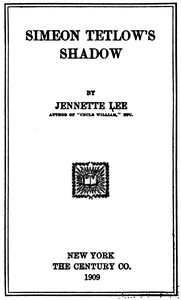
Simeon Tetlow's Shadow
by Jennette Lee
Language: en402 downloads on Project Gutenberg
Subjects
In: Novels·American Literature
Public-domain ebook sourced from Project Gutenberg #51982.
Public-domain ebook
by Jennette Lee
Language: en402 downloads on Project Gutenberg
Subjects
In: Novels·American Literature
Public-domain ebook sourced from Project Gutenberg #51982.
The opening · free to read
IT was turning dusk in the office, though it was scarcely three o’clock and outside the sun was still shining, beyond the busy streets. The two men sitting on opposite sides of the small room bent closer to their desks. The younger glanced up and got up to turn on the electric light. The little scowl that had begun to form itself on the face of the older man changed to a look of relief. His pen moved faster over the paper.
The older man was Simeon Tetlow, President of the “R. and Q.” Railroad. It might almost be said that he was the road. Its minute ramifications and its great divisions were hardly more than the nerves and arteries that threaded Simeon Tetlow’s thin frame. And the orders that went out from the tiny office, high up in the big block, were the play of his flitting finger-tips upon the keyboard of the whole clanking system. The tiny, shriveled figure gave no hint of the power that ticked carloads of live stock and human beings to their destination and laid its hand upon roads half dead, or dying, or alive and kicking, sweeping them gently into the system, with hardly a gulp.
Simeon Tetlow was an iron man, wiry and keen--an intellect without heart or soul or conscience, his co-workers would have told you. Each new road absorbed, each influx of power, seemed only to tighten a spring somewhere inside that shot the bolt. He could work day and night without tiring; and that was the reason, in part, why at forty-two he was president of the “R. and Q.” road; and the reason why at forty-two his hand, when it reached out for its abstemious glass of water, trembled so that it was quickly withdrawn. No one knew the man. No one guessed the nervous horror that often racked the small frame driven relentlessly by its big brain.
He reached out for a slip of paper that lay at hand and ran his eye over it, jotting down a few figures. Then he pushed it to one side and went on writing. The younger man came across the office and laid another slip of paper on the desk. He took the one that had been pushed aside, made a memorandum on it, and filed it in a pigeon-hole at the right. He was a short, young man, with broad shoulders and a round face. The face as it bent above the slip of paper had a dull look. There was a kind of patience in it not usual in so young a man, and when he turned his eyes to his employer they glowed with a clear light, as if something were shining behind them.
“What is it, John?” The man reached out a nervous, groping hand. His gaze had not left the page before him.
“This one next, sir.” The young man touched the outstretched hand with the slip of paper.
“Yes, yes.” It was almost testy.
The other returned to his desk and the scratching pens raced with the minutes.
A call-boy entered with a handful of letters. The young man took them and ran them through his fingers. He arranged them in piles, reserving a part for himself. These he read, making notes and filing them rapidly. One letter, the one at the bottom of the pack, was not addressed to the great corporation, but--in a fine, small hand--to “John Bennett.” He read this one last, looking thoughtfully at the lines and folding it with slow fingers. The patient look was still in his face, but the light of the eyes was gone. It seemed to have sunk back, leaving the flesh dull and heavy.
His employer glanced up suddenly. His quick eye sought the electric bulb, with a flash of impatience, and returned to its work.
The young man rose and turned on more lights. He moved about the room, putting things away for the night.
Simeon Tetlow finished his letters and pushed them from him. The young man came across and began to gather them up. His dull face came in range of his employer’s eye.
“Give those I ’ve marked to Hanscom. Have the rest ready in the morning. I shall dictate.”
“Yes, sir.” The young man finished gathering them up.
The man glanced again, half-impatiently, at the heavy face. The room seemed suddenly gloomy, in spite of the red-hot wires looping the light about them.
The young man brought a hat and coat and laid them beside his employer. “May I speak to you a minute, sir?” he asked as he put them down.
The other glanced again, sharply, at his face. “Go ahead.” His hand was reaching for the hat.
“I shall have to hand in my resignation, sir.” The young man said it slowly, as if repeating something he had learned by heart.
The hand on the hat drew back. “What ’s that?” He laughed curtly and shot a look of suspicion at the impassive face. “More money?”
The face flushed. “No, sir.” He hesitated a little. “My mother is sick.”
“Umph!” The man’s face cleared. “You don’t need to resign for that.” He did not ask what was the matter with the mother. He had not known that John had a mother. She seemed to be springing into existence very inconveniently. “Get a nurse,” he said.
“She has had a nurse. But she needs me, I think.” He did not offer more details.
The older man shrugged his shoulders a little--a quick shrug. He pushed forward a chair with his foot. “Sit down. Your father dead?” quickly.
“No, sir. But--father is--father.” He said it with a little smile. “She’s never had anybody but me,” he went on quickly. “She’s been sick ever since I was a little thing, and I’ve taken care of her. It frets her to have a woman around. She does n’t wash the dishes clean, and her cooking is n’t really very good.” He was smiling a little as he said it.
The man shot a quick look at him. “You ’re going home to wash dishes?”
“Yes, sir.”
“Um-m.” The fingers played a little tune on the desk. “I ’ll raise you twenty-five a month. Get a better nurse.”
The boy shook his head. “I ’m afraid it would n’t do.” He was hesitating. “I think she misses me.”
“Umph! Very likely!” The man glanced at him over quick spectacles. “What ’s the matter with her? Sit down.” He touched the chair again with his foot.
The young man sat down. “We don’t know what it is. She cannot walk--cannot stand--a good deal of the time--and sometimes she suffers. But it is a kind of nervousness that is hardest to bear. She cannot lie quiet. Something seems to drive her.”
The man nodded. His fingers opened and closed. “What else?” he said brusquely.
“That ’s all--except that it quiets her to have me around. I can get work in Bridgewater and do the housework nights and mornings.”
The man was scowling at him intently.
“It ’s what I ’ve always done, till I came here,” he said quickly.
“Washed dishes and cooked and made beds?”
“Yes, sir.”
“It’s no work for a man.”
“I know.” The dull face smiled a little. “The boys always called me ’Sissie Johnny.’”
“Umph! I ’m glad they did!... ’Sissie Johnny’!” He smiled grimly and took a card from the desk before him, holding it a minute in his fingers, snapping it back and forth. “Has she ever seen a specialist?”
The young man shook his head. “No, sir.” The man wrote a few words on the card and blotted it quickly. “Take her to see Dr. Blake. He is the best nerve specialist in five hundred miles. If she is n’t well enough to go to him, have him come to her. I ’ll pay the bill.” He thrust himself into his hat and coat and got himself out of the room, shrugging nervously.
The book keeps going
Reading is free forever. Sign up and watch scenes appear while you read.



Scenes Storieta drew for other classics.
New illustrated classics
Once or twice a month: the latest books to get full character casts, scene art, and free comic editions. No account needed.