Public-domain ebook
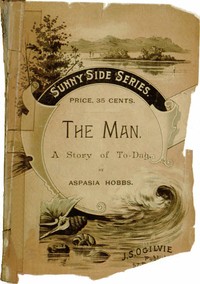
The Man: A Story of To-day
English450 downloads on Project GutenbergDownload EPUB
Public-domain ebook sourced from Project Gutenberg #52049.
Public-domain ebook
English450 downloads on Project GutenbergDownload EPUB
Public-domain ebook sourced from Project Gutenberg #52049.
The opening · free to read
Scene: A street corner in London, on one hand a gin palace, opposite a pawn shop--those two monsters who feed on the vitals of the poor--all about is abject wretchedness.
Locke stops, sighs and says, “Oh, this is so very unpoetic.” Sandy Mackaye replies, “What, man, no poetry here! Why, what is poetry but chapters lifted from the drama of life, and what is the drama if not the battle between man and circumstance, and shall not man eventually conquer? I will show you too in many a garret where no eye but that of the good God enters, the patience, the fortitude, the self-sacrifice and the love stronger than death, all flourishing while oppression and stupid ignorance are clawing at the door!”
But right will conquer, dearest, and the goodness that has never been weighed in the balances, nor tried in the fire, how do you know it is goodness at all? It may only be namby-pamby--wishy-washy--goody-goody, who knows? We are all in God’s hand, sister, and the bad is the stuff sent, on which to try our steel.
Sir:--I have received your letter warning me that if I use your name in a certain book of local history (said book entitled THE MAN) that you will cause my arrest for malicious libel, and also sue me for damages. To this I can only say that the book is now in the hands of the electrotypers, and I am not inclined to change a line in it, on your suggestion, even if I could. Please believe me, when I say, that I bear you no ill-will and have no desire to injure you or place you in a wrong light before the public, what I have written being but truth penned without exaggeration or coloring. I make no apology or excuse. What I have written I have written.
Sir:--Your registered letter of June 30th, received, wherein you state that you have no further use for my services, and that whereas you generally give an employee a letter of recommendation when you discharge them, yet in my case you cannot do so.
Although I have made no request for such recommendation, I regret your conscience will not allow you to supply it.
You remember the scene of five years ago in your office? No one knows a word of this, and never will, unless you tell it (which I hardly think you care to do). You swore then you would get even with me--is your vengeance now satisfied?
I have no malice toward you--I cannot afford to have against anyone--although I must say that your action in deducting from my wages the price of one set of false teeth purchased from Dr. Poole is not exactly right. You know, Mr. Bilkson, you lost those teeth purely through accident and no one regretted the occurrence more than I. With best wishes for the continued prosperity of Hustler & Co., I remain,
What I have to write is of such great value, the circumstances so peculiar, the record so strange, and the truths so startling, that it is but proper I should explain who and what I am, in order that any person, so disposed, may fully verify for himself the things I am about to relate.
Just at that most quiet hour of all the twenty-four, in the city, on a summer’s morning, when the darkness is stubbornly giving way to daylight, there came a violent ring at Mr. Hobbs’ door-bell, followed up with what seemed to be quite an unnecessary knocking.
Mr. Hobbs was interested in an elevator, and when he heard that ring he was sure the elevator had burned--in fact, he had a presentiment that such would be the case; besides this, Mr. Hobbs always carried a goodly assortment of fears ready to use at any moment.
“There, didn’t I tell you!” he excitedly exclaimed to his wife, as he rushed down the stairs--he hadn’t told his wife anything, just bottled up his fears in his own bosom and let them ferment, but that made no difference--“Didn’t I tell you!” and he hastily unlocked and opened the door. No one there!
He looked up the street and down the street. Nothing but a clothes-basket, covered over with a threadbare shawl, which evidently a long time ago had been a costly one. Mr. Hobbs expected a messenger with bad news and Mr. Hobbs was disappointed, in fact was mad; and he snatched that shawl from the basket, staggered against the door, and a voice, like unto that of a young and lusty bull, went up the stairway where Mrs. Hobbs stood peering over the banisters:
“Maria, for God’s sake come quick! There’s something awful happened! Quick, will you!”
Mrs. Hobbs was not very brave, but curiosity often reinforces courage; so the good lady came down the stairs two steps at a time, and stood by the side of her liege, who had got his breath by this time and stood peering over the basket.
And there they stood together, all in white, with bare feet, on the front porch, and nearly broad daylight.
In the basket, all wrapped up in dainty flannel, smiling, cooing and kicking up its heels, lay a baby--well, perhaps two months old, and on a card written with pencil were these words:
“_God knows._”
Mr. and Mrs. Hobbs had no children, and they each looked upon this as a gift from providence--basket and all. They cared for the waif as their own child, and if their reward does not come in this life, I am sure it will in another.
“Her name shall be Aspasia Hobbs, for I always said my first girl (Mr. and Mrs. Hobbs had been married five years, and had no children, but the babies were already named; which, I am told, is the usual custom) should be named Aspasia, after your mother, dear,” said Mrs. Hobbs.
And Aspasia Hobbs it was, and is yet: and I am Aspasia Hobbs: and Mr. and Mrs. Hobbs are the only parents I have ever known.
I am now an old maid, aged thirty-seven (I must tell the truth). I am homely and angular, and can pass along the street without a man turning to look at me. From five years’ constant pounding on a caligraph my hands have grown large and my knuckles and the ends of my fingers are like knobs. I can walk twenty miles a day, or ride a wheel fifty.
The bishop of Western New York, in a sermon preached recently, said riding bicycles is “unladylike” (and so is good health for that matter)--but if the good bishop would lay aside prejudice and robe and mount a safety, he could still show men the right way as well as now--possibly better, who knows?
But, in the language of Spartacus, “I was not always thus.” Thank Heaven, I am strong and well! They used to say, “She is such a delicate, sensitive child, we can not keep her without we take very, v-e-r-y good care of her.” Some fool has said that hundreds of people die every year because they have such “very good care.”
My father was a member of the firm of Hobbs, Nobbs & Porcine, was a Board of Trade man, and, therefore, had no time to give to his children; but he was a good provider, as the old ladies say, and used to remind us of it quite often. “Don’t I get you everything you need?” he once roared at my mother, when she hinted that an evening home once in a while would not be out of place. “Here you have an up-stairs girl, a cook, a laundress, a coachman, a gardener, a tutor for Aspasia, and don’t I pay Doctor Bolus just five hundred dollars a year to call here every week and examine you all so as to keep you healthy? Great Scott, the ingratitude of woman! they are getting worse and worse every day!”
My father was a good man--that is he was not bad, so he must have been good. He never used tobacco, and I never heard him swear but once, and that was when Professor Connors brought in a bill reading:
“Debtor, to calisthenics for wife and daughter, $50.”
“I’ll pay it,” said my father grimly, “but I will deduct it from Bolus’ check, for you say it’s for the health and therefore it belongs to Bolus’ department and he should have furnished the goods.”
We lived on Delaware avenue, in one of the finest houses, which my father bought and had furnished throughout before my mother or any one of us were allowed to enter. He was a good man, and wanted to astonish--that is to say, surprise us. So one Saturday night, at dinner, he said,
“On Monday, my dears, we will leave this old Michigan street for a house on the ‘Avenue.’ I have given up our pew in Grace Church, and to-morrow, and hereafter, Rev. Fred. C. Inglehart and Delaware avenue are plenty good enough for us.”
Our family have the finest monument in Forest Lawn, and father assured us that if Methusalah was now a boy this monument would be new when his great grandchildren died of old age. He waxed enthusiastic, and added, as he lapsed into reverie,
“It’s a regular James Dandy, and knocks out Rodgers and Jowette in one round.”
I am a graduate of Dr. Chesterfield’s academy, and also of the high-school. I have studied music with Mr. McNerney and Senor Nuno, elocution with Steele Mackaye; and father once offered to wager Mr. Porcine that “Aspasia could do up any girl on the avenue or Franklin street at the piano.”
I was a rich (alleged) man’s daughter, and as I had a managing mamma and went in society I had the usual love (how that word is abused!) experiences. I am not writing an autobiography, but merely telling what is absolutely necessary for you to know of me; otherwise, I would relate some insipid mush about flirtations with several gilded youths, who waltzed delightfully and made love abominably--just as if a man could make love! But suffice it to say, I never, in those old days, met a man I could not part with and feel relieved when he had taken his “darby” and slender cane and hied him down the steps. Mamma said I was heartless and didn’t know a good chance when I saw it.
One little affair of the pocket-book--that is, I mean of the heart--might be mentioned. A certain attorney, Pygmalion Woodbur by name--old Buffalonians know him well--paid his respects to me in an uneasy and stilted fashion. He was ten years my senior, had a monster yellow moustache generally colored black, which he combed down over the cavern in his face. He dressed in the latest, and was looked upon as a great catch. How these old bachelor men-about-town are lionized by a certain set of women!
He called several times, invited himself to dinner, took mamma riding and threw out side glances--grimaces--in my direction. One fine evening I sat reading in the parlor, alone, and in walked Mr. Woodbur and began about thusly:
“Aspasia--I may call you by your first name, now can’t I?--and you must call me Pyggie, for short. I have just spoken to your father and he says it’s all right,” etcetera, etcetera, etcetera.
He slid off from the sofa on his knees, and seized my left hand and kissed it violently.
Fair lady, have you ever been kissed with a rush, by a man with a large yellow moustache colored black? Well it’s just like being jabbed with a paint brush!
Now, after his poorly memorized speech had been delivered, and I had jerked my hand away, there was a pause. I tried to laugh and I tried to cry; then I tried to faint, and was too mad to do either; so I just inwardly raged and then came the explosion--
The book keeps going
Reading is free forever. Sign up and watch scenes appear while you read.



Scenes Storieta drew for other classics.
New illustrated classics
Once or twice a month: the latest books to get full character casts, scene art, and free comic editions. No account needed.