Public-domain ebook
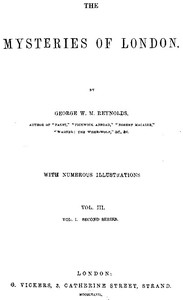
The Mysteries of London, v. 3/4
Language: en489 downloads on Project Gutenberg
Subjects
In: Crime, Thrillers and Mystery·Novels·British Literature
Public-domain ebook sourced from Project Gutenberg #52056.
Public-domain ebook
Language: en489 downloads on Project Gutenberg
Subjects
In: Crime, Thrillers and Mystery·Novels·British Literature
Public-domain ebook sourced from Project Gutenberg #52056.
The opening · free to read
It was about nine o'clock in the evening of the 2nd of November, 1826, that a travelling-carriage stopped, on its way to London, to change horses at the principal hotel in the little town of Staines.
The inmates of the vehicle were two ladies:—an elderly domestic in livery and a female attendant occupied the box.
The night was clear, fine, and frosty: the moon shone brightly; and the carriage lamps threw a strong glare to a considerable distance in front of the vehicle.
The active ostlers speedily unharnessed the four wearied steeds, and substituted as many fresh ones in their place: the two postboys leapt into their saddles; the landlord cried "All right!"—and the carriage rolled rapidly away from the inn, the horses' shoes striking fire against the stones.
"If there be any thing particularly calculated to raise the spirits," said one lady to the other, a few minutes after the chariot had left the peaceful town behind, "it is travelling upon such a beauteous night as this."
"I am delighted to observe that you are in good spirits this evening, my dear Lady Hatfield," was the reply. "After passing four long months at Sir Ralph Walsingham's country seat, London will present fresh attractions for your ladyship."
"My dear Miss Mordaunt," returned Lady Hatfield, in a serious tone, "you are aware that I am indifferent to those formal parties and ceremonial assemblies which are reckoned amongst the pleasures of the fashionable world; and I can assure you that had not my uncle purported to return to London in a few days, my own inclinations would have urged me to prolong my stay at Walsingham Manor."
"For my part," said Miss Mordaunt, "I am quite delighted with the idea of hastening back to the great metropolis. A summer in the country is only tolerable because each day brings one nearer to the enjoyments of a winter in town. But really, my dear Lady Hatfield, you are not reasonable. Rich, young, and beautiful as you are—your own mistress—and with the handsomest man in England dying to lay his coronet at your feet——"
"I shall never marry, Julia," hastily interrupted Lady Hatfield. "Pray let us change the conversation. A few minutes ago I was in excellent spirits; and now——"
She paused—and a deep sigh escaped her bosom.
"Did I not say that you were quite unreasonable?" exclaimed her companion. "Here am I—five years older than yourself,—for I do not mind telling you, my dear friend, that I shall never see thirty again;—and yet I have not renounced the idea of changing my condition. I know that I am neither so good-looking nor so wealthy as you;—still I have my little ambition. Sir Christopher Blunt would deem himself honoured were I to smile graciously upon him; but my brother, the lieutenant—who, by the by, expects his captaincy in a few days, thanks to the interest of your kind uncle Sir Ralph—declares that if ever I marry a mere knight, he will never speak to me again."
Lady Hatfield had fallen into a profound reverie, and paid not the slightest regard to the confidential outpourings of her garrulous companion.
Miss Mordaunt, who laboured under the pleasing impression that Lady Hatfield's silence was occasioned by the deep interest which she took in the present topic, continued to rattle away with her tongue as fast as the carriage did with its wheels.
"I am sure it was a very great act of kindness in you to ask me to spend the winter with you in London; for as papa is compelled to reside in Ireland, in consequence of the unsettled state of his tenantry, I should have been under the necessity of returning to the Emerald Isle, after my four months' visit with you to Walsingham Manor, had you not taken that compassion on me. But let us speak of yourself, dear Lady Hatfield. Without a soul in the world to control your actions—with the means of procuring every enjoyment—and with Lord Ellingham going mad on your account——"
"Julia," said Lady Hatfield, with a start,—"again I beseech you to drop this subject. And, as you will be my companion for some months to come, let me now, once for all, enjoin you to abstain from such topics. As you cannot read the secrets of my heart, pray bear in mind the fact that many a light word uttered thoughtlessly and with no malicious intent, may touch a chord that will thrill," she added calmly, but bitterly, "to the inmost recesses of my soul."
"Oh! my dear Lady Hatfield," exclaimed Miss Mordaunt, who, in spite of her loquacity, was a very good-natured person, "I am rejoiced that you have given me this warning. And how foolish of me not to have observed—what indeed I now remember—that the topic of Love never was agreeable to you. To be sure! it was during the sermon upon the felicity of the wedded state, that you fainted and were taken into the vestry!"
Lady Hatfield writhed in mental agony; and bitterly at that moment did she repent the invitation which she had given her thoughtless companion to pass the winter with her in London.
The carriage had now reached the little town of Bedfont, which it traversed without stopping; and continued its rapid way towards Hounslow.
But all of a sudden the course of the chariot was checked—as if by an unexpected impediment in the way; and the horses began to plunge frightfully.
At the same time the lady's-maid on the box uttered a dreadful scream.
Lady Hatfield drew down the window nearest to her: the chaise that moment came to a full stop; and a stern, but evidently disguised voice exclaimed, "Keep your horses quiet, you damned fools—and don't mind me! If you stir till I give you leave, I'll blow out the brains of both of you."
"Robbers!" shrieked Miss Mordaunt in a despairing tone: "Oh! what will become of us?"
Lady Hatfield looked from the window; and at the same instant a man, mounted on horseback, with a black mask over his countenance, and a pistol in each hand, was by the side of the vehicle.
"Villain!" cried the livery-servant on the box. "But you shall swing for this!"
"Perhaps I may," said the highwayman, coolly, though still speaking in a feigned tone, as is the custom with individuals of his profession upon such occasions as the one we are describing: "and if you attempt to move, old fellow, from where you are, an ounce of lead shall tumble you down from your perch. Beg pardon, ma'am," continued the robber, turning towards Lady Hatfield, who had shrunk back into the corner of the carriage the moment the desperado appeared at the window; "sorry to inconvenience you; but—your purse!"
Lady Hatfield handed the highwayman her reticule.
"Good!" said he, perceiving by its weight and a certain jingling sound which it sent forth, that it contained gold. "But you have a companion, ma'am—_her_ purse!"
Miss Mordaunt complied with this demand, and implored the "good gentleman" not to murder her.
The highwayman gave no reply; but vouchsafed a most satisfactory proof of his intended forbearance in that respect, by putting spurs to his steed, and darting off like an arrow in the direction of Hounslow.
"Cowardly villains that you are!" ejaculated the livery-servant, hurling this reproach against the postboys.
"And what are you, old fool?" cried the postillion who rode the wheel-horse. "But he'll be nabbed yet."
"Drive on—drive on!" exclaimed Lady Hatfield from the window. "We are all frightened—and not hurt."
"Indeed, my dear," said Miss Mordaunt, as the carriage started off rapidly once more, "I am seriously hurt—grievously wounded!"
"You, Julia!" cried her ladyship, in unfeigned surprise.
"Yes—in pocket," was the answer, implying deep vexation. "All the remainder of my quarter's allowance——"
"Oh! compose yourself on that head," interrupted Lady Hatfield. "You shall not be compelled to acquaint Mr. Mordaunt with your loss."
This assurance, conveying a promise of pecuniary assistance, materially tended to tranquillise the mind of Miss Mordaunt; but the event which had just occurred—apart from the mere robbery of her reticule—awoke the most painful reflections in the mind of Lady Hatfield.
"By the by," said Miss Mordaunt, after a short pause—for she never remained long silent,—"this audacious outrage reminds me of something your uncle Sir Ralph Walsingham was telling me one day, when you interrupted him in the middle. I think he informed me that about six or seven years ago—when you were only eighteen or nineteen—you were staying at your dear lamented father's country-house, where you were quite alone—for of course one does not call the servants anybody; when the mansion was broken into by robbers during the night——"
"Julia!" exclaimed Lady Hatfield, her whole frame fearfully convulsed by the powerful though useless efforts which she made to subdue her agitation: "never, I implore you, again allude to that dreadful event!"
"Well—I never will," said Miss Mordaunt. "And yet, if one must not speak of Love—nor yet of marriage—nor yet of midnight burglaries——"
The book keeps going
Reading is free forever. Sign up and watch scenes appear while you read.



Scenes Storieta drew for other classics.
New illustrated classics
Once or twice a month: the latest books to get full character casts, scene art, and free comic editions. No account needed.