Public-domain ebook
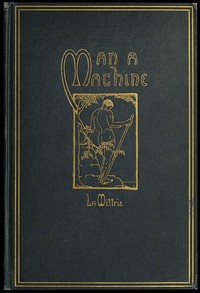
Man a Machine
by Julien Offray de La Mettrie
Language: en1,787 downloads on Project Gutenberg
Subjects
Public-domain ebook sourced from Project Gutenberg #52090.
Public-domain ebook
by Julien Offray de La Mettrie
Language: en1,787 downloads on Project Gutenberg
Subjects
Public-domain ebook sourced from Project Gutenberg #52090.
Man a Machine is the 1748 French work of Julien Offray de La Mettrie, a physician‑philosopher whose life unfolded amid the turbulence of eighteenth‑century Europe. The volume reproduces the original Leyden title page and follows the French paragraphing, while a team of scholars, including Gertrude C. Bussey, M. W. Calkins, and George Santayana, has supplied an English translation that strives to preserve La Mettrie’s precise meaning even when it clashes with English syntax. The opening passages trace La Mettrie’s education, his medical career, and the series of controversies that forced him from France to Leyden and finally Berlin, setting the stage for his bold claim that the human soul is nothing more than a material mechanism. The text thus combines biographical sketch, polemic against religious and academic orthodoxy, and the groundwork for his materialist doctrine.
The voice is that of an Enlightenment polemicist, dense with rhetorical flourishes, historical digressions, and a fervent belief in the power of reason over faith. Its style reflects the scholarly French of the mid‑1700s, filtered through a careful, sometimes literal, English rendering that retains the original’s cadence and occasional grammatical quirks. Readers who relish the history of ideas, especially the early debates on mind‑body dualism, and who appreciate a blend of medical autobiography with philosophical argument, will find La Mettrie’s vigorous, if occasionally polemical, prose rewarding.
The opening · free to read
PREFACE.
The French text presented in this volume is taken from that of a Leyden edition of 1748, in other words, from that of an edition published in the year and in the place of issue of the first edition. The title page of this edition is reproduced in the present volume. The original was evidently the work of a Dutch compositor unschooled in the French language, and is full of imperfections, inconsistencies, and grammatical blunders. By the direction of the publishers these obviously typographical blunders have been corrected by M. Lucien Arréat of Paris.
The translation is the work of several hands. It is founded on a version made by Miss Gertrude C. Bussey (from the French text in the edition of J. Assezat) and has been revised by Professor M. W. Calkins who is responsible for it in its present form. Mademoiselle M. Carret, of the Wellesley College department of French, and Professor George Santayana, of Harvard University, have given valued assistance; and this opportunity is taken to acknowledge their kindness in solving the problems of interpretation which have been submitted to them. It should be added that the translation sometimes subordinates the claims of English structure and style in the effort to render La Mettrie's meaning exactly. The paragraphing of the French is usually followed, but the italics and the capitals are not reproduced. The page-headings of the translation refer back to the pages of the French text; and a few words inserted by the translators are enclosed in brackets.
The philosophical and historical Notes are condensed and adapted from a master's thesis on La Mettrie presented by Miss Bussey to the faculty of Wellesley College.
FREDERIC THE GREAT'S EULOGY ON JULIEN OFFRAY DE LA METTRIE.
Julien Offray de la Mettrie was born in Saint Malo, on the twenty-fifth of December, 1709, to Julien Offray de la Mettrie and Marie Gaudron, who were living by a trade large enough to provide a good education for their son. They sent him to the college of Coutance to study the humanities; he went from there to Paris, to the college of Plessis; he studied his rhetoric at Caen, and since he had much genius and imagination, he won all the prizes for eloquence. He was a born orator, and was passionately fond of poetry and belles-lettres, but his father thought that he would earn more as an ecclesiastic than as a poet, and destined him for the church. He sent him, the following year, to the college of Plessis where he studied logic under M. Cordier, who was more a Jansenist than a logician.
It is characteristic of an ardent imagination to seize forcefully the objects presented to it, as it is characteristic of youth to be prejudiced in favor of the first opinions that are inculcated. Any other scholar would have adopted the opinions of his teacher but that was not enough for young La Mettrie; he became a Jansenist, and wrote a work which had great vogue in that party.
In 1725, he studied natural philosophy at the college of Harcourt, and made great progress there. On his return to Brittany, M. Hunault, a doctor of Saint Malo, had advised him to adopt the medical profession. They had persuaded his father, assuring him that a mediocre physician would be better paid for his remedies than a good priest for absolutions. At first young La Mettrie had applied himself to the study of anatomy: for two years he had worked at the dissecting-table. After this, in 1725, he took the degree of doctor at Rheims, and was there received as a physician.
In 1733, he went to Leyden to study under the famous Boerhaave. The master was worthy of the scholar and the scholar soon made himself worthy of the master. M. La Mettrie devoted all the acuteness of his mind to the knowledge and to the healing of human infirmities; and he soon became a great physician.
In the year 1734, during his leisure moments, he translated a treatise of the late M. Boerhaave, his Aphrodisiacus, and joined to it a dissertation on venereal maladies, of which he himself was the author. The old physicians in France rose up against a scholar who affronted them by knowing as much as they. One of the most celebrated doctors of Paris did him the honor of criticizing his work (a sure proof that it was good). La Mettrie replied; and, to confound his adversary still more, he composed in 1736 a treatise on vertigo, esteemed by all impartial physicians.
By an unfortunate effect of human imperfection a certain base jealousy has come to be one of the characteristics of men of letters. This feeling incites those who have reputations, to oppose the progress of budding geniuses. This blight often fastens on talents without destroying them, but it sometimes injures them. M. La Mettrie, who was advancing in the career of science at a giant's pace, suffered from this jealousy, and his quick temper made him too susceptible to it.
In Saint Malo, he translated the "Aphorisms" of Boerhaave, the "Materia Medica," the "Chemical Proceedings," the "Chemical Theory," and the "Institutions," by this same author. About the same time, he published an abstract of Sydenham. The young doctor had learned by premature experience, that if he wished to live in peace, it was better to translate than to compose; but it is characteristic of genius to escape from reflection. Counting on himself alone, if I may speak thus, and filled with the knowledge he had gained from his infinitely skilful researches into nature, he wished to communicate to the public the useful discoveries he had made. He published his treatise on smallpox, his "Practical Medicine," and six volumes of commentary on the physiology of Boerhaave. All these works appeared at Paris, although the author had written them at Saint Malo. He joined to the theory of his art an always successful practice, which is no small recommendation for a physician.
In 1742, La Mettrie came to Paris, led there by the death of M. Hunault, his old teacher. Morand and Sidobre introduced him to the Duke of Gramont, who, a few days after, obtained for him the commission of physician of the guards. He accompanied the Duke to war, and was with him at the battle of Dettingen, at the siege of Freiburg, and at the battle of Fontenoy, where he lost his patron, who was killed by a cannon shot.
La Mettrie felt this loss all the more keenly, because it was at the same time the reef on which his fortune was wrecked. This is what happened. During the campaign of Freiburg, La Mettrie had an attack of violent fever. For a philosopher an illness is a school of physiology; he believed that he could clearly see that thought is but a consequence of the organization of the machine, and that the disturbance of the springs has considerable influence on that part of us which the metaphysicians call soul. Filled with these ideas during his convalescence, he boldly bore the torch of experience into the night of metaphysics; he tried to explain by the aid of anatomy the thin texture of understanding, and he found only mechanism where others had supposed an essence superior to matter. He had his philosophic conjectures printed under the title of "The Natural History of the Soul." The chaplain of the regiment sounded the tocsin against him, and at first sight all the devotees cried out against him.
The common ecclesiastic is like Don Quixote, who found marvelous adventures in commonplace events, or like the famous soldier, so engrossed with his system that he found columns in all the books he read. The majority of priests examine all works of literature as if they were treatises on theology, and filled with this one aim, they discover heresies everywhere. To this fact are due very many false judgments and very many accusations, for the most part unfair, against the authors. A book of physics should be read in the spirit of a physicist; nature, the truth, is its sole judge, and should absolve or condemn it. A book of astronomy should be read in the same manner. If a poor physician proves that the blow of a stick smartly rapped on the skull disturbs the mind, or that at a certain degree of heat reason wanders, one must either prove the contrary or keep quiet. If a skilful astronomer proves, in spite of Joshua, that the earth and all the celestial globes revolve around the sun, one must either calculate better than he, or admit that the earth revolves.
But the theologians, who, by their continual apprehension, might make the weak believe that their cause is bad, are not troubled by such a small matter. They insisted on finding seeds of heresy in a work dealing with physics. The author underwent a frightful persecution, and the priests claimed that a doctor accused of heresy could not cure the French guards.
To the hatred of the devotees was joined that of his rivals for glory. This was rekindled by a work of La Mettrie's entitled "The Politics of Physicians." A man full of cunning, and carried away by ambition, aspired to the place, then vacant, of first physician to the king of France. He thought that he could gain it by heaping ridicule upon those of his contemporaries who might lay claim to this position. He wrote a libel against them, and abusing the easy friendship of La Mettrie, he enticed him to lend to it the volubility of his pen, and the richness of his imagination. Nothing more was needed to complete the downfall of a man little known, against whom were all appearances, and whose only protection was his merit.
For having been too sincere as a philosopher and too obliging as a friend, La Mettrie was compelled to leave his country. The Duke of Duras and the Viscount of Chaila advised him to flee from the hatred of the priests and the revenge of the physicians. Therefore, in 1746, he left the hospitals of the army where he had been placed by M. Sechelles, and came to Leyden to philosophize in peace. He there composed his "Penelope," a polemical work against the physicians in which, after the fashion of Democritus, he made fun of the vanity of his profession. The curious result was that the doctors themselves, though their quackery was painted in true colors, could not help laughing when they read it, and that is a sure sign that they had found more wit than malice in it.
M. La Mettrie after losing sight of his hospitals and his patients, gave himself up completely to speculative philosophy; he wrote his "Man a Machine" or rather he put on paper some vigorous thoughts about materialism, which he doubtless planned to rewrite. This work, which was bound to displease men who by their position are declared enemies of the progress of human reason, roused all the priests of Leyden against its author. Calvinists, Catholics and Lutherans forgot for the time that consubstantiation, free will, mass for the dead, and the infallibility of the pope divided them: they all united again to persecute a philosopher who had the additional misfortune of being French, at a time when that monarchy was waging a successful war against their High Powers.
The title of philosopher and the reputation of being unfortunate were enough to procure for La Mettrie a refuge in Prussia with a pension from the king. He came to Berlin in the month of February in the year 1748; he was there received as a member of the Royal Academy of Science. Medicine reclaimed him from metaphysics, and he wrote a treatise on dysentery, another on asthma, the best that had then been written on these cruel diseases. He sketched works on certain philosophical subjects which he had proposed to look into. By a sequence of accidents which befell him these works were stolen, but he demanded their suppression as soon as they appeared.
The book keeps going
Reading is free forever. Sign up and watch scenes appear while you read.



Scenes Storieta drew for other classics.
New illustrated classics
Once or twice a month: the latest books to get full character casts, scene art, and free comic editions. No account needed.