We have already pointed out the simplicity of outline observable in old English cottages, and the absence of exaggeration and that disagreeable fussiness brought about by too much striving after the picturesque. It must not, however, from this be concluded that ancient village buildings are always plain and do not at times possess elegant ornamentation and graceful details.
The general outline, however, is always simple and quiet, for, as will be seen by the examples we give (two of the most elaborate cottages in England), the roof lines are very little broken up or varied.
The first of these buildings is at Clare in Suffolk, and the second is at Newport in Essex, the latter being one of the richest counties in England for cottage architecture, many of its villages retaining quite a mediæval aspect down to the present time.
We will now say a few words upon the methods of applying ornamental detail to cottages adopted in mediæval times, and we shall commence with those structures erected in "Post-and-pan" construction. We trust that our readers have not forgotten what is meant by the ugly-sounding expression "Post-and-pan," and regret that we are quite unable to discover or invent some more elegant name for this description of building. Some years back a number of architects and archæologists were examined before a parliamentary commission. The commission objected to the words "Post-and-pan" being used in their report, and suggested to the witnesses that they should find some more scientific expression for this kind of work! It was found, however, impossible to invent any one which conveyed the idea so concisely and satisfactorily, so the old-fashioned name "Post-and-pan" received parliamentary sanction! This being the case, our girls need not scruple to use it, and may it not, after all, be as valuable for the formation of the lips as the "prunes" and "prism" of Little Dorritt?
There are several ways of applying ornamentation to "Post-and-pan" buildings. The first is to add mouldings, tracery or carving, to the doorways, windows, cornices, corbels and other constructive parts of the building.
The second is to arrange the "posts" in patterns by introducing curved beams amongst them, or other woodwork, forming a kind of tracery pattern.
The third is to adorn the "pans" (panels) either with stamped plaster-work called "pargeting," or with coloured plaster-work, or wood-carving.
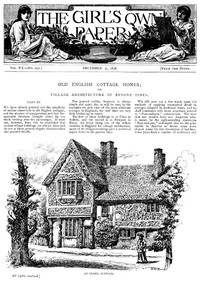
The first of these methods is seen in the beautiful example which we have sketched at Newport in Essex: here it will be noticed that the bow window of the upper storey is adorned with wood tracery, and its corbel richly carved with figure subjects, all executed in oak. The "spurs," as they are called, which carry the projection of the upper storey, are richly moulded and rest upon elegant little colonnettes. The pans are filled in with brickwork laid in herring-bone patterns. The centre of the building is recessed back, but in order to preserve the severe and simple lines of the roof, the latter does not follow the line of the recess, but is supported upon an arched beam, from the centre of which projects a lifting-crane, a treatment quite peculiar to the home counties and the south of England.
Of course this building is far more elaborate than most cottages, and the tradition of the place accounts for this by the supposition that it was formerly the dwelling of a farm bailiff to the Abbot of Westminster.
The beautiful little village of Newport has several examples of interesting domestic work and a very noble church.
The building which we illustrate dates from the 15th century, and is still in excellent repair though not in any way restored.
The very elaborate cottage represented in our first sketch is an excellent example of pargeting, the surface of the pans being covered by a rich kind of shawl-pattern executed in hard plaster, like the Newport example. The constructive portions of the building are elaborately treated. We are unable to account for the amount of elaboration bestowed on this cottage, but as it is close to the church, which is a very handsome building and liberally endowed with chantries, it is very probable that this may have been the dwelling of one of the chantry priests.
Clare was an important place in the Middle Ages and possessed a castle, remains of which are still to be seen. Richard Strongbow, the Conqueror of Ireland, is said to have lived in it.
The Manor of Clare in later times belonged to Edmund Mortimer, Earl of March. There was also a priory here, built in 1248 by Richard, Earl of Gloucester.
A very curious poem exists in the form of a dialogue, "betwixt a secular askyng and a frere answering at the grave of Dame Johan of Acris" (of Clare). It is a quaint example of Old English and begins in rather a curious manner.
Q. "What man lyeth here, sey me, Sir Frere?"
A. "No man."
Q. "What ellis?"
A. "It is a woman."
Then follows her pedigree all in rhyme, from which it appears that she was a daughter of King Edward I., and the remarkable circumstance is stated, that she was borne of her "moder"!
As the poem is about three pages long and all pretty much like the sample we have given, we will not inflict it upon our readers.
H. W. BREWER.
ABOUT PEGGY SAVILLE.
BY JESSIE MANSERGH (Mrs. G. de Horne Vaizey), Author of "Sisters Three," etc.
Peggy felt weak and shaken for some days after her fright, and was thankful to stay quietly indoors and busy herself with her new task. The gas fire could be turned on in her room whenever she desired, and at every spare moment she ran upstairs, locked her door behind her, and began to write. Robert insisted that the work should be kept secret, and that not a word should be said about the competition downstairs, for he was sensitive about the remarks of his companions, and anxious to keep a possible failure to himself. All the work had to be done upstairs therefore, and the frequent absence of the partners from the schoolroom, though much regretted, did not seem at all inexplicable to the others. It was understood that Peggy and Robert had some interest in common, but as winter advanced this was no unusual occurrence in a house where Christmas was a carnival, and surprises of an elaborate nature were planned by every member of the household. It was taken for granted that the work had some connection with Christmas, and inquiries were discreetly avoided.
With an old calendar before her as a model for the lettering, Peggy did her work neatly and well, and the gilt "arabesques" had an artistic flourish which was quite professional. When Robert was shown the first half-dozen sheets he whistled with surprise, and exclaimed, "Good old Mariquita!" a burst of approval before which Peggy glowed with delight. It had been agreed that, after printing the first ten days of January, Peggy should go on to the first ten of February, and so on throughout the year, so that Rob should be able to use what quotations had already been found under each heading, and should not be detained until the whole thirty or thirty-one had been chosen.
The partners were most fastidious in their selection at the beginning of their work, but when half the time had passed and not one-third of the necessary number of quotations had been found, alarm seized upon the camp, and it was realised that a little more latitude must be shown.
"We shall have to use up all the old ones which we struck off the list," said Rob disconsolately. "I'm sorry; but I never realised before that three hundred and sixty-five was such an outrageously large number. And we shall have to get books of extracts and read them through from beginning to end. Nearly two hundred more to find; a hundred and fifty, say, when we have used up those old ones! It will take us all our time!"
"I'll get up at six every morning and read by my fire," said Peggy firmly. "If it's necessary I'll get up at five, and if I can't find bits to suit all the stupid old things, I'll--I'll write some myself! There! Why shouldn't I? I often make up things in my head, and you wouldn't believe how fine they are. I think of them days afterwards, and ask myself, 'Now where did I read that?' and then it comes back to me. 'Dear me; I made it up myself!' If we get very short, Rob, there wouldn't be any harm in writing a few sentences and signing them 'Saville,' would there?"
"Not if they were good enough," said Rob, trying to suppress the laugh which would have hurt Peggy's feelings, and looking with twinkling eyes at the little figure by his side, so comically unprofessional, with her lace collar, dainty little feet, and pigtail of dark brown hair. "You mustn't get up too early in the morning and overtire yourself. I can't allow that!" he added firmly. "You have looked like a little white ghost the last few days, and your face is about the size of my hand. You must get some colour into your cheeks before the holidays, or that beloved Arthur will think we have been ill-treating you when he comes down."
Peggy gave a sharp little sigh and relapsed into silence. It was the rarest thing in the world to hear her allude to any of her own people. When a letter arrived, and Mrs. Asplin asked questions concerning father, mother, or brother, she answered readily enough, but she never offered information, or voluntarily carried on the conversation. Friends less sympathetic might have imagined that she was so happy in her new home that she had no care beyond it, but no one in the Vicarage made that mistake. When the square Indian letter was handed to her across the breakfast table, the flush of delight on the pale cheeks brought a reflected smile to every face, and more than one pair of eyes watched her tenderly as she sat hugging the precious letter, waiting until the moment should come when she could rush upstairs and devour its contents in her own room. Once it had happened that mail day had arrived and brought no letter, and that had been a melancholy occasion. Mrs. Asplin had looked at one envelope after another, had read the addresses twice, thrice, even four times over before she summoned courage to tell of its absence.
"There is no letter for you to-day, Peggy!" Her voice was full of commiseration as she spoke, but Peggy sat in silence, her face stiffened, her head thrown back with an assumption of calm indifference. "There must have been some delay in the mail. You will have two letters next week, dearie, instead of one."
"Probably," said Peggy. Mellicent was staring at her with big, round eyes; the Vicar peered over the rim of his spectacles; Esther passed the marmalade with eager solicitude; her friends were all full of sympathy, but there was a "Touch-me-if-you-dare!" atmosphere about Peggy that day which silenced the words on their lip. It was evident that she preferred to be left alone, and though her eyes were red when she came down to lunch, she held her chin so high, and joined in the conversation with such an elegant flow of language, that no one dare comment on the fact. Two days later the letter arrived and all was sunshine again; but in spite of her cheery spirits, her friends realised that Peggy's heart was not in the vicarage, and that there were moments when the loneliness of her position pressed on her, and when she longed intensely for someone of her very own, whose place could not be taken by even the kindest of friends.