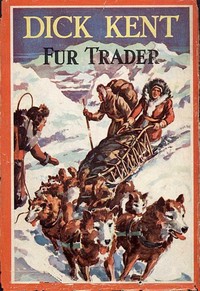
Dick Kent, bronzed by exposure to wind and sun, leaned over the rough pine table in the trading room of Factor MacClaren at Fort Good Faith and listened intently to the conversation being carried on at that particular moment between Murky Nichols, prospector and gentleman of parts, and Corporal Rand of the Mackenzie River detachment of the Royal North West Mounted Police. On the paper in front of them, torn from a convenient packing case, were a number of irregular lines, dots and scrawls, which had been placed there with the aid of the stub of a lead pencil, held awkwardly in the hands of the big prospector.
“I want to show yuh,” Nichols explained eagerly, “jus’ where I think ol’ Daddy McInnes crossed the Dominion Range. He travelled east an’ then south until he got to Placer Lake, goin’ through what the Indians call Blind Man’s Pass. There ain’t no other way he could o’ got through, sick an’ worn out like he was. That pass must come out on this side of the range somewhere near where yuh picked up his body.”
Corporal Rand drummed softly on the table and regarded Murky’s animated face with thoughtful interest.
“Sounds reasonable,” he commented. “In fact, that’s exactly the way I had it figured out myself. Blind Man’s Pass must be something more than a myth—a mere Indian legend. McInnes got through some way, travelling along a fairly well defined, not too difficult trail. No man can walk over Dominion Range, neither can he crawl under it. Yet McInnes came through. I have conclusive proof of that. But where is Blind Man’s Pass?”
“It’s there somewhere,” Nichols declared doggedly.
“Certainly. I agree with you, Murky.” The mounted policeman took the pencil from the prospector’s hand and drew a straight line near the center of the map. “This line,” he pointed out—Dick thought a little impatiently—“represents a distance of thirty miles. The country is rough, broken, almost inaccessible along its entire length. Somewhere within that thirty miles is a narrow opening, probably not more than fifty, a hundred or two hundred feet wide, which forms one end of what is called Blind Man’s Pass. Now how are you going to find it? There are a thousand different openings, all more or less alike. Attempt to follow any one of them, and you end up against a solid rock wall. You go back and start all over again somewhere else—and with the same result. I spent two weeks out there, going through the same stupid performance day after day. Only infinite patience or fool’s luck will lead you to the right opening.”
So interested had Dick Kent become that presently he crowded closer to the two men and began staring at the paper himself. Exactly what were they trying to do? What were they talking about? Who was McInnes, and why all this bother about a fabled trail through the mountains no one seemed to know anything about? He was interrupted in his train of thought by the next statement of the mounted policeman:
“McInnes had been dead more than a week when I found him. You could see the poor devil had been half-starved and had suffered every sort of hardship and privation. How he had managed to stagger along with that heavy load is more than I can imagine.”
“Too bad ol’ Daddy has passed,” Murky sighed regretfully. “I ’member seeing him one time ’bout three years ago over in the Goose Lake country. Might’ fine ol’ man he was, an’ a good trapper, folks said. Never failed to bring in a good catch ever’ spring—mostly fox, marten an’ beaver—an’ he got top prices ’cause he knew how to cure his fur—all prime, A-Number-1 stuff it was. He had a knack, almost amountin’ to genius for locatin’ black and cross fox an’ then gettin’ ’em to walk plump into his traps.” Nichols paused to gaze reminiscently out of the window and to smile to himself. “Couldn’t beat him that particular way, no, sir. A big catch ever’ year—fortune for most men; yet Daddy allers complained that he wa’n’t gettin’ nothin’ atall, that he was either gonna quit or cross the Dominion Range, where trappin’ was a hull lot better.”
“You’re right about the black fox skins,” remarked Corporal Rand, pushing the paper aside. “In the pack I found beside the body, there were eight of the shiniest, loveliest black pelts I’ve ever looked upon.”
“An’ he came through Blind Man’s Pass,” mused Murky. “The clever ol’ coot. Too bad he didn’t live to tell about it.”
Dick had edged still closer. His eyes were shining with interest. He reached over and touched the sleeve of the corporal’s scarlet tunic.
“Pardon me, Corporal Rand—but I’ve been eavesdropping. You don’t mind, I hope.”
The mounted policeman turned quickly and smiled into the eager face.
“Certainly not, you’re welcome to any information or nonsense you may have heard. Isn’t that the truth, Murky?”
“It sure is.”
“And may I ask you a question?” Dick persisted.
“Yes,” smiled Rand.
“What is Blind Man’s Pass?”
“A reality or a legend—I’m not sure which. Outside of Daddy McInnes I’d say it was a legend. We used to laugh at the old tales about it. The Indians claimed that years and years ago one of their ancestors had discovered a long, narrow pass or defile that cut Dominion range somewhere due west of here. In 1895 a party of mounted police explorers investigated the story by making a very careful, painstaking search through all the country lying between Cauldron Lake and Summit River. Nothing came of it. The party decided that the tale was a myth. Blind Man’s Pass was, until a few weeks ago, a bye-word among all the white men living in this section.”
Corporal Rand paused and favored Dick with a most engaging smile.
“And what about Daddy McInnes?” the young man inquired.
“I’ll give you the bald facts and you can draw your own conclusions. A little over a year ago Daddy McInnes left us. For years it had been his ambition to trap on the other side of the Dominion Range in what is commonly known as the Caribou Hills country. As the crow flies, Caribou Hills are less than three hundred miles away. It wouldn’t have been much of a journey if McInnes could have gone straight there, crossing the mountains. But, of course, he couldn’t. He chose instead the more sensible and longer route by way of the Yellowhead Pass, which, as you know, is many hundred miles south of here. It took Daddy the greater part of one summer to make the trip.”
Corporal Rand rose slowly to his feet and walked over to a window, gazing somberly out across a bleak, snow-streaked meadow that extended west and north to meet the encroaching woodland. He swung about presently, and continued:
“But Daddy came back. What motive prompted him, I have no way of finding out. All I know is that he did come back—but not by the Yellowhead route! I came upon his dead body less than a week ago. It was lying in a sheltered spot near a little knoll, less than a hundred yards from the banks of Run River. It was easy to determine the cause of his death. He died of starvation and exposure. McInnes is an old, old man and this last trip had proved too much for him.”
“And you don’t think that he had contrived somehow to cross over the range?” queried Dick.
“Absolutely, utterly impossible.”
“If he didn’t come by the Yellowhead route, or cross the mountains—”
“The only possible solution is Blind Man’s Pass,” interrupted Corporal Rand.
“But you can’t find it.”
“I haven’t yet. But I have every hope that we will in a very short time. The best scout and woodsman who ever enlisted in a service of the R. N. W. M. P. is out there now looking for it—a man called Malemute Slade.”
“Malemute Slade!” shouted Dick, clapping his hands in glee. “Why, corporal, I know him. He’s a friend of mine.”
“I’m glad to hear that. I knew that Slade was well acquainted with Factor MacClaren’s nephew, Sandy. Are you by any chance the Dick Kent, who accompanied Sandy last summer to Thunder River in search of a gold mine?”
“Yes,” answered Dick.
Corporal Rand laughed as he extended his hand.
“I guess that we’ll shake on that. The mounted police haven’t forgotten the incident. Time and time again, before a crackling fire, when we happened to meet on patrol, Sergeant Richardson entertained me with the history of your exploits.”
“We had a lot of trouble with the Henderson gang,” stated Dick.
“So I heard. Fortunately they’re wiped out. They were the worst band of outlaws that ever infested the North. By the way, what ever became of that young Indian lad, Toma, who used to accompany you on so many of your expeditions?”
“He’s out with Sandy right now on a hunting trip,” Dick replied. “I’m expecting them back today.”
Murky Nichols rose lazily, yawned, and stretched himself to his full length.