A COUNTRY BOY IN WINTER.
BY SARAH O. JEWETT.
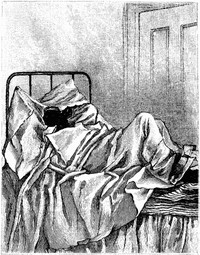
The wind may blow the snow about, For all I care, says Jack, And I don't mind how cold it grows, For then the ice won't crack. Old folks may shiver all day long, But I shall never freeze; What cares a jolly boy like me For winter days like these?
Far down the long snow-covered hills It is such fun to coast, So clear the road! the fastest sled There is in school I boast. The paint is pretty well worn off. But then I take the lead; A dandy sled's a loiterer, And I go in for speed.
When I go home at supper-time, Ki! but my cheeks are red! They burn and sting like anything; I'm cross until I'm fed. You ought to see the biscuit go, I am so hungry then; And old Aunt Polly says that boys Eat twice as much as men.
There's always something I can do To pass the time away; The dark comes quick in winter-time-- A short and stormy day. And when I give my mind to it, It's just as father says, I almost do a man's work now, And help him many ways.
I shall be glad when I grow up And get all through with school, I'll show them by-and-by that I Was not meant for a fool. I'll take the crops off this old farm, I'll do the best I can. A jolly boy like me won't be A dolt when he's a man.
I like to hear the old horse neigh Just as I come in sight, The oxen poke me with their horns To get their hay at night. Somehow the creatures seem like friends, And like to see me come. Some fellows talk about New York, But I shall stay at home.
TODD AND KETCHUM'S "GRATE SHOW."
BY ELLA RODMAN CHURCH.
Any one who is well acquainted with boys knows what a common thing it is for them to get up a circus. So there is nothing extraordinary in that to write about. But some of the things that happened at Todd and Ketchum's "Grate Show" were a little out of the common way.
One of these things was that the Giant fought and fell apart. How he managed to do it will be explained further on.
Rufus Todd was twelve, and Harry Ketchum eleven; but they felt very much grown up, because each was the eldest of several brothers and sisters, and the younger ones were always spoken of as "the children." Rufus's brother San (his name was Alexander, and it seemed too much of a name for so small a boy) always wanted to do the things he did; but Rufe was very apt to frown, and tell him he was too little.
When Todd and Ketchum were getting up their "Grate Show," Mr. Ketchum, Harry's father, said, "You don't spell it right."
"Oh yes, we do, sir," replied Rufe, who thought that Mr. Ketchum didn't know much about shows; "that is the way Artemus Ward spelled his."
Mr. Ketchum laughed, and said, "Oh, well, if you want to spell it just as Artemus does, that is all right."
He kindly helped them with the large handbill which they got ready to nail in front of the tent, and said that he thought it would attract crowds. It was to be hoped not, for the tent was a queer affair, made of sheets and quilts and unsteady poles, and it wouldn't take very much to topple it over. But they had no misgivings.
San Todd was sent around the village, which was a very small one, to ask people to buy tickets for the "Grate Show," as the proprietors thought it would be scarcely dignified to go themselves; and San, who was a very exact, straight-forward little fellow, thought it his duty to describe to the people just what they were going to see.
"We've got a Giant," he would say, "and a Dwarf, and a Bearded Lady, and a Elephant, and Rufe thinks he can make a wild Indian, mebbe."
The last part always made them laugh, and quite a number of tickets were disposed of.
One of San's first visits was made to Mrs. Williams, a lady who, with her daughter, was boarding for the summer at Dr. Gurner's. Miss Fanny was quite a grown-up young lady, and San said she was the nicest-looking girl he had ever seen; he particularly wanted her to come to the show.
But she had gone out for a walk; so the little boy saw Mrs. Williams, and asked her if she would let Miss Fanny come.
"Will you take good care of her if I do?" said the lady, smiling at him very pleasantly.
"Yes, ma'am," was the prompt reply; "she shall have a reserved seat, if she pays for it."
It did not occur to San that this was rather a queer way of inviting a young lady to go to an entertainment.
"And what is the price of a reserved seat?" continued Mrs. Williams.
"Eight cents," replied the young ticket seller. "You can see every thing there; and six cents for the next, where you don't see much; and four cents for the places where you can't see anything."
"I don't believe I can go," said Miss Fanny's mother, "but here is the money for a reserved seat for Fanny. Suppose, though, that she should be rather late--she is going to town to-morrow--wouldn't some one else get her seat?"
"No, ma'am!" very emphatically; "Miss Fanny'll have her seat, even if she don't come at all."
Mrs. Williams couldn't see just how this was to be managed; but she thought that to hear San in his capacity of ticket vender was quite worth the money.
The next afternoon was the day of the show, and the weather was bright and pleasant. A great many people came--so many, that they couldn't all get into the tent at once, and those who did get in were politely requested to move about carefully for fear of its coming down.
When the show began it was discovered that the Bearded Lady had a very youthful face, and in spite of the fringe of hair tied under her chin, and her sitting cross-legged upon a high box with a cushion on it, everybody soon recognized Susie Ketchum.
It was mean of people to say that the Dwarf was not small for his age, just because they saw it was Willie Todd dressed up, when he had a little pillow on his back for a hump, and all. And if the Elephant (Mr. Ketchum's hired man on his hands and knees, with a gray blanket thrown over him) did drop his trunk, it was only because it wasn't properly fastened on.
The Giant, though, was superb; he towered up to the very ceiling, and looked so fierce and terrible, with his swarthy skin and huge mustache, that, though the spectators thought they saw Rufe Todd's blue eyes twinkling in the upper story, they didn't dare to believe it. Besides, how could he have lengthened himself out so?
So they all just stared in amazement. But presently there were some queer movements about the middle of the human structure, and a smothered voice seemed to proceed from its stomach. Then there was an unmistakable "Get out!" a response of "You did that on purpose," and the Giant suddenly broke in two, while the halves took to hitting each other. The tent was dragged down with him; the children screamed, and everybody scrambled. But when they got out from the sheets and quilts, they all began to laugh, even the two pieces of the Giant, Rufe and Harry, who had found it more uncomfortable to be one than they expected.
Just at this time Miss Fanny arrived, and as soon as she saw San, she said, "And where is my reserved seat, young man?"
"That is all right," was the smiling reply; "nobody hasn't sat in it."
"Ladies and gentlemen," said Rufus, coming forward with a very handsome bow, "the circus is over."
"That is very evident," replied Miss Fanny, laughing with the others; and San considered it quite a compliment that she said it was the funniest circus she ever saw.
Nobody could have been so unfeeling as to remark she hadn't seen it at all.