Public-domain ebook
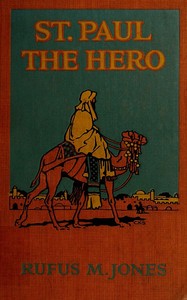
St. Paul the Hero
Language: en305 downloads on Project Gutenberg
Subjects
In: Biographies·History - Religious
Public-domain ebook sourced from Project Gutenberg #52694.
Public-domain ebook
Language: en305 downloads on Project Gutenberg
Subjects
In: Biographies·History - Religious
Public-domain ebook sourced from Project Gutenberg #52694.
The opening · free to read
“Father, who made the mountains that reach clear up into the sky over there where the sun goes down in the west?”
“It was God, my dear little boy. Don’t you remember the psalm we read in the synagogue last week: ‘I will lift up mine eyes unto the mountains, from whence cometh my help. My help cometh from the Lord who made the heavens and the earth’? God made the Taurus Mountains on the west of our dear city and He made those peaks of the Amanus you see off there in the East, over which the storks fly in the autumn, and He made this wonderful river, the Cydnus, which dashes through the cleft in the mountains and makes those great waterfalls which you love and which rushes headlong through the city on its way to the blue sea.”
“Well, Father, He must be wonderful if He did that! But I don’t see how He ever could spread out this great blue tent of a sky over all these fields and over all the city and over both the mountain ranges and as far as men have ever been. All the way to holy Jerusalem it goes—and farther, to Alexandria where the man lives, who wrote the book you read to me yesterday. Is there any end to that tent and what is it made of? Nobody in all our province of Cilicia can weave tent-cloth like that!”
“No, my son, nobody has ever found an end to the tent of the sky. It covers the whole world. It is harder to get to the end of it than it is to go to the end of the rainbow, which you tried to find a few days ago. But, my dear boy, God has made something more wonderful than the mountains, more wonderful than the river, more wonderful even than the blue canopy of the sky, that covers the world.”
“What can it be, Father, that is more wonderful than these things? Do you mean the sea, which you sail over when you go as a pilgrim to holy Jerusalem, to the passover?”
“No, not the sea, though that is wonderful and dreadful. I mean the law which God wrote with His own finger and gave to our great prophet Moses. That is God’s greatest gift to our race. I want my little boy to love the beauty of the mountains and the river and the sky and the sea. But beyond all things, I want him to love the holy law of God, to learn it by heart, to keep every word of it and to grow up and be one of Jehovah’s own men. My boy comes of the tribe of Benjamin, the favourite of all the sons of our father Jacob, and some day this little boy may become the leader and deliverer of God’s longsuffering people. Will little Saul promise to be Jehovah’s man, and will he always love and keep the whole law which our God gave to Moses?”
“Will it be very hard to do, Father, and must I give up all the things I like to do?”
“Yes, my dear boy, it will often be very hard and you will have to give up some things you like to do. But if you keep the whole law of God and make yourself perfect and do everything God asks you to do in the holy law, all the people of our race forever will call you blessed, and you will be the hero of the tribe of Benjamin, and you will help to bring the Messiah for whom we long and pray, and Jehovah will give you eternal life in His kingdom.”
“Oh, Father, I don’t care how hard it is, I will do it. I will let my pet stork out of his cage, so that he can fly off with the other storks over the mountains. I will not do one single thing on the holy Sabbath that is wrong. I will not play by the river any more with little Gentile boys. I will learn every word of Moses’ law and say it all to mother when she puts me to bed. I will be ready to serve my race when God calls for some one to do the great deed, as David did in the book we read.”
His father patted his boy on the head and smiled, as they walked home along the banks of the rushing Cydnus and looked off at the sun-lit tops of the Taurus Mountains.
Little Saul had had ten birth-days and he had already caught the spirit of his race which was very strong in his father and mother who kept feeding him on the stories of the past and waking in him the desire to be the hero of his tribe. Tarsus, a beautiful city of the province of Cilicia, was his home. The city was twelve miles from the Mediterranean Sea and ships came up the river to the great wharves on either bank. Not far away to the south was the great island of Cyprus and through a pass in the Amanus Mountains a road went to Jerusalem and the land of his fathers. He had been often ill and weak during the ten years he had lived and often he had lain by the window and looked out on the world and wondered. More than once he had seen an army go marching up the street, carrying the Roman eagles and flashing Damascus blades in the sun. He wondered where they were going and what they would do with these terrible swords.
He had an older sister who was too old to play games with him, but she took him on walks by the river and like everybody else she told him Hebrew stories about the heroes he loved. She would picture to him often a city on a great hill, with valleys running round it, with a gorgeous temple in it, and she would say, “Some day you and I will go there to live and that will be our home and we shall be where we can see the temple of God every day!”
Saul’s father was proud of many things. He had married a wise and beautiful woman, of his own tribe, who made his home a very happy one. He was proud of his wife. He was proud of this strange boy who pondered and wondered and who promised to become some day a great Rabbi and leader. He was proud of his tribe and of his race. He was still more proud to be a Pharisee and to be classed among those who strictly kept the law and worshipped every least letter of it, and then he was proud that he was a Roman citizen. He had done some service to the empire and the great honour of being enrolled a citizen had been conferred upon him, so that little Saul had been born a Roman citizen and had received a double name, one for his home people—Saul, and one for Roman citizens to call him by, Paul, which meant, “the little one.”
This was the boy who talked with his father by the shore of the Cydnus, one evening about twenty years after Christ was born in Bethlehem.
Months passed by and the little boy of Tarsus grew stronger and more eager and earnest. His father had sailed from the port of Messina for Tyre and Ptolemais and Cæsarea, on his way to Jerusalem to keep the Passover in the Holy Land. Little Saul had begged to be taken with him that he might see the Temple and stand on the very ground over which the great heroes of his race had walked, but he was told that he must wait until he was a few years older and then he should go to Jerusalem to study with a great Rabbi who could answer all his questions. For a long time he had gazed at the sky where the sun had gone down over the Taurus. He was really not looking at anything—he was just gazing off into space and wondering. He wondered whether he would ever see the world beyond those mountains, the world he had heard men talk about, the world of Asia and Greece and Rome. Then he turned to look toward the dim, yet shimmering peaks in the East and he wondered whether he would some day climb those ranges and go through the pass into Syria and on into the land he loved best—the real world of his own race.
He had not yet read any of the stories of Greece. He had dimly heard of the Trojan war, but it was only a name of little meaning. Theseus and Jason and Achilles and Ulysses were not his heroes. They were never mentioned in his home, though he sometimes heard the boys in the street speak of them. His heroes had all lived over the other mountains. Their names he heard almost every day. They were household words. He sometimes made believe that he was David and he would run with a little hand sling and kill again the mighty Philistine giant that threatened his people. When he climbed a high hill-top he imagined himself Moses on Nebo, looking over Jordan on the wonderful land of promise, and every peak covered with a cloud that looked like smoke seemed to him once more Sinai, with the Lord above giving the law in the darkness and the thunder. He wished he could see the Seraphim as Isaiah did, with two wings over their faces, and two wings all the way down to their feet and two wings moving like a bird’s to carry them wherever the Lord willed them to go. And still more he wished that he could see that wonderful figure which Ezekiel saw by the river Chebar—a living creature with the face of a man, and a calf and a lion and an eagle, all woven in and out with wings and all full of eyes, flashing like lightning, whirling like wheels, and moving wherever the Spirit of God carried the strange living creature. He thrilled whenever he heard the story of Daniel and he wondered whether he himself would have dared to pray to Jehovah and go to the lions for it. He had seen a lion once who was being carried to Ephesus in a cage, to be let out in the amphitheatre. The lion roared and shook his cage and showed his terrible teeth. Then little Saul thought of calm, brave Daniel going down into a den full of beasts like that.
And Shadrach, Meshach and Abed-nego, the three heroes of the burning fiery furnace, were men he loved to hear about. “Be it known unto thee O King, that we will not serve thy gods, nor worship the golden image which thou hast set up.” Those words always stirred him like a trumpet. And he waited every time to hear once more about one like unto a son of God walking with these brave Jews in the midst of Nebuchadnezzar’s fire. But best of all he liked the story of the faith of great father Abraham. He could almost see him laying the sticks of wood on the altar and binding his own only boy upon them. He wondered if his father would have done it with him, if he heard the Lord tell him to do it! Then suddenly came the joyous relief: the ram in the thicket, and little Isaac spared, just as the dreadful knife flashed in the air.
These heroes were going in procession through his mind as he gazed at the eastern gate in the mountains through which the road ran that led on toward the one city of all the world. Just then his mother stood by his side and took his hand in hers. She could see that big thoughts were moving in him and she felt a kind of awe as she looked down at the pale earnest face.
“Mother, which is the hardest of all the commandments to keep—I mean, really to keep, and not to break at all?”
In her mind, the fond Jewish mother standing in the dusk by the boy she loved, ran over all the commandments. “Thou shalt not have any other gods but Jehovah.”
“Thou shalt not make any graven image.”
“Thou shalt not take the name of the Lord thy God in vain.”
“Thou shalt observe the Sabbath day and keep it holy.”
“Thou shalt honour thy father and mother.”
“Thou shalt do no murder.”
“Thou shalt not commit adultery.”
“Thou shalt not steal.”
“Thou shalt not bear false witness.”
“Thou shalt not covet, or desire.” While she was thinking how to answer, little Saul said: “I know which is the easiest.”
“And which is it?” asked his mother.
“Thou shalt honour thy father and mother. It is the easiest thing there is to do. I don’t have to stop to think to do that! It is not so easy, though, to keep the Sabbath day holy. There are so many things to remember. Now that I have let my pet stork go, I do not feel tempted any more to play with him on the Sabbath day. But sometimes I start off for a walk before I think, and I carry things that are too heavy to be lifted on the Sabbath day. I wonder if I shall ever get so righteous, like our great Hebrew saints, that I shall not do anything wrong on the Sabbath day. It is very, very hard to be perfectly good. Do you not think, Mother, that this is the hardest of all the commandments to keep?”
The book keeps going
Reading is free forever. Sign up and watch scenes appear while you read.



Scenes Storieta drew for other classics.
New illustrated classics
Once or twice a month: the latest books to get full character casts, scene art, and free comic editions. No account needed.