THE LONGEST DAY IN THE YEAR.
BY EMILY HUNTINGTON MILLER.
I don't know, what the almanac man said about it, but Dan said it was the longest; and Dan was certainly the one who understood the matter best.
It began pretty much like other days, only that there was a heavy fog, and Dan knew that it was bad weather for haying, and tip-top for fishing. He made up his mind to go fishing. Perhaps if his mind had not been already made up, he would not have minded it so much when his father said at the breakfast table:
"We must get the scythes in good order, so's to take a fair start at the lower meadow to-morrow. Don't let me have to waste time hunting after you, Daniel, when I'm ready to go at it."
Daniel's appetite was gone at once. How he hated to turn that heavy creaking old grindstone! and how sure his father was to find a dozen things to do first, and keep him waiting all the morning! He went around by the sink drain, and dug his bait; he examined his fishing-pole; he put up his lunch; he even tried a worm on the hook; and then he wandered disconsolately around, wishing grindstones had never been invented.
He went to the end of the garden, and leaned sulkily over the low stone wall, eating the half-ripe harvest apples, and throwing the cores spitefully away. Down the road a few rods lay the mill-pond, and in the middle of the road nearby stood Deacon Skinner's horse and chaise.
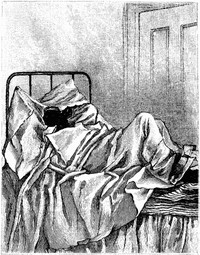
Old Whitey had his nose down, and one leg crooked in a meditative fashion. The Deacon was over in the field, making a bargain with Solomon Murray for some young cattle. What fun it would be to start the old horse up, and set him trotting home! Dan could almost hit him with an apple core. He tried two or three, just to see, and then he picked a smooth round stone from the wall, and sent it singing through the air.
Old Whitey brought up his nose with a jerk, straightened his fore-leg, and started off at a brisk trot, the chaise top tilting and pitching back and forth.
Dan laughed--at least the laugh began to grow, when he caught one glimpse of a frightened little face at the chaise window, and knew that Nanny Dane, the Deacon's little lame grandchild, was in the chaise.
It was only a glimpse, and then the bank of gray fog swallowed Whitey and the chaise, and it seemed to Dan that they had gone straight into the mill-pond.
"Daniel! Daniel! Come on now, and be spry about it!" called his father, as he moved toward the grindstone; and Dan obeyed, though he felt as if his feet had all at once turned to lead.
Round and round and round; his tough little hands were blistered on the handle, but he did not know it; his mouth and throat were as dry as the stone, but he did not think of it. "_Crrr-crrr-crrr_," rang the rough, wearisome noise, until his ears were so deafened he did not even hear it. For he was perfectly sure he had killed little Nanny Dane. What would people say? What would they do to him? Hang him, of course; and Dan felt in his heart that he deserved it, and that it would be almost a satisfaction.
"There," said his father at last, "I reckon that'll do, Daniel. You've been faithful and stiddy at your work, and now you may go fishing."
Dan never knew how he got to Long Pond, or how he passed the slow hours of that dismal day. The misery seemed intolerable, and before evening he had made up his mind that he could bear it no longer. He would go home and tell his father, he would tell everybody. They might hang him, they might do anything they pleased.
Tramping desperately home with his empty basket in his hand, he heard the sound of wheels behind him, dragging slowly through the deep sand. Perhaps that was the Sheriff coming to arrest him. Dan's heart beat harder, but he did not look around. The wheels came nearer; they stopped, and some one said:
"Hullo, Daniel! been fishin'? Fisherman's luck, hey? Well, jump in here, and I'll give ye a lift."
Before Dan knew it he was over the wheel and sitting beside Deacon Skinner in the old chaise, with Whitey switching his tail right and left as he plodded along.
"Git up, Whitey," urged the Deacon; "it's getting along toward chore-time. Whitey ain't so spry as he used to be, but he's amazin' smart. This mornin' I left little Nanny in the shay while I was making a dicker with Solomon Murray, and a keerless thing it was to do, but I'd as soon expected the meetin'-house to run away as Whitey. I reckon something must have scart him; but he just trotted off home as stiddy as if I'd been driving, and waited at the door for mother to come and get Nanny before he went to the barn."
"Oh, Deacon Skinner," burst out Dan, "it was me; I scart Whitey."
"Did ye now, sonny? Well, there wuzn't any harm done, and I know ye didn't mean to."
"I did, I did," said Dan, sobbing violently from the long strain of excitement. "I didn't know Nanny was in the chaise, and I threw a stone at him."
"Well, well," said the Deacon, rubbing his stubbly chin, and looking curiously at Dan. "Beats all what freaks boys will take, but I know ye won't do it agin."
"I never will," said Dan, solemnly. "This has been the awfulest longest day that ever was in the world."
ABOUT CROTCHETS AND QUAVERS.
BY MRS. JOHN LILLIE.
I well remember the first morning I ever spent in a foreign Conservatory of Music. I arrived just as the Harmony Class had assembled. Beside me sat a slim little girl, with a very pretty pale face and a tired, anxious look. When we had all opened our books, she whispered to me, "May I look over you?"
The expression in her eyes was so piteous that it went to my heart to answer, "You may if you like, dear; only it won't help you. I don't know much of anything myself."
I never shall forget her look as she burst into a silent fit of crying, which for ten minutes stopped the lesson.
Often since I have thought of my little worried companion, who struggled on through the winter, always declaring she could not learn because she could not like it, and I have wondered if there were not a great many young students who feel in the same way.
It is so stupid to hear of semibreves and crotchets and quavers and minims and scales and clefs and scores, and all sorts of terms like "allegro" and "andante" and "con moto" and "adagio," and, indeed, whole Italian sentences, that used to look to me when I was a child like impertinent intrusions into English music.
But have you ever thought whether this system of music which we have to-day may not have had a story--a far-off story almost as entrancing as a fairy tale?
I think had some one told my little friend the story of the system she was toiling to understand, it would all have looked very different, and the study would have been tinged with a real delight.
Now what I propose to tell you is the history of the notes we use. This is really an introduction to the study of thorough-bass, or harmony; and if you make yourself complete master of the first simple rules or ideas, you will find later that many seemingly difficult things come almost instinctively.
You know, of course, how music is written to-day--the five lines; the division of bars; the arrangement of time; the value of notes. Of course you can easily understand that such a perfect system did not come without years of trial of various methods, and centuries of experiment, and a very crude sort of music.
Away back in early Oriental times there was music at festivities, triumphs, or times of mourning, and from the Greeks came the first ideas of harmony. You see, directly music came to be written down, it was evident that some sort of a system had to be established.
In very early ages musical sounds were represented by the letters of the alphabet. These were the days when good St. Gregory had singing-schools in ancient Rome. The singers chanted psalms and other church music, which must have been very solemn and beautiful.
This system came to an end, however, and was replaced by the use of a series of characters. These were called neumæ, and each character had a different name. The first was known as the virga, and it was a long single note; the bivirga represented two notes; the trivirga, three; the punctus was a short note, etc.
Now I have culled out of an old volume some illustrations showing how music was written in ancient times, and I want you to study them, and see how curious the methods were which preceded our present perfect system.
Fig. 1 shows the neumæ. There are ten here, but authorities differ as to the number that were really in use. These neumæ were placed over the words, as shown in Fig. 2. We are not quite certain what melody they here represent, but the solution given underneath is the probable one: