The opening · free to read
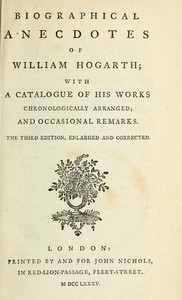
The author of these imperfect sheets cannot present them a second time to the world, before he has expressed his gratitude for the extreme candour with which they have been treated by the Monthly Reviewers. If J. N. has not availed himself of all the corrections designed for his service, it is because the able critic who proposes them has been deluded by intelligence manifestly erroneous. J. N. received each particular he has mentioned, in respect to the assistance bestowed on Hogarth while his Analysis was preparing, from Dr. Morell, a gentleman who on that subject could not easily mistake. Implicit confidence ought rather to be reposed in a literary coadjutor to the deceased, than in any consistory of females that ever "mumbled their wisdom over a gossip's bowl." Authors rarely acquaint domestic women with the progress of their writings, or the proportion of aid they solicit from their friends. If it were needful that Dr. Morell should translate a Greek passage[1] for Hogarth, how chanced it that our artist should want to apply what he did not previously understand? I must add, that the sentiments, published by the Reviewer concerning these Anecdotes, bear no resemblance to the opinion circulated by the cavillers with whom he appears to have had a remote connection. The parties who furnished every circumstance on which he founds his reiterated charges of error and misinformation, are not unknown. Ever since this little work was edited, the people about Mrs. Hogarth have paid their court to her by decrying it as "low, stupid, or false," without the slightest acknowledgement for the sums of money it has conducted to The Golden Head in Leicester Fields. While the talents of the writer alone were questioned by such inadequate judges of literary merit, a defence on his part was quite unnecessary. He has waited, however, with impatience for an opportunity of making some reply to their groundless reflections on his veracity. This purpose he flatters himself will have been completely executed after he has observed that all credentials relative to his disputed assertion shall be ready (as they are at this moment) for the Reviewer's inspection. J. N. cannot indeed dismiss his present advertisement without observing, that though the amiable partialities of a wife may apologize for any contradiction suggested by Mrs. Hogarth herself, the English language is not strong enough to express the contempt he feels in regard to the accumulated censure both of her male and her female Parasites.
J. N.
Nov. 1, 1782.
[1] Whereabouts is this translation of a Greek passage to be found in the Analysis? It may have escaped my hasty researches.
ADVERTISEMENT TO THE FIRST EDITION.
When this pamphlet was undertaken, the Author had no thought of swelling it to it's present bulk; but communicating his design to his friends, they favoured him with various particulars of information. Some of these accommodated themselves to his original plan, if he can be supposed to have had any, but others were more intractable. Still aware of the value even of disjointed materials, which his profession would not afford him leisure to compact into a regular narrative, and conscious that these sheets, rude and imperfect as they are, may serve to promote a publication less unworthy of its subject, he dismisses his present work without any laboured apology for the errors that may be detected in it; claiming, indeed, some merit on account of intelligence, but not the least on the score of arrangement or composition. He takes the same opportunity to observe, that many curious anecdotes of extraordinary persons have been unfortunately lost, because the possessors of those fugitive particulars had not the power of communicating them in proper form, or polished language, and were unwilling to expose them in such a state as these are offered to the world.
May 9, 1781.
The ingenious Mr. CRAYEN of Leipzig having translated the First Edition of these Anecdotes, &c. into the German Language, dispatched a copy of his work to J. N. attended by the obliging letter here subjoined:
Sir,
Though I have not the honour of being acquainted with you, I hope your goodness will excuse the liberty I take of sending you a German translation of the Biographical Anecdotes of Mr. Hogarth you published. Being convinced of the merits of your production, and its usefulness to such collectors of prints and connoisseurs in our country as don't understand the English language, I undertook this translation, and flatter myself you will be pleased to accept of it as a proof of my real esteem for you.
You will find, that I did not always adhere literally to the original, but made some abridgments, alterations, notes, &c. &c. But I hope you will do me the justice to consider, that I wrote for my countrymen, and therefore left out such passages, poems, anecdotes, &c. &c. as would have been entirely uninteresting to them, and have swelled the volume to no purpose.
As to the typographical performance, I think you will be tolerably satisfied of it. Though the noble art of printing is of German origin, your nation has improved and brought it to the highest pitch of perfection in point of neatness, elegance, and correctness.
The book keeps going
Keep reading, and see it illustrated
Reading is free forever. Sign up and watch scenes appear while you read.
Scenes Storieta drew for other classics.