Public-domain ebook
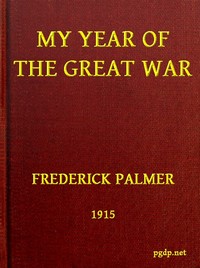
My Year of the Great War
Language: en1,857 downloads on Project Gutenberg
Subjects
In: History - European·History - Modern (1750+)·History - Warfare
Public-domain ebook sourced from Project Gutenberg #52886.
Public-domain ebook
Language: en1,857 downloads on Project Gutenberg
Subjects
In: History - European·History - Modern (1750+)·History - Warfare
Public-domain ebook sourced from Project Gutenberg #52886.
Frederick Palmer’s My Year of the Great War is a first‑hand account by an American correspondent who spent the conflict embedded with the British army, the Royal Navy, and the front‑line troops of France and Belgium. The opening pages set the tone with a mixture of observation and analysis: Palmer weighs the accuracy of his earlier predictions about artillery, trench stalemates, and the decisive nature of the Marne, then moves to a candid self‑assessment of his role as a “eager observer” rather than a military expert. He promises a blend of personal experience, visits to the Grand Fleet, time in occupied Belgium, and extended stays on the British front, and broader reflections on the causes and moral complexities of the war, all filtered through the lens of a journalist who was both participant and chronicler.
The narrative voice is that of a reflective, educated reporter writing in the early‑20th‑century journalistic style, marked by long, flowing sentences and a tendency to interweave factual description with philosophical musing. Its language is dense but earnest, echoing the period’s penchant for exhaustive detail and moral contemplation. Readers who enjoy immersive war memoirs, historical analyses that combine battlefield description with commentary on politics and society, and the perspective of a Western observer navigating both Allied and occupied territories will find Palmer’s account engaging.
The opening · free to read
Wrong as to the duration of the struggle and its bitterness; right about the part which artillery would play; right in suggesting the stalemate of intrenchments when vast masses of troops occupied the length of a frontier. Had the Germans not gone through Belgium and attacked on the shorter line of the Franco-German boundary, the parallel of fact with that of prediction would have been more complete. As for the ideal of “The Last Shot,” we must await the outcome to see how far it shall be fulfilled by a lasting peace.
Then my friend asks, “How does it make you feel?” Not as a prophet; only as an eager observer, who finds that imagination pales beside reality. If sometimes an incident seemed a page out of my novel, I was reminded how much better I might have done that page from life; and from life I am writing now.
I have seen too much of the war and yet not enough to assume the pose of a military expert; which is easy when seated in a chair at home before maps and news despatches, but becomes fantastic after one has lived at the front. One waits on more information before he forms conclusions about campaigns. He is certain only that the Marne was a decisive battle for civilisation; that if England had not gone into the war the Germanic Powers would have won in three months.
No words can exaggerate the heroism and sacrifice of the French or the importance of the part which the British have played, which we shall not realise till the war is over. In England no newspapers were suppressed; casualty lists were given out; she gave publicity to dissensions and mistakes which others concealed, in keeping with her ancient birthright of free institutions which work out conclusions through discussion rather than taking them ready-made from any ruler or leader.
Whatever value this book has is the reflection of personal observation and the thoughts which have occurred to me when I have walked around my experiences and measured them and found what was worth while and what was not. Such as they are, they are real.
Most vital of all in sheer expression of military power was the visit to the British Grand Fleet; most humanly appealing, the time spent in Belgium under German rule; most dramatic, the French victory on the Marne; most precious, my long stay at the British front.
A traveller’s view I had of Germany in the early period of the war; but I was never with the German army which made Americans particularly welcome for obvious reasons. Between right and wrong one cannot be a neutral. By foregoing the diversion of shaking hands and passing the time of day on the Germanic fronts, I escaped having to be agreeable to hosts warring for a cause and in a manner obnoxious to me. I was among friends, living the life of one army and seeing war in all its aspects from day to day, instead of having tourist glimpses.
Chapters which deal with the British army in France and with the British fleet have been submitted to the censor. In all, possibly one typewritten page fell foul of the blue pencil. Though the censor may delete military secrets, he may not prompt opinions. Whatever notes of praise and of affection which you may read between the lines or in them spring from the mind and heart. Undemonstratively, cheerily as they would go for a walk, with something of old-fashioned chivalry, the British went to death.
Their national weaknesses and strength, revealed under external differences by association, are more akin to ours than we shall realise until we face our own inevitable crisis. Though one’s ancestors had been in America for nearly three centuries and had fought the British twice for a good cause he was continually finding how much of custom, of law, of habit, and of instinct he had in common with them; and how Americans who were not of British blood also shared these as an applied inheritance that has been the most formative element in the crucible of the races which has produced the American type.
My grateful acknowledgments are due to the American press associations who considered me worthy to be the accredited American correspondent at the British front, and to Collier’s and Everybody’s; and may an author who has not had the opportunity to read proofs request the reader’s indulgence.
FREDERICK PALMER.
British Headquarters, France.
The book keeps going
Reading is free forever. Sign up and watch scenes appear while you read.



Scenes Storieta drew for other classics.
New illustrated classics
Once or twice a month: the latest books to get full character casts, scene art, and free comic editions. No account needed.