Public-domain ebook
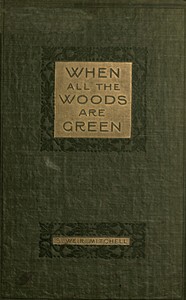
When All the Woods Are Green: A Novel
Language: en370 downloads on Project Gutenberg
Subjects
Public-domain ebook sourced from Project Gutenberg #53120.
Public-domain ebook
Language: en370 downloads on Project Gutenberg
Subjects
Public-domain ebook sourced from Project Gutenberg #53120.
The opening · free to read
The night of summer comes late in this north land. Although it was nearly nine o’clock, the shadows, long gathering in the valleys and the woods, had but just now overflowed onto the broad levels of the river. Above was hurry of low-lying clouds, through which swift star-gleams seemed to flit, like the momentary beacons of the rare fireflies along the shore. Far away the shriek of a departing train broke the general stillness and rang fainter and more faint in wild variety of tones among the farther hills.
On the bank of this wide Canadian river, a little above the margin, stood under the yet dripping trees a group of diverse people, but all of one household. Travel-weary and silent, for a time they looked down on the dimly lit stream, and heard, as they waited, the murmur and hum of its waters, or, with eyes as yet unused to the gloom, strove to see the group of men about the boats on the beach below them.
“This way, Margaret,” said a man’s cheerful voice; “take care; there is my arm, dear. How delightful to see the old river!”
The night was so dark that Lyndsay hesitated as he stood on the verge.
“What is it?” said his wife.
“I do not quite like to go up to-night in this depth of darkness. Do you think it quite safe, Polycarp? Can you see?”
“Not very well,” said the guide, “but soon break and have heap moon.”
“I think we must risk it, my dear. You will go with me.” Then he said a word of caution to the guides, and called to the boys, “Come, Dicky, and you, Jackums.” They ran down the slope in haste and stood a little, made quiet for once in their noisy lives, but interested, alert, and peering through the darkness.
“Is that you, Tom and Ambrose? How are you all? and Pierre—have you kept me a big salmon?”
He shook hands with each of the guides, having a gay word of kindly remembrance for all in turn. Meanwhile the sister of the boys came down to the canoes, made silent, like the children, by the night, the pervasive stillness, and the novelty of the situation.
“Baggage gone up, Pierre?”
“Yes, Mr. Lyndsay; everything is right,—and the salmon thick as pine-needles. The small traps are all in. We might be getting away.”
“Shall the women need their waterproofs, Tom?”—this to a huge form which loomed large as it moved among the other men, who were busy adjusting the small freight of hand baggage. The voice, when it broke out in reply, was, even for a fellow of six feet two, of unproportioned loudness.
“They won’t want none; it ’s a-goin’ to bust out clear.”
Miss Anne Lyndsay, the maiden aunt of the children, came down the bank as Thunder Tom replied. Her steps, too feeble for health, were thoughtfully aided by Edward, the youngest boy. To her turned Rose, the niece, a woman of twenty years.
“Did you ever hear the like?”
She felt the queer impropriety of this terrible voice in the solemn stillness which, somehow, adequately suggested the tribute of the bated breath.
“Won’t need no wraps, Miss Lyndsay. Rain’s done. There fell a power of water.”
“What a voice, Aunt Anne!” said Rose. “It ’s like the boom of the sea.”
“He explodes,—he doesn’t speak; a conversational cannonade.”
“Hush,” said Mrs. Lyndsay, the mother; “he is quite sensitive about it. He was with us last year, and a very good man, too, as I know.”
“Canoe is ready, sir.”
“It is like a parting salute,” said Rose.
“Well, my dear,” whispered Miss Anne, “it will be a fine reminder for a certain person; all things have their uses.”
“Thanks, Aunt Anne. A certain person has a not uncertain consciousness that she doesn’t need it. Folks complain that we women speak too loud. I am sure our men have lost their voices. As for the English women you admire so much, I could hardly understand them at all, with their timid, thin voices, and fat a’s.”
“Stuff!” said Miss Anne. “That is English.”
“I prefer Shakspere’s English,” said Rose. “I advise them to read ‘Love’s Labor’s Lost.’”
“That is our old battle-field, Rose. But you would have to be consistent, and I do assure you, if you talked as Shakspere talked, you would make a sensation.”
“Come, adjourn that skirmish,” said Archibald Lyndsay, who had been rearranging the canoeloads.
Then the voice, to which others were as whispers, roared:
“Who’s for where, Mr. Lyndsay?”
“All right. Tom, your voice is really getting broken. Come, Margaret,--this way dear.”
“It’s so,” said Tom. “I kin speak bigger if I try,”—this to Miss Lyndsay, apologetically, as he aided her into the boat. “Fact is, Miss, I was twins, like them boys, and Bill he died. He hadn’t no voice to count on. It’s main useful when you’re drivin’ logs.”
“What a baby he must have been in a quiet family!” whispered Anne to Rose and Ned. “Imagine it!”
“I didn’t understand what he said, Aunt Anne,” remarked the boy.
“I do not think he quite understood himself. Perhaps he had a vague notion that he had to talk so as to represent the dead brother, ‘who hadn’t no voice to count on.’”
“I like it,” remarked Rose. “Yes, papa.”
“This way,” said Lyndsay; “here, Margaret, in my canoe.”
“Could I have Ned with me, brother?” asked Miss Anne.
“Certainly. Here, in this canoe, not the birch. This one,—now, so, with your face up the river, and you, Ned,—yes, on the cushion on the bottom.”
The book keeps going
Reading is free forever. Sign up and watch scenes appear while you read.



Scenes Storieta drew for other classics.
New illustrated classics
Once or twice a month: the latest books to get full character casts, scene art, and free comic editions. No account needed.