Public-domain ebook
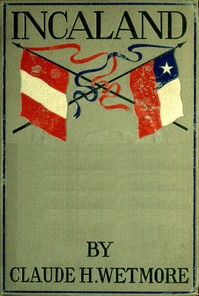
Incaland A Story of Adventure in the Interior of Peru and the Closing Chapters of the War with Chile
English464 downloads on Project GutenbergDownload EPUB
Public-domain ebook sourced from Project Gutenberg #53204.
Public-domain ebook
English464 downloads on Project GutenbergDownload EPUB
Public-domain ebook sourced from Project Gutenberg #53204.
The opening · free to read
Harvey held some of the white substance in both hands, examined it curiously, then let it filter through his benumbed fingers.
“This is snow, isn’t it?” he exclaimed.
Hope-Jones and Ferguson laughed.
“What! Have you never seen snow before?” asked the former.
“Of course not. Didn’t I tell you that I visited the States only once, when I was little more than a baby, and remained but a month or two? I’ve never been in these regions any more than have you. I can remember rainfall, but snow! this is the first I have seen,” and he stooped over again, scooping up a fresh handful of the white, fluffy flakes that had covered the ground to the depth of an inch.
“Look out!” screamed Hope-Jones.
Ferguson and Harvey jumped to one side, warned by the cry, not a second too soon, for a huge boulder, roaring with the sound of an express train, bounded down the mountain side, crashed over the place where they had stood, and disappeared below the ledge, reverberating as it fell into the chasm.
“Narrow escape that!”
“I should say so,” said Harvey, who had dropped his snow and stood looking at the two young men, his cheeks quite pale.
The three who thus had barely escaped death were explorers from Callao, Peru, in the year 1879, and this day they were eight hours’ walk beyond Chicla, the highest point to which the Oroya railroad had been built, and to which terminal they had journeyed by train from the main seacoast city of Peru.
Harvey Dartmoor was seventeen years of age, the birthday which marked his passage from sixteen having been celebrated a week before his departure from home. His father had been a wealthy iron merchant in Peru, but the reverses which that country had sustained in the few months of the war with Chile, and which are described in detail in “Fighting Under the Southern Cross,” had forced Mr. Dartmoor, as well as many others in Lima and Callao, to the brink of the financial precipice beneath which yawned the chasm, ruin.
Harvey had been more in the confidence of his father than Louis, who was a year older. This was perhaps due to the younger lad’s resemblance to his father, in face and in personal bearing; or, perhaps, to the fact that he was more studiously inclined and therefore passed more time at home than did Louis, who was fond of outdoor sports, and preferred a spin in Callao Bay, or a dash over the pampas on his pony, with his chum Carl Saunders as a companion, to poring over books in the library.
It was in this manner—by being frequently at home and in the office—that Harvey had learned of his father’s distress of mind, caused by financial difficulties, long before other members of the family had realized the true state of affairs; and this observance by the lad and his inquiries had as a sequel his appearance in the great Andes chain, or the Cordilleras of Peru.
His companions were an Englishman and an American, who had resigned clerkships in offices to undertake this journey. Horace Hope-Jones, the senior, had been five years on the Peruvian coast, coming to Callao from Liverpool, and John Ferguson had lived in Ohio until 1875, when he was offered a very good salary to enter the employ of a large American house which had branch establishments in several cities on the southwest coast. One was twenty-three, the other twenty-two.
They were well known in the cities, and were popular in amateur athletic circles, both having been members of a famous four of the Callao Rowing Club, that had wrested victory from fours sent from Valparaiso, Panama, and other cities. Harvey Dartmoor was a junior member of this club, and it was while serving as coxswain that he became acquainted with Hope-Jones and Ferguson.
It came about curiously that the three were in the Andes, at an altitude of 16,500 feet, this twenty-third day of August, 1879. Two days before they had stood on the beach at Callao, breakers of the Pacific Ocean dashing at their feet; now they were in a wilderness of granite, snow-capped peaks rising on every side, and behind, towering above these, were still others, stretching in a seemingly endless chain.
Their quest in this vastness was gold, and an Indian’s narrative caused their search for yellow metal in the interior, where the great Incas once ruled.
Hope-Jones and Ferguson had lived in bachelor apartments in Lima, which is eight miles from Callao, and for a year their wants had been attended to by an old native, named Huayno, who cooked their meals, made their beds and kept their rooms tidy.
He was singularly uncommunicative during the first eight months of his service, but later, falling ill and being treated kindly by the young men, he told them that he was of direct descent from the Incas; indeed, that there flowed through his veins blood of the royal Atahuallpa, and that he might have been a king had not the race been first betrayed by the white men from Spain and then gradually exterminated, until only a few were left; and these wandered in bands through the interior, turned from a once proud people to Philistines, because of the injustice done them.
Thus old Huayno would talk evenings for hour after hour, speaking in Spanish with a strange mixture of the Indian tongue, and they would listen intently, because he told wonderful things of life in that portion of the interior to the north of Cerro de Pasco, where the foot of white man had never trod.
The Indian became worse instead of better, and finally was bedridden. Hope-Jones and Ferguson had grown much attached to him. They recognized a person above the station in which circumstances had placed him, and, moreover, they felt sorry for one who was far away from his people and so lonely. Therefore, instead of sending him to a hospital, they called a doctor and engaged a nurse to be near his side during the day, while they were absent at their offices. The physician shook his head, after examining the old man, and said:—
“He cannot linger long; perhaps a week, possibly two, but no longer.”
Ten days later the end came, and a few hours before Huayno breathed his last, he beckoned Hope-Jones and Ferguson to his side.
“My masters, I know that I am about to die,” said he. “The sun of my life is setting in the hills and soon it will have disappeared. Before darkness comes I have much to tell you. In these weeks you have done much for me, as much as you would have done a brother; and so I, in turn, shall do for you. Give me, I pray you, from that bottle, so the strength may come to my voice.”
One of them handed him a glass, into which he had poured some cordial, and the Indian drank slowly, then raised himself partly in bed, leaning on pillows which had been placed behind his back.
He was a tall, well-formed man, his skin of light copper color, and he wore a beard that reached halfway to his waist. His cheeks were much sunken and shrivelled, and resembled stained pieces of chamois skin that had been wet, then dried without stretching. His luminous black eyes glistened from deep cavities under shiny brows.
“I am of the tribe of Ayulis,” he continued, his voice much firmer. “They now inhabit the country round about the river Marañon, where they cultivate yacas, plantains, maize, and cotton, and from the latter the women weave gay cloths, so that their attire is of more splendid color than that of any tribe. Eighty-five years ago it was not thus; then we were not compelled to cultivate the fields, for having gold in abundance we employed others to work. That gold proved our curse, for the white men came from Spain and levied tribute upon us, more and more each year, until we knew that soon all would be taken away. They levied tribute which we were compelled to pay, but they never learned from where we secured the metal, although they searched in parties large and small and put many of our leading men to the torture, in effort to force the secret from them. An Ayulis has no fear of pain, and they laughed when burned with hot irons and when boiling oil was poured upon them.
“When at last the Spaniards drove them too far, they choked the approaches to the mine with the trunks of huge trees, and all voiced a pledge that the place should never be opened again, nor would the location be made known to these unwelcome visitors from Spain. I am one hundred years old now; I was twenty then, and I remember well the great meeting of our tribe. Later we were revenged. Six months from that day we joined forces with the Jivaros, and at night we entered the town of Logroño, where a terrible butchery befell. Every white man was beheaded and every woman was carried away. Then other white men came and we were hunted through the forests for years, until at last we settled on the banks of the Marañon and there turned our attention to farming.
“We thought no more of gold, my masters, for that had been our curse; but well I remember the days when the yellow metal was in plenty, and with these eyes I have seen a nugget of gold taken from the mine of which I speak, that was as large as a horse’s head and weighed four arrobas.[1] Silver was so plentiful and iron so scarce that horses were shod with the white metal.
“Now I come to a time later by twenty years, when, by accident, I killed a man of our tribe. They would not believe me that I had meant him no harm, and that the arrow was not sped by design, but they declared that I should die. Had I been guilty I would have awaited the punishment; but I was innocent, and so I fled, and for a time I joined the savages on the Ucalayli, but in a few years I pushed on, over the mountains, to this coast where I have since been.”
Hope-Jones and Ferguson had listened breathlessly, bending forward, for the old Indian’s voice had grown weaker and weaker. Soon he added:—
“I will tell you where the gold mine lies, for you have been kind to me. Take paper and pencil, that you may write down what I may say and not forget.”
The book keeps going
Reading is free forever. Sign up and watch scenes appear while you read.



Scenes Storieta drew for other classics.
New illustrated classics
Once or twice a month: the latest books to get full character casts, scene art, and free comic editions. No account needed.