The opening · free to read
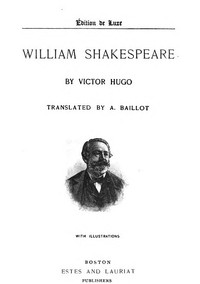
The true title of this work should be, "Apropos to Shakespeare." The desire of introducing, as they say in England, before the public, the new translation of Shakespeare, has been the first motive of the author. The feeling which interests him so profoundly in the translator should not deprive him of the right to recommend the translation. However, his conscience has been solicited on the other part, and in a more binding way still, by the subject itself. In reference to Shakespeare all questions which touch art are presented to his mind. To treat these questions, is to explain the mission of art; to treat these questions, is to explain the duty of human thought toward man. Such an occasion for speaking truths imposes a duty, and he is not permitted, above all at such an epoch as ours, to evade it. The author has comprehended this. He has not hesitated to turn the complex questions of art and civilization on their several faces, multiplying the horizons every time that the perspective has displaced itself, and accepting every indication that the subject, in its rigorous necessity, has offered to him. This expansion of the point of view has given rise to this book.
Hauteville House, 1864.
The book keeps going
Keep reading, and see it illustrated
Reading is free forever. Sign up and watch scenes appear while you read.
Scenes Storieta drew for other classics.




![Cover of Shakspeare and His Times [Vol. 1 of 2]
Including the Biography of the Poet; Criticisms on His Genius and Writings; A New Chronology of His Plays; A Disquisition on the on the Object of His Sonnets; And a History of the Manners, Customs, and Amusements, Superstitions, Poetry, and Elegant Literature of His Age](/covers/53625.jpg)
![Cover of Shakspeare and His Times [Vol. 2 of 2]
Including the Biography of the Poet; Criticisms on His Genius and Writings; A New Chronology of His Plays; A Disquisition on the on the Object of His Sonnets; And a History of the Manners, Customs, and Amusements, Superstitions, Poetry, and Elegant Literature of His Age](/covers/53626.jpg)