Public-domain ebook
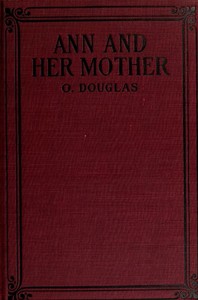
Ann and Her Mother
by O. Douglas
Language: en352 downloads on Project Gutenberg
Subjects
Public-domain ebook sourced from Project Gutenberg #53522.
Public-domain ebook
by O. Douglas
Language: en352 downloads on Project Gutenberg
Subjects
Public-domain ebook sourced from Project Gutenberg #53522.
The opening · free to read
It was a wonderfully comfortable room, brightly yet softly lit, and warmed by a noble fire. There was a pleasant space and emptiness about it, an absence of ornaments and irrelevant photographs; each piece of furniture, each of the few pictures, was of value.
Mrs. Douglas had a book in her lap and in her hand a half-finished stocking, for she considered that she was wasting time if she did not knit while reading.
Ann sat on a stool by the fire, poring over a seedsman's catalogue, a puzzled frown on her brow.
"I wish," she said, without looking up, "I do wish I knew more about gardening. I can't make out from this what will grow best with us.... Don't you think, Mother, it is almost lèse-majesté to call a rose Queen Mary, and describe it as 'a gross feeder? Oh, and this! Mr. Asquith, 'very compact in form, rosy in colour.' What humourists the compilers of seedsmen's catalogues are! And what poets! Where was it we read that article about catalogues? It said that the very names were like a procession of princes--'amber and carmine Queens, and Princes' Feathers, and Cloth of Gold.' The names tempt one simply by the glory of the sound. 'Love-in-a-Mist ... Love-Fire, a rich cream with a faint suggestion of apricot primrose in petal'--and with a drop one learns that this beauty can be bought for the sum of tuppence! ... Delphiniums we must have--dozens of them. I can picture us next summer lying on the lawn in deck-chairs on hot, sunny days, looking between tall, blue delphiniums to green hilltops. Won't it be lovely, Mother?"
"H'm," said her mother in a dry voice, "at present you have only the hilltops. I haven't imagination enough to picture the hot sun and the lawn and the blue delphiniums."
"_Mother!_" said Ann, wheeling round on her stool and facing her parent, who was knitting with provoking calm, "there's nothing sporting about you at all. It always rains in November, but that's nobody's fault, and you might at least try to look as if you didn't mind. Nobody ever said a glen was a cheery place in winter, but, myself, I like it frightfully. When Uncle Bob left me the Green Glen for my very own I determined that somehow or other I would manage to build a house in it--a little white-faced house among the heather. Not big, but big enough to hold us all--six good bedrooms, one big living-room, a hall we could sit in, a smaller room to feed in. You all made objections--all except Charlotte, who encouraged me. You pointed out all the disadvantages: six miles from a station, a steep hill road, carting difficult! You told me that building in these days was only the pastime of a millionaire, but--the house is built and, because the architect was a man of sense and listened to what I wanted, it is exactly the house I meant it to be in my dreams, so 'Dreams' it will be called."
"I thought you hated new houses?"
"So I do, except when it is my own house in my own Green Glen. And you will admit that it is comfortable."
"It's very bare," Mrs. Douglas said.
"Well, I like it bare. And your own room is far from bare. It is more like a museum than anything else, with so many mementoes of other days hung on the walls, and photographs of us all at every age and in every attitude, and shelves and shelves of devotional books, not to speak of all the little stucco figures you have cherished for years. Their heads have been gummed on so often they fall off if you look at them. Davie was always being entreated by you to mend them, and he found, finally, that Moses' head (or was it Eli?) would only remain on if turned the wrong way about--so his beard was down his back! ... To return to 'Dreams,' I admit the garden is still unmade, and the road a mere track, but wait and you will see it blossom like the rose. We shan't have any fences--there is no need for them among the hills, and the heather will grow to the edges of our shaven lawns, and we'll have herbaceous borders as gay as a carnation ribbon, and beds of mignonette..."
Mrs. Douglas laid down her stocking and looked at her daughter. "No fences? And rabbits nibbling the mignonette--it's a thing they have a particular fancy for; and sheep eating the vegetables..."
"Go on with your stocking, Motherkin, and don't try to be crushing. We'll have fences then, and wire to keep out the rabbits, and we'll cover the fences with rambler roses--the bright red single kind; I don't like Dorothy Perkins. And there's simply no end to what we can do with the burn; it would make any garden fairyland, with those shining brown pools fringed with heather. What luck to have a burn! Before the house we are going to have a paved bit, so that you can go out and take the air without getting your feet wet. There will be no 'gravel sweep,' and no one will be able to come to our door except on their own feet, for the road will stop a long way from the house."
Ann clasped her hands round her knees, and rocked herself in joyful anticipation.
"I remember," she went on, "hearing as a child some one praise a neighbourhood with the phrase, 'It is full of carriage people.' I wondered at the time what kind of people they were, and if they perhaps had their abode in a carriage, like a snail in its shell! When 'motor people' come to Dreams they will have to leave their motors and walk. We shall say to them, like True Thomas, 'Light down, light down from your horse o' pride.' ... But, Mother, is this really going to bore you terribly? Do you miss so badly the giddy round of Priorsford? The pavements? The shops? The tea-parties?"
Mrs. Douglas gave a long sigh. "I don't want to grumble, but, you know, I always did say it was rash to attempt to stay a winter in the Green Glen. It's well enough in the summer (though even then I would prefer to be nearer civilisation), and fine for the children, but in November, with the fields like sponges, and the road a mere Slough of Despond, and the hills covered with mist most of the time, and the wind coming down the glen howling like an evil spirit, and the station six miles away, and only a pony trap between us and complete burial; Mark and Charlotte in India, and Jim in South Africa, and the children in Oxfordshire with their other grandmother, I feel like a pelican in the wilderness. I told you I would, and I do."
"Poor dear, but..."
"Through the day it isn't so bad. I admit the mornings are rather beautiful, and when it happens to be fine I can potter about outside, and Marget is always a divert. In the afternoon when it rains (and it has rained practically every day for three weeks) I sew and write letters and read, and there is always tea to look forward to. But in the evenings--and the curtains have to be drawn now about four o'clock--when there is no chance of a ring at the bell, no postman, no telephone-call, no stray callers, and the owls hoot, and my eyes get tired with reading, and one can't knit for ever even with four wild grandchildren to knit for, well----"
"But, my dear," said her daughter, "just think how you will appreciate Priorsford when you get back. We are very much alone just now--it was an odd chance that sent Mark and Charlotte to India and Jim to South Africa the same winter--but don't let's have to remember it as the winter of our discontent.... We must face facts. Neighbours we have almost none. Mr. Sharp, at the Manse, is practically the only one, and he is so shy that speaking to him is like trying to carry on a conversation with a very young rabbit in a trap. The Scotts aren't so very far away as the crow flies, only over the other side of the hill, but it is five miles round by the road. It's an unpeopled world, but the great thing to remember is that any moment you please you can have a case packed, order the pony trap, drive to the station, buy a ticket, and in about two hours you would be in Glasgow, in the Central Station Hotel, among all the city gentlemen, feasting your eyes on people, forgetting the owls in listening to the Glasgow accent, eating large meals, frequenting picture houses...."
Mrs. Douglas dropped both her book and stocking in her indignation.
"Ann, you know I never enter a picture house, and I haven't the least desire to go to Glasgow in the meantime."
"I tell you what," Ann cried, "go in for a course of reading and improve your mind. It's an opportunity that may not occur again."
"I'm too old to improve my mind; besides, it isn't very nice of you to suggest that it needs improving."
Ann studied her mother with her head on one side. "You're sixty, aren't you? Sixty's nothing. The late Mr. Gladstone learned Arabic when he was eighty. Besides, you are the most absurd person for sixty I ever saw. Your hair is as soft and brown as it was when you were thirty, and you have a complexion that is the envy of less fortunate women. And the odd thing is, I believe you hate to be told so. I believe you want to look old."
"Last summer," said Mrs. Douglas, "I overheard Rory say to Alison, 'Alis, Gran is nearly sixty; I heard her say so,' and Alis, with a depth of pity in her voice, replied, 'Oh, poor Gran!' But when I think I'm only sixty I feel like pitying myself. In the Times last night there were six people among the 'Deaths' who were over ninety. It frightens me to think that I may live to a great age, and, perhaps, see you all go before me--and I get so wearied sometimes for your father and the boys...."
Ann laid her hand on her mother's. "I know," she said, "I know. But, Mother, are those who are gone so much more dear to you than we who are left? As Pharaoh said to Hadad: 'What hast thou lacked with us, that, behold, thou seekest to go to thine own country?'"
"Ah, my dear, nothing, but..."
"The old answer," said Ann. "Nothing, nothing--'howbeit let me go in any wise.' ... Well, we have wandered from our subject. What do you say, Mums, to reading Robert Louis right through? We have the Edinburgh edition here. He will teach you to love the moorlands."
Mrs. Douglas recoiled in horror from the suggestion.
"Oh no! No. No. The very name of R.L.S. makes me think of the eternal crying of whaups, and we are fairly beset with the creatures here. Really to appreciate Robert Louis you must read him immersed in a town with no hope of a holiday, or on the burning, shining plains of India, or on the South African veldt. To read there of 'a great, rooty sweetness of bogs' and 'the infinite, melancholy piping of hill-birds,' and 'winds austere and pure' is like water in a thirsty land. But when one is seated in the bogs, and deaved by the hill-birds it's only an irritation. I'd rather read Ethel M. Dell, and warm myself with the thought of heroes whose eyes are like slumbering volcanoes, and heroines who generally manage to get a flogging from some one before they win through to happiness."
Ann laughed. "It's quite true. Here we must read books hot with life, full of intrigues and sensational developments. We have all the simplicity we want in the Green Glen."
Her mother sighed. "I'm not really discontented, Ann, though I'm afraid I sound so. But I seem to lead such a useless life here. A few letters to sick and sad people is all I accomplish. If there were some people about the doors whom I could visit and, perhaps, help a little. Once a minister's wife always a minister's wife. I can't get out of the habit of trying to help. But there's only old Geordie's cottage, and he hasn't even a wife, and he wouldn't thank me for a visit."
The book keeps going
Reading is free forever. Sign up and watch scenes appear while you read.



Scenes Storieta drew for other classics.
New illustrated classics
Once or twice a month: the latest books to get full character casts, scene art, and free comic editions. No account needed.