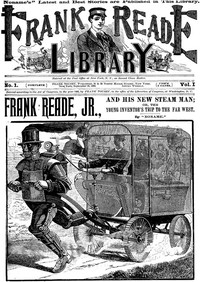
Frank Reade was noted the world over as a wonderful and distinguished inventor of marvelous machines in the line of steam and electricity. But he had grown old and unable to knock about the world, as he had been wont once to do.
So it happened that his son, Frank Reade, Jr., a handsome and talented young man, succeeded his father as a great inventor, even excelling him in variety and complexity of invention. The son speedily outstripped his sire.
The great machine shops in Readestown were enlarged by young Frank, and new flying machines, electric wonders, and so forth, were brought into being.
But the elder Frank would maintain that, inasmuch as electricity at the time was an undeveloped factor, his invention of the Steam Man was really the most wonderful of all.
“It cannot be improved upon,” he declared, positively. “Not if steam is used as a motive power.”
Frank, Jr. laughed quietly, and patted his father on the back.
“Dad,” he said, with an affectionate, though bantering air, “what would you think if I should produce a most remarkable improvement upon your Steam Man?”
“You can’t do it!” declared the senior Reade.
Frank, Jr., said no more, but smiled in a significant manner. One day later, the doors of the secret draughting-room of design were tightly locked and young Frank came forth only to his meals.
For three months this matter of closed doors continued. In the machine shop department, where the parts of machinery were secretly put together, the ring of hammers might have been heard, and a big sign was upon the door:
No admittance!
Thus matters were when one evening Frank left his arduous duties to spend a few hours with his wife and little boy.
But just as he was passing out of the yard, a darky, short in stature and of genial features, rushed excitedly up to him.
“Oh, Marse Frank,” cried the sable servitor, “Jes’ wait one moment!”
“Well, Pomp,” said Frank, pleasantly, “what can I do for you?”
The darky, who was a faithful servant of the Reades, and had accompanied both on their tours in foreign lands, ducked his head, with a grin, and replied:
“Yo’ father wants yo’, Marse Frank, jes’ as quick as eber yo’ kin come!”
“My father,” exclaimed Frank, quickly. “What is it?”
“I don’t know nuffin’ ‘bout it tall, Marse Frank. He jes’ say fo’ me to tell yo’ he want fo’ to see yo’.”
“Where is he?”
“In his library, sah.”
“All right, Pomp. Tell him I will come at once.”
The darky darted away. Frank saw that the doors to the secret rooms were locked. This was a wise precaution for hosts of cranks and demented inventors were always hovering about the place and would quickly have stolen the designs if they could have got at them.
Not ten minutes later Frank entered the library where his father was.
The elder Reade was pacing up and down in great excitement.
“Well, my son, you have come at last!” he cried. “I have much wanted to see you.”
“I am at your service, father,” replied Frank. “What is it?”
“I want you to tell me what kind of a machine you have been getting up.”
“Come now, that’s not fair,” said Frank Jr. with twinkling eyes.
“Well, if it’s any kind of a machine that can travel over the prairies tell me so,” cried the elder Reade, excitedly.
Frank, Jr., was at a loss to exactly understand what his father was driving at. However, he replied:
“Well, I may safely say that it is. Now explain yourself.”
“I will,” replied the senior Reade. “I have a matter of great importance to give you, Frank, my boy. If your invention is as good as my steam man even, and does not improve upon it, it will yet perform the work which I want it to do.”
A light broke across Frank, Jr.’s face.
“Ah!” he cried. “I see what you are driving at. You have an undertaking for me and my new machine.”
Frank, Sr., looked steadily at Frank, Jr., and replied:
“You have hit the nail upon the head.”
“What is it?”
“First, I must tell you a story.”
“Well?”