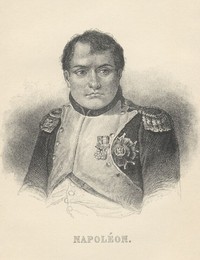
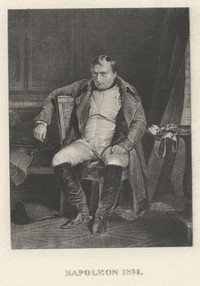
THE EMPEROR NAPOLEON.
REMOVAL OF FOUR PERSONS OF OUR ESTABLISHMENT.--RECOLLECTIONS OF THE EMPEROR’S EARLY LIFE.
Oct. 18, 1816.—I did not see the Emperor until five o’clock, when he sent for me to attend him in the drawing-room. He continued indisposed; but he had been engaged all the morning in dictating to the Grand Marshal. He summoned all the persons of his suite in succession. He was low-spirited and heavy; but at the same time there was a certain restlessness about him. He sought to amuse himself in various ways. He first tried chess, then dominos, and then chess again; but he was at length compelled to return to his chamber, finding it impossible to sit up. The state of the weather, joined to the vexations to which we are exposed, concur in producing torments almost beyond endurance. The weather has an effect on the nerves, and the persecutions that are heaped upon us are still worse to bear. Every word uttered by the Governor increases our misery. To-day he had signified his intention of removing four of our establishment, which has been the cause of general lamentation among the household: the individuals singled out for removal regret their separation from their companions; while those who are to remain are tormented by the fear of speedily sharing the same fate. We compared Sir Hudson Lowe to Scylla, devouring the four companions of Ulysses.
The Governor has informed me that he also intends removing my servant, who is an inhabitant of the island, and with whom I am very well satisfied. He is doubtless afraid that the man will become too much attached to me. He proposes to send me a servant of his own choosing, a favour for which I feel very grateful, though I have no intention of availing myself of the kind offer.
At dinner the Emperor ate but little. During the dessert, however, his spirits revived a little, and we began to converse on the events of his early life. This is a subject on which he delights to dwell, and which always affords him a source of new and lively interest. He repeated many of the particulars which I have already related at different times. He said that he loved to go back to that happy age when all is gaiety and enjoyment;—that happy period of hope and rising ambition, when the world first opens before us, and the mind fondly cherishes every romantic dream. He spoke of his regiment, and the pleasures he had enjoyed when he first mingled in society. On mentioning the different balls and fêtes which he had attended in his youthful days, he described one as having been particularly splendid. “But,” said he, “at that time my notions of splendour were very different from what they now are.”
Alluding to the date of certain circumstances, he observed that it would be difficult for him to divide his life year by year. We observed that if he would only date the events of four or five years, we could easily take all the rest upon ourselves. He reverted to his military début at Toulon, the circumstances that first called him into notice, the sudden ascendency which he acquired by his first successes, and the ambition with which they inspired him: “And yet,” said he, “I was far from entertaining a high opinion of myself. It was not till after the battle of Lodi that I conceived those lofty notions of ambition which were confirmed in Egypt, after the victory of the Pyramids and the possession of Cairo. Then,” said he, “I willingly resigned myself to every brilliant dream.”
The Emperor had become very cheerful and talkative, and he did not retire until midnight. We looked upon this as a sort of resuscitation.
MADAME DE GENLIS’ NOVELS.
19th.—Our four proscripts, namely, the Pole, Santini, Archambault, and Rousseau, left us about the middle of the day. In an hour they sailed for the Cape with a brisk wind.
About three o’clock the Emperor sent for me. He was in the drawing-room, and he desired to have Madame de Genlis’ novels brought to him. He read a few pages aloud; but he soon laid down the books, observing that they told him nothing. It was not so with me: the few pages that I had just heard touched many tender strings. They presented a picture of the elegant society of Paris, detailed the names of streets and monuments, described familiar conversations, and retraced well-known portraits: all this produced a forcible impression on me. The realities exist, I myself exist, and yet we are separated, by distance, time, and, doubtless, by eternity! I could at this moment look with indifference on pleasure and gaiety; but the recollection of persons and places, which had thus been revived, filled me with feelings of deep melancholy and regret.
The Grand Marshal now arrived, and the Emperor dictated to him till dinner-time.
In the evening the Emperor asked for the Arabian Nights; but he was unable to read, and soon laid aside the book.
VALUATION OF THE BOOKS SENT OUT TO US.—THE GRAND MARSHAL COMES TO LIVE NEARER TO US.
20th.—I spent the day in estimating the value of the books sent to us from London, and for which an enormous sum is claimed from the Emperor. Our valuation did not amount to even half that sum.
The Emperor did not appear in the drawing-room until a moment before dinner; he had not, he said, seen any body the whole day; he had sought for diversion, and found it in continued application. After dinner he again took up the Arabian Nights.
The Grand Marshal and his family have this day left Hut’s Gate, their first residence, which was situated about one league from Longwood. They have at last taken possession of their new house, by which means we are now nearly under the same roof. This was quite an event for them and for us.
EXPEDITION OF ST. LOUIS IN EGYPT.—OUR FEMALE AUTHORS.—MADAME DE STAEL.—THE WRITERS INIMICAL TO NAPOLEON WILL BITE AGAINST GRANITE.
21st.—I went after breakfast to see Madame Bertrand. She was so confined at Hut’s Gate that she will have no cause to regret being shut up within our enclosure, and we shall be very great gainers by it. For my part it seemed to me as if I had found part of my family.
Our limits become every day more circumscribed. The number of sentries is augmented, every thing reminds us incessantly of our horrible prison.
The Emperor said to me, whilst he was dressing, “that he was determined to apply, once more, regularly to his occupations, which had been interrupted by the late ill-treatment from our horrible Governor.” I urged him to do so with all my might, as well for his own sake as for ours, and for France and History.
The weather was too bad to allow the Emperor to take the air. He went into his library, and looked over the History of the Crusades by Michaud, and the Memoirs of Joinville. He then went to the drawing-room, and conversed for some time longer; particularly respecting the servant whom they wish to take from me, the one they intend to give me, &c.
The Governor will only give for the Emperor’s plate a sum more than one fifth less than the plate is valued at in Paris, and yet he will neither allow any competition for the sale of it in the Island, nor of its being taken to London!...
The unfortunate people that have been shipped for the Cape will be fed like common sailors. I have heard, on this occasion, that the same thing took place on board the Northumberland, and that the Emperor’s servants had not had any indulgence more than the common sailors, except by paying for it.
After dinner the Emperor read, in Joinville, an account of the expedition of St. Louis in Egypt. He analysed it, pointing out its defects, and comparing the movements and the plan of that Expedition with the plan adopted by himself; concluding that “if he had acted in the same manner as St. Louis had done, he should undoubtedly have shared the same fate.”
The Emperor retired early and sent for me. The conversation again fell upon his excursions in Egypt, and in Syria. Matilda, a novel, by Madam Cottin, the scene of which is laid in those countries, being incidentally mentioned, led the Emperor to take a review of our female authors. He spoke of Madame Roland and her Memoirs, of Madame de Genlis, of Madame Cottin, whose Claire d’Albe he had just been reading, and of Madame de Staël. He spoke at length about the latter, and repeated in part what has already been said. Speaking of her exile, he said: “Her house had become quite an arsenal against me; people went there to be dubbed knights. She endeavoured to raise enemies against me and fought against me herself. She was at once Armida and Clorinda.” Then, summing up his arguments as he was wont to do, he said: “After all, it cannot be denied that Madame de Staël is a very distinguished woman, endowed with great talents and possessing a considerable share of wit. She will go down to posterity. It was more than once hinted to me, in order to soften me in her favour, that she was an adversary to be feared, and might become a useful ally; and certainly if, instead of reviling me as she did, she had spoken in my praise, it might no doubt have proved advantageous to me; for her position and her abilities gave her an absolute sway over the saloons, and their influence in Paris is well known.” He then added, “Notwithstanding all that she has said against me, and all that she will yet say, I am certainly far from thinking or saying that she has a bad heart: the fact is, that she and I have waged a little war against each other, and that is all.” Then taking a review of the numerous writers who have declaimed against him, he said: “I am destined to be their food, but I have little fear of becoming their victim; they will bite against granite; my history is made up of facts, and words alone cannot destroy them. In order to fight against me successfully, somebody should appear in the lists armed with the weight and authority of facts on his side. If such a man as the great Frederick, or any other man of his cast, were to take to writing against me, it would be a different thing; it would then, perhaps, be time for me to begin to be moved; but as for all other writers, whatever be their talent, their efforts will be vain. My fame will survive: and when they wish to be admired, they will sound my praise.”
CARE TAKEN OF THE WOUNDED IN THE ARMIES.—BARON LARREY.—CHARACTERISTIC CIRCUMSTANCE.
22nd—23d. The weather has been very bad. The Emperor, suffering greatly from the tooth-ache, and having a swelled cheek, has not been able to go out for the last two days. I have spent the greatest part of them with him, in his apartment, or in the drawing-room, which he has converted into a promenade, by opening the doors of communication from one to the other.
Amongst the various subjects of our conversation, he once told me certain things which he had heard, and at which I much rejoiced. Nothing can give a more striking proof of the horrors of our situation than the importance which I attached to them. But every thing is in proportion to the situation in which we are placed.
At another time, the Emperor expressed his regret at being so lazy with respect to the English language. I told him that he now knew as much of it as he wanted. He could read all books; it was now only necessary to reduce the whole to a regular system—but, were the rule and compass fit things for him?