The long red clay road, winding down from the cabin where the McBirneys lived on their high shelf of Tennyson mountain, was frosted delicately with white, and by the roadside the curious frost flowers lifted their heads, as airy-fine as fern. From the half-hidden cabins all around the semicircle of mountains that skirted the valley of Lee, shafts of smoke arose, showing that the people were about the business of the day. Straight, gray and shadowy these smoke-shafts lifted through the lilac-tinted air; and below in the little town, other shafts of smoke ascended as if in friendly answer.
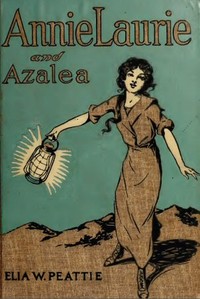
Azalea McBirney, in her dark riding skirt and bright knitted cap and reefer, came running from the cabin with the manner of a girl very much behindhand.
“Ain’t he there yet, Zalie?” a voice called from the cabin. “Ain’t Jim brought them ponies around yet?”
“No, mother,” Azalea answered over her shoulder, starting toward the stable. “Maybe the ponies have been naughty again. I’ll go see.”
“You just stay where you be,” commanded James Stuart McBirney from the stable. “You’ve got all your work done, ben’t you? Well, that’s all you have to think about. This here is my job and I mean to do it whatever comes, though these here ponies certainly do act up on a morning like this.”
“Well, I would just as soon get my breath for a moment,” Azalea remarked to nobody in particular, seating herself on the bench by the side of the door. “As Hi Kitchell’s mother says, ‘I bin goin’ like a streak o’ lightnin’ since sunup.’”
Her cheeks were, indeed, a trifle over-flushed, and forgetting for a moment how time was hastening along, and that she and Jim ought already to be on the road to school, she leaned her head against the side of the cabin and looked about her contentedly. She loved the scene before her; loved the pines with their light coating of hoarfrost; loved the waterfall with its gleaming icicles; loved the scent of the wood-smoke and the sight of “Molly Cottontail” scampering through the bushes.
Moreover, the kiss of Mary McBirney lay warm on her lips—Mary McBirney who had taken her in when she was a motherless and friendless girl, and whom she found it sweet to call mother. “Mother” was a longer word than Jim—otherwise James Stuart McBirney, the true son of the house—found it convenient to use when he spoke of the woman who was the background of his world. “Ma” was the term he chose, and Mary McBirney would not have cared to have him try any other.
For Jim was just Jim—her own freckled, shy, plucky fellow. He went down to the district school, riding on the pony the Carsons had given him, while beside him, quite as if she were his own sister, rode Azalea, who trusted him to see her through any danger of the road, who laughed as much as anybody could wish at his “hill billy” jokes, and who never, never forgot how he had welcomed her into his home, to share all he had, though there never had, at any time, been very much to share.
Yet, though she had been only the “child wonder” of a wandering “show” when she came to the McBirney’s—her own poor little mother lying dead in one of the wagons—it was she, and not Jim, the carefully reared boy, who had the grand little ways. Jim was a country boy, with a country boy’s straightforward, simple manners. But about Azalea there was something—well, something different. So different was she from the McBirneys that she seemed like a cardinal bird which had been storm-driven into one of the martin gourds that hung in the high cross-trees before the McBirney’s door.
All that was easily understood by the few who knew her story. Her grandfather had been Colonel Atherton, the richest, the proudest, and the most elegant gentleman in all the countryside. He had owned great plantations in the old slave days, and had built the beautiful manor house which their new, wonderfully kind neighbors, the Carsons, recently had bought. Azalea’s mother had exiled herself by a marriage with a man of whom no parent could approve, and as misfortune drove her ever lower and lower, she came at length to be a performer in the miserable roadside show with which she had come, in her last hour, to the scene of her father’s old home. That home had long since passed into other hands, and concerning it Azalea’s mother had told her daughter nothing. It had been by an accident that she later learned the truth.
When Mr. and Mrs. Carson, the friends who had from the first of their acquaintance with her endeavored to add to her happiness, learned her story, they asked her to come into their home to be a sister to their own girl, Carin. And Azalea in her secret heart had longed to go—more than she ever would have told, she longed to be with these accomplished and gracious friends, whose wealth made it possible for them to do almost anything they pleased, and who seemed pleased to do only interesting things. But when she remembered the welcome that had been given her by Mary McBirney, and indeed, by all of the McBirney family, and how she had, in a way, taken the place of their little dead Molly, she was able to put temptation from her; and the hour in which she had made her choice and been gathered in “Ma” McBirney’s arms was the happiest she ever had known.
So, though she was born Azalea Knox, the granddaughter of Colonel Atherton, she was now known as Azalea McBirney, the waif the McBirneys had taken into their cabin to grow up side by side with their son James Stuart. And all over the Valley of Lee an interest was felt in her; partly because of her being an orphan, and a child of quaint and lovable ways, and partly because of a strange happening. Not long after she had come to live with the good mountain folk, the owner of the show with which she had once traveled had kidnapped her, and the search for her had been long and anxious.
When she was rescued and brought back to the home where she was so welcomed and loved, all of the neighbors had a protective feeling for her, and rejoiced that the Carsons, who had come down from the North, and who seemed so eager to be of help to everybody, should have taken her in to be taught with their daughter. Never had there been such neighbors as the Carsons in Lee. They made goodness their business, it seemed. Through them the mountain folk were finding a market for their homemade wares—their woven cloth and their counterpanes, their baskets and chairs, and comfort had come into many a home where hitherto there had been cruel poverty.
But there on the bench by the doorway in the nipping morning air sits Azalea, with her nose and ears growing redder and redder!
“Jim,” she called, awakening from her reverie, “we’ll be late as sure as anything.”
“Coming right along now, sis,” answered the boy as he came running from the stable with the two ponies. “Hop into the saddle, Zalie, and we’ll just pelt it down the mountain. Here, I’ll hold him. There you are. Hi—they’re off.”
They surely were. Pa McBirney, busy in his little smithy, heard the clatter of hoofs and thrust his head from the door.
“Watch out, you two!” he warned.
“We will,” they called in chorus as they dashed on.
“My sakes,” said pa, coming in from the shop and wiping his hands on his leathern apron, “I trust to luck ma didn’t see ’em going off. Them young uns are getting too much spirit in ’em to suit me; and as for the ponies, I think they ought to be cut down on their feed.”
But neither Azalea nor James Stuart was wanting anyone to cut down on anything. As the firm-footed ponies took the cut-offs, minding neither curve nor steep, the children shouted with delight.
“Late?” yelled Jim mockingly. “Who said late? We couldn’t be late if we tried.”
They reached the parting of their ways, and Azalea, who was leading, turned in her saddle to wave to Jim.
“Good-bye, boy,” she called.
“So long, sis,” he answered, and turned to follow the creek, and then to mount the hill at the top of which stood the district school. But Azalea kept on along the low-winding road till she came to The Shoals, from whose four tall chimneys the smoke mounted into the tinted air. Benjamin, the polite black boy, was at the horse-block to help her dismount and to lead away Paprika, her pony; and Tulula Darthula, the maid, opened the door to welcome her. Azalea spoke a laughing word of greeting and ran on down the corridor to the schoolroom.
It was a small room, semicircular in shape, opening on the wintry garden. The rounding portion of the wall was all of glass, which in summer time gave way to screens, so that it then seemed an actual part of the garden. Now, the polished panes reflected the flames leaping in the fireplace, and revealed the frost-fringed hemlocks without. Before the fire sat Miss Parkhurst, the quiet, gray-eyed governess, and with her, Carin, the friend whose approval was more to Azalea than anything else in the world save the love of the new “mother.”
“Oh, here I am, late!” cried Azalea contritely. “Please forgive me, ma’am.”
Helena Parkhurst gave a pardoning smile.
“I really think we’re ahead of time this morning—Carin and I. Take off your things, child, and come up to the fire. We’ve been trying to have it at its best when you came.”
But Azalea’s fingers, stiffened with holding the bridle reins, made sorry work with her buttons, and Carin flew to her aid.
“You smell like winter, Azalea,” she laughed, sniffing; “all cold and clean.”
Azalea laughed happily. Whatever this blue-eyed, golden-haired friend of hers did seemed right to her—nay, better than merely right—complete. It warmed Azalea more than the glow of the room to have Carin snatch her cap from her, and pull her reefer off, and tumble her with affectionate roughness into the chair before the blaze.
“Colonial history again this morning,” said Miss Parkhurst after a time. “We’re to read about the Delaware and the Virginia Colonies, since Carin’s ancestors came from the first and Azalea’s from the second.”
“Well, they’ll be different enough, won’t they?” remarked Carin. “They were different sort of folk before they crossed the Atlantic, and their differences grew after they settled here. And yet here Azalea and I are, as alike as can be.”
“But I don’t think the differences of the colonists grew, Carin,” said Azalea, “and I’m terribly afraid you and I aren’t alike. I couldn’t be like you if I tried for ever and ever.” She gave a wistful sigh, and Miss Parkhurst, watching her without seeming to do so, saw the light of hero-worship in her eyes. She knew that Azalea was one of those who are born to love hungrily, and to live eagerly; and she was thankful that, having so hungry a heart, she was able, when it came to a matter of opinion, to form her own ideas, and to hold to them. Azalea’s heart was in leading strings to Carin, but her excellent little brain went on its independent way, though Carin had traveled and studied, and been all her life with charming and cultivated people, and Azalea had been tended no more than a patch of wayside daisies.
Miss Parkhurst brought the books they were needing from the library, and Carin taking hers, sighed happily: “Isn’t it beautiful to be here by ourselves—just the three of us? No one else would fall into our way of doing. How nice it is of you, Miss Parkhurst, to let us follow up whatever idea we’re interested in, and to help us learn all we can about that subject, instead of making us dash from one thing to another, till we haven’t a notion what we are trying to learn. I’d never get anywhere, studying in the old-fashioned way, jumping from subject to subject, and having to wait for a whole class of stupid creatures to come tagging along.”