
Public-domain ebook
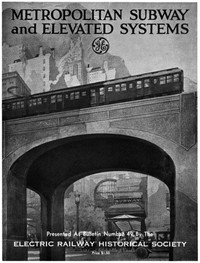
Metropolitan Subway and Elevated Systems Bulletin 49
Language: en334 downloads on Project Gutenberg
Subjects
In: History - Modern (1750+)·Engineering & Technology
Public-domain ebook sourced from Project Gutenberg #54009.
Public-domain ebook
Language: en334 downloads on Project Gutenberg
Subjects
In: History - Modern (1750+)·Engineering & Technology
Public-domain ebook sourced from Project Gutenberg #54009.
The opening · free to read
The transportation system of the city of Boston comprises a combination of both rapid transit and surface lines operated under a single fare arrangement with transfer privileges permitting a continuous ride in one general direction from one end to the other of the system. The elevated lines and the Tremont St. Subway were originally built by the railway company in 1901. Today the total transportation system includes more than 500 miles of line of which 37 miles are subway and elevated tracks. The population served in the district of more than 92 square miles is considerably over a million people and the number of revenue passengers carried, approximates 350,000,000 per year. Statistics are not available as to the passengers carried on the Rapid Transit lines.
The original elevated structure operated between Sullivan Sq., Charlestown, and Dudley Street, with two branches through the city, one by subway under Tremont St. and the other by the way of Atlantic Ave. and South Station. In 1908-9 the elevated structure was extended to the present terminal at Forest Hills and the Washington St. Subway was completed through the business part of the city. The Cambridge Subway was placed in operation in 1912. Recent extensions include an elevated line from Sullivan Square to Everett and reconstruction of the tunnel to East Boston.
Since July 1, 1919, the system has been operated by the Board of Trustees of the Commonwealth. Under the direction of this board are included not only the details of operation and management, but also the decisions as to fares to be charged independent of the State Department of Public Utilities.
Under the direction of the present management a continuous program of improvements has been inaugurated which has necessitated the re-routing of trains to handle the traffic to the best advantage.
Briefly there are four main routes as follows:
Forest Hills-Everett (via tunnel) 8.59 miles Forest Hills-Everett (via elev.) 9.35 miles Harvard-Andrew 5.56 miles No. Station West-Kenmore 2.87 miles Bowdoin-Maverick Sq. 1.67 miles
The Forest Hills-Everett route is called the main line, and the Harvard-Andrew route the Cambridge Subway. The Bowdoin-Maverick Square line up to the present has been operating three-car trains with overhead trolley, but new equipment consisting of steel cars is now on order and the third rail is now being installed in the tunnel. The Lechmere Sq.-Broadway line over East Cambridge Viaduct and Tremont St. Subway is also considered a rapid transit route, although surface type cars are used with overhead trolley. These cars are equipped for multiple unit control and are operated in three-car trains.
The rush hour trains on the main line include as high as eight cars, which is the limit set by the length of the station platforms. The signal system is entirely automatic and during rush hours the headway varies from 2 to 3½ minutes on the main line. The maximum grades encountered are 2 to 3 percent with a high percentage of heavy curvature. By taking advantage of the transfer arrangements at terminals, rides of 14 miles can be obtained for a single fare.
The power system as originally installed included several engine-driven direct-current plants suitably located for distributing 600 volts direct to the trolley. With the extension of the system, however, an alternating-current station was installed at South Boston, generating 25-cycle three-phase current for distribution at 13,200 volts to synchronous converter substations. Alternating-current generating equipment has also been installed at the Lincoln Station. The total installed capacity of turbine stations is now 115,000 kw. while the direct-current generating stations have practically all been discontinued.
There are in operation for supplying power to both elevated and surface lines a total of 12 synchronous converter substations having a total rated capacity of 58,000 kw. The power consumption of the Rapid Transit lines is somewhat less than half the total energy used.
Direct current is distributed from the several substations at 600 volts and is collected on the rapid transit systems from an 85-lb. over-running third rail.
Altogether there are 420 cars in the rapid transit service, the older cars weighing about 34 tons with seating capacity of 48 and the newer type as used in the Cambridge Subway 43 tons each, arranged to seat 72 passengers. On account of the limiting clearances in the old subway the Cambridge cars cannot be used on the main line. All cars are motor cars and no attempt is made to use trailers. Each car is equipped with two motors and multiple unit control.
------------------------------------------------------------------------
The Brooklyn Rapid Transit Company controls all of the elevated and surface lines in Brooklyn including those reaching Coney Island. It also has entrance to Manhattan over the lines of the New York Municipal Railway Corporation, which was organized by the B. R. T. to finance and construct a part of the new city lines allotted to the B. R. T. The New York Municipal line runs through the new Broadway subway as far north as 60th St. thence east through the 60th St. tunnel under the East River to a connection with the Astoria and Corona lines in Queens. Other subway and bridge routes have been completed during the past few years as part of a definite plan, which contemplates the elimination of the present stub end operation at the lower end of Manhattan.
The Brooklyn Bridge line built in 1883 and the Brooklyn Elevated R. R. in 1888 formed the nucleus of the present Brooklyn Rapid Transit system. Electrical equipment was tried out in 1898 and additional motor cars were put in service in 1902. This improvement rapidly displaced the “steam dummies” and facilitated the extension of lines and the handling of a rapidly increasing traffic.
Of the present lines on the Brooklyn Rapid Transit system 89.20 miles of route aggregating 258.35 miles on a single track basis can be classed as rapid transit lines and operate multiple unit trains with third rail current collection. This includes the several elevated branches in Brooklyn and the newer subway lines of the dual system all of which are operated by the New York Consolidated R. R. Co., which is the operating organization.
The lines of the Brooklyn Rapid Transit system, which are operated by the New York Consolidated R. R., according to figures for the year ended June 30, 1921, handled 404,970,640 passengers over the rapid transit lines.
The original power equipment consisted of engine-driven direct-current generators, which have gradually been retired due to obsolescence.
Power for operating the B. R. T. system is now generated in two alternating-current plants with installed capacities as follows:
Central (Third Av. & 2nd. St.) 16,500 kw. Williamsburg (Kent Av. & Rush St.) 182,500 kw.
Power is generated and transmitted at 6600 volts, 25 cycles, three-phase. Owing to the diversified feeding system it is not possible to estimate the portion used by the elevated and surface lines. Power for the operation of the Manhattan lines is purchased from the Interborough Rapid Transit Co.
For supplying 600 volts to the entire system the B. R. T. has in operation 98 synchronous converter units aggregating 142,500 kw. These units range in size from 500 to 4000 kw. each. Many of the stations feed both elevated and surface lines so that it is difficult to approximate the capacity available for the rapid transit service.
The New York Consolidated R. R. Company operates in subway and elevated service a total of 1550 cars each equipped with two motors and multiple unit control. These include the equipment operated over the New York Municipal lines through the new subways. 900 of the newest cars use GE-248 motors and weigh, fully equipped, about 45 tons with seats for 72 passengers. These new cars are operated in all motor car trains.
Trains up to seven cars are operated in rush hour service and the minimum headways approximate two minutes. The maximum length of ride possible for a single fare is from Corona through the Broadway subway to Coney Island, about 21 miles. The maximum grade on the system is 5 per cent on the New York Municipal line.
------------------------------------------------------------------------
The present Chicago Elevated Railroads are an amalgamation of the four systems which up to 1911 were operated as independent lines. Under the unified system of operation a single fare takes the passenger from one end of the system to the other, except that north of Howard Street on the Evanston line an additional fare is collected. The longest continuous ride without change is from Wilmette to Jackson Park, a distance of 24 miles.
The first elevated road, afterward known as the South Side Elevated, started operation in June, 1892, with steam engines. After the successful demonstration on the Intramural Railway this line was electrified; all steam equipment being withdrawn in 1898.
What is now the Chicago and Oak Park Elevated Railroad began operation in 1893 also with steam locomotives. Electrical operation began in September, 1896.
The Metropolitan West Side was originally planned for steam locomotive operation, but developments in electric traction during the construction period were so rapid that orders for steam equipment were cancelled and operation began in May, 1895, with electric equipment.
The Northwestern Elevated began operation in May, 1900, and was planned as an electric rad from the start. In 1897 the “Union Loop” was built to facilitate interchange of passengers from the different lines, but a separate fare was required on each road up to 1913.
The population served by the Chicago Elevated Lines is estimated at more than 1,000,000 people; the total number of passengers handled annually is about 190,000,000. Trains of from six to eight cars are operated during rush hour service on a two-minute headway with a maximum of 72 trains per hour on a track of the loop. Plans are being made to extend some of the station platforms to permit the use of more than 6- and 8-car trains.
An extensive program of improvements to the present rapid transit system has been proposed, but no definite steps have yet been taken toward authorizing the work. These plans include a subway section under the present loop district with several additional elevated lines.
PRESENT MILEAGE OF CHICAGO ELEVATED LINES
══════════════════════╤═══════╤═══════╤═══════╤═══════ │ Route │Single │ Yard │ Total │ Miles │ Track │ │ Track │ │ Miles │ │ ├───────┼───────┼───────┼─────── Northwestern Elevated │ 19.7│ 52.33│ 9.28│ 61.61 Chicago & Oak Park │ 9.32│ 20.38│ 2.28│ 22.66 Metropolitan West Side│ 23.83│ 53.63│ 7.78│ 61.41 South Side │ 16.15│ 35.99│ 9.97│ 45.96 Loop │ 2.12│ 4.72│ ....│ 4.72 ├───────┼───────┼───────┼─────── │ 91.12│ 167.05│ 29.31│ 196.36 ──────────────────────┴───────┴───────┴───────┴───────
The power for the early elevated lines was derived from engine-driven direct-current power plants all of which have since become obsolete. All power, therefore, is supplied from the network of the Commonwealth Edison Co., which maintains an ample reserve to supply all needs. While a large percentage of the power now being purchased is generated at 25 cycles, the policy of the Power Co. on all new equipment is to specify 60 cycles.
The book keeps going
Reading is free forever. Sign up and watch scenes appear while you read.



Scenes Storieta drew for other classics.

New illustrated classics
Once or twice a month: the latest books to get full character casts, scene art, and free comic editions. No account needed.