Public-domain ebook
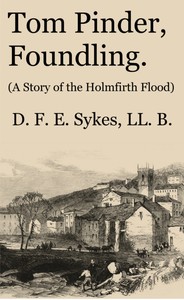
Tom Pinder, Foundling: A Story of the Holmfirth Flood
Language: en411 downloads on Project Gutenberg
Subjects
In: Historical Novels·Novels·British Literature
Public-domain ebook sourced from Project Gutenberg #54121.
Public-domain ebook
Language: en411 downloads on Project Gutenberg
Subjects
In: Historical Novels·Novels·British Literature
Public-domain ebook sourced from Project Gutenberg #54121.
The opening · free to read
THE Hanging Gate is a public-house of venerable aspect. It stands at the corner of one of four cross ways, where the road from the summit of Harrop Edge cuts the turnpike from Leeds to Manchester. It pays rates in the township of Diggle, and to Diggle it properly belongs; but the small cluster of tumble-down cottages that constitutes a very small hamlet rejoices in the name of Wakey, a name whose origin has hitherto baffled the researches of local antiquarians. The inn itself is a low, two-storied, rambling building. Its rooms are so low that a moderately tall man must dodge the oaken rafters. There is much stabling, now largely abandoned to the rats, for the pristine glory of the Hanging Gate departed with the stage coach. A long horse-trough by the side of the inn front still stands to remind the wayfarer of the days when the highway was quick with traffic, but the sign itself bears eloquent testimony of decay and fallen fortunes though it still flaunts its ancient legend on a miniature crate that rocks and creaks over the narrow doorway: "This Gate hangs well and hinders none; Refresh and pay and travel on."
But on a certain winter's night of 183--, when this story opens, the guest more bent upon refreshing than travelling on might have pleaded good excuse. Outside, the snow lay upon field and road knee-deep, the thatches, gables, and very faces of the scattered houses of Wakey were splashed and bespattered with snow, which for days had fallen in big flakes, silent and sad as the grey leaves of latest autumn, making thick the air as with the lighting of grasshoppers. The moon in the low-hanging sky was veiled by heavy masses of dark cloud that stole across the heavens like mutes oppressed by the sombre garb of woe. Signs of life about the Wakey there seemed none, save the mellowed light that shone across the bisecting roads from the curtained lattices of the Hanging Gate. It was eight o'clock and the hand-loom weavers or mill-hands habiting the small stone-build houses that straggled from the valley up the bleak sides of Harrop Edge had gone to bed, not so much because they were weary as to save fire and light. The village smithy flanking the stables of the Hanging Gate was closed and the smith himself, big burly Jim o' Little Hannah's had forged his last shoe and blown the last blast from his bellows, poured his last pint down his throat in the neighbouring taproom and trudged home to his little wife and large family. The few frequenters of the tap-room had tarried till tarry they might no longer, for times were bad, money was scarce and the credit given by the best of innkeepers has its limits.
Mrs. Betty Schofield, the buxom hostess of the Hanging Gate was no wise dismayed by the slackness of her custom. Rumour had it that Betty was a very warm woman. She had been some years a widow, and her husband had left her, as the gossips said, well worth picking up. Look at her as she sits in the long kitchen before a roaring fire of mingled coal, peat and logs. Below the medium height, with wavy brown hair, a soft brown eye, a dimpled chin, now inclined to the double, a full and swelling bust, a mouth not too small and smiling lips that parted only to display a perfect set of teeth--it does one good to look upon her rosy cheek.--Happy the man, you say, who shall own those ample charms and for whom shall beam the ready smile or soften the warm brown eyes.
There are another two seated in the brick-tiled kitchen. Mary o' Stuart's commonly called Moll o' Stute's, and Mr. William Black. Moll shall have precedence in honour of her sex and calling, a noble calling, of a verity, for Mary was the midwife of the valley. She is scantily clad for the time of the year, yet you judge that it is not from cold that she huddles by the fireside, but rather for convenience of lighting the black clay pipe she so intently sucks, one long skinny brown arm resting on her knee, her eyes fixed upon the glowing fire that casts its flickering light upon the sharp hard-featured face. Her black hair is long and though streaked with grey is still abundant, and rebellious locks, escaped from the coil, stray over the scraggy shoulders, round which a shabby, faded, flannel shawl hangs loosely. No one knows where Moll lives, if it be not at the Hanging Gate, which, if not her home, is for Moll a sort of Poste Restante, and if not there to be always seen there she can always be heard of. Moll has less need of fixed abode than ordinary mortals. She has reached the age of fifty or more, and still bears her virgin name and owns to neither chick nor child, though there were that breathed mysterious hints of wild passages of thirty years gone bye, when Moll's cheek was soft and rosy and her form, though tall, lacked nought of grace and suppleness. "A saucy queen," the village grannies said, "and one that always thought herself too good for common folk; but pride had had its fall,"--a reflection that seemed to bring comfort to the toothless, hollow-cheeked beldames as they wheezed asthmatically of the scandals of a youth long fled, when Mary's foot light upon the village green and her laugh was readiest at feast or wakes.
On the opposite side of the hearth sat Mr. Black, the village Schoolmaster, a little lean man well past his meridian, his hair sparse and thin, and sparse and thin all his form and frame. He is clean shaven, but his lips are firm and his eye bright and keen. Though he has the lean and hungry look of the born conspirator, never did such a look so belie a man; for a gentler being never breathed than William Black, nor one more secure in the affection and esteem of high and low for many miles around. He was not a that country man and how or by what fate, driven by what adversity or sore mischance, he had drifted to that wild neighbourhood none presumed to know. He kept a day school for boys and girls, whose parents paid fourpence a child per week when they could afford it, and less when they couldn't--generally less. Then on alternate week-nights he kept a night-school where strapping and ambitious youths from loom or farm or bench, whose education had been neglected in their tender youth sought painfully to learn to read and write and sum. These were known to pay as much as twopence a lesson. Mr. Black--even in those irreverent days and parts, where few even of the better sort escape a nick-name, he was always called Mr. Black,--was a bachelor, and his modest household and Mr. Black himself were ruled by a spinster sister, shrill of voice, caustic of speech, with profound contempt for her brother's softness, but unceasing and untiring in the care of the household gods, and happiest in those "spring cleanings" that were not confined to spring. But to-night Mr. Black has fled before his sister's voice and twirling mop, and a look of seraphic content rests upon his face as he meditatively puffs his long churchwarden and sniffs the fragrant odour of the mulled ale that simmers in the copper vessel, shaped like a candle-snuffer, or, as Mr. Black reflected, like a highly burnished dunce's cap, and which the plump hand of Mrs. Schofield had thrust nigh to its rim in the very heart of the ruddy fire. The schoolmaster's thin legs, clad in stout stockings of native wool, knit by Miss Black's deft fingers, were crossed before the blaze and the grateful warmth falls upon them, the while the clogging snow slowly melts from his stout boots.
"Redfearn o' Fairbanks is late to-night," he said at length, after a silence broken only by the click of Mrs. Schofield's steel knitting needles.
"Aye, it's market day in Huddersfilt, yo' know, Mr. Black, an' th' roads 'll be bad to-neet. But Fairbanks 'll win through if th' mare dunnot fall an' break his neck."
"Th' mare's nooan foaled 'at 'll break Tom o' Fairbank's neck," said Moll o' Stuart's, grimly. "It's spun hemp that bides for him, if there's a God i' heaven."
"Whisht yo' now, Moll, an' quit speakin' o' your betters, leastwise if you canna speak respectful."
"Betters! Respectful! Quo' she," retorted Molly with a defiant snort, pulling hard at her filthy cuddy.
"Aye betters!" snapped the landlady, or as nearly snapped as lips like hers could snap. "It's me as says it, an' me as 'll stand to it. Wheer i' all th' parish will yo find a freer hand or a bigger heart nor Tom o' Fairbanks? Tell me that, yo' besom."
"Aye free enew," said Molly curtly.
Mrs. Schofield bridled indignantly.
"Oh! It's weel for yo' to sit by mi own fireside an' eat o' mi bread an' nivver so happy as when yo're castin' up bye-gones 'at should be dead an' buried long sin."
"Aye, aye, let the dead past bury its dead," put in the schoolmaster soothingly.
"An' what if Redfearn o' Fairbanks ware a bit leet gi'en i' his young days," went on the irate hostess. "He's nooan th' first an' he'll nooan be th' last. He's nobbut human like most folk 'at ivver I heard tell on. He's honest enough now, if he's had to wear honest. An' it's weel known...."
But what was so well known that the voluble tongue of Mrs. Schofield was about to repeat it at large shall not be here set down, nor was destined that night to enlighten the company; for the outer door was opened, and a gust of keen wind laden with feathery flakes of snow whirled up the narrow passage, well nigh extinguishing the slender light of the oil lamp on the wall, and causing the great burnished metal dishes and the very warming-pan itself to sway gently on their hooks.
"It's Fairbanks, hissen," said Mrs. Schofield "Talk o' the de'il," muttered the irrepressible Moll but no one heeded.
Then was heard much stamping of feet in the outer passage and kicking of boot toes on the lintel of the door and not a little coughing and clearing of the throat.
"Ugh! Shut the door to, man," cried a hearty voice; "do yo' want me to be blown into th' back-yard?"
The heavy bolt-studded door was pressed back and there strode into the room a tall well-built man. Top-booted, spurred, with riding-whip in hand, and wearing the long heavy-lapetted riding-coat of the period--a hale, hearty man fresh-complexioned, with close cropped crisping hair, the face clean shaven after the fashion of the times, a masterful man, you saw at a glance, and one who knew it. Though he was over the borderland of his fifth decade, time had neither wrinkled his ruddy face nor streaked his crisp brown hair. Behind him as he strolled into the kitchen, shambled a thick-set, saturnine, grim-visaged churl, who knew more of his master's business and far more of his master's secrets than the mistress of Fairbanks herself. It was Aleck, the shepherd and general factotum of Fairbanks farm, Aleck the silent, Aleck the cynic, Aleck the misogynist, against whose steeled heart successive milk-maids and servant wenches had cast in vain the darts and arrows of amorous eyes and who was spitefully averred to care only for home-brewed ale, and the sheep-dog, Pinder that now, already, was shaking the snow oft his shaggy coat preparatory to curling himself up before the fire.
The book keeps going
Reading is free forever. Sign up and watch scenes appear while you read.



Scenes Storieta drew for other classics.
New illustrated classics
Once or twice a month: the latest books to get full character casts, scene art, and free comic editions. No account needed.