Before undertaking the present work I had no experience as an editor. It is unnecessary for me to say, therefore, that, were I now to undertake it, I should pursue a somewhat different course from that which I have pursued. The New English Canaan is, in many respects, a singular book. One of its most singular features is the extent of ground it covers. Not only is it full of obscure references to incidents in early New England history, but it deals directly with the aborigines, the trees, animals, fish, birds and geology of the region; besides having constant incidental allusions to literature,--both classic and of the author’s time,--to geography, and to then current events. No one person can possess the knowledge necessary to thoroughly cover so large a field. To edit properly he must have recourse to specialists.
It was only as the labor of investigation increased on my hands that I realized what a wealth of scientific and special knowledge was to be reached, in the neighborhood of Boston, by any one engaged in such multifarious inquiry. Were I again to enter upon it I should confine my own labors chiefly to correspondence; for on every point which comes up there is some one now in this vicinity, if he can only be found out, who has made a study of it, and has more information than the most laborious and skilful of editors can acquire.
In this edition of the New Canaan I have not laid so many of these specialists as I now wish, under requisition; and yet the list is a tolerably extensive one. In every case, also, the assistance asked for has been rendered as of course, in the true scientific spirit. My correspondence has included Messrs. Deane, Winsor and Ellis on events in early New England history; Professor Whitney on geographical allusions; Professors Lane and Greenough, Dr. Everett and Mr. T. W. Higginson, on references to the Greek and Latin classics, or quotations from them; and the Rev. Mr. Norton on Scriptural allusions. Mr. J. C. Gray has hunted up for me legal precedents five centuries old, and Mr. Lindsay Swift has explained archaic expressions, to the meaning of which I could get no clew. On the subject of trees and herbs I called on Professors Gray and Sargent; in regard to birds, Mr. William Brewster was indefatigable; Mr. Allen, though in very poor health, took the chapter on animals; Professor Shaler disposed of the geology; Messrs. Agassiz and Lyman instructed me as to fish, and Professor Putnam as to shell-heaps. I met some allusions to early French and other explorers, and naturally had recourse to Messrs. Parkman and Slafter; while in regard to Indian words and names, I have been in constant correspondence with the one authority, Mr. J. Hammond Trumbull, who has recognized to the fullest extent the public obligation which a mastery of a special subject imposes on him who masters it.
In closing a pleasant editorial task, my chief regret, therefore, is that the notes in this volume contain so much matter of my own. They should have been even more eclectic than they are, and each from the highest possible authority on the subject to which it relates.
C. F. A., JR.
QUINCY, MASS., April 4, 1883.
MORTON OF MERRY-MOUNT.
In the second book of his history of Plymouth Plantation, Governor Bradford, while dealing with the events of the year 1628 though writing at a still later period, says:--
“Aboute some three or four years before this time, ther came over one Captaine Wolastone (a man of pretie parts), and with him three or four more of some eminencie, who brought with them a great many servants, with provisions and other implaments for to begine a plantation; and pitched themselves in a place within the Massachusets, which they called, after their Captains name, Mount-Wollaston. Amongst whom was one Mr. Morton, who, it should seeme, had some small adventure (of his owne or other mens) amongst them.”[1]
There is no other known record of Wollaston than that contained in this passage of Bradford.[2] His given name even is not mentioned. It may be surmised with tolerable certainty that he was one of the numerous traders, generally from Bristol or the West of England, who frequented the fishing grounds and the adjacent American coast during the early years of the seventeenth century. Nothing is actually known of him, however, until in 1625 he appeared in Massachusetts Bay, as Boston Harbor was then called, at the head of the expedition which Bradford mentions.
His purpose and that of his companions was to establish a plantation and trading-post in the country of the Massachusetts tribe of Indians. It was the third attempt of the kind which had been made since the settlement at Plymouth, a little more than four years before. The first of these attempts had been that of Thomas Weston at Wessagusset, or Weymouth, in the summer of 1622. This had resulted in a complete failure, the story of which is told by Bradford and Winslow, and forms one of the more striking pages in the annals of early New England. The second attempt, and that which next preceded Wollaston’s, had closely followed the first, being made in the summer of 1623, under the immediate direction of the Council for New England. At the head of it was Captain Robert Gorges, a younger son of Sir Ferdinando Gorges. Weston’s expedition was a mere trading venture, having little connection with anything which went before or which came after. That of Gorges, however, was something more. As will presently be seen, it had a distinct political and religious significance.
Robert Gorges and his party arrived in Boston Bay in 1623, during what is now the latter part of September. They established themselves in the buildings which had been occupied by Weston’s people during the previous winter, and which had been deserted by them a few days less than six months before. The site of those buildings cannot be definitely fixed. It is supposed to have been on Phillips Creek, a small tidal inlet of the Weymouth fore-river, a short distance above the Quincy-Point bridge. The grant made to Robert Gorges by the Council for New England, and upon which he probably intended to place his party, was on the other side of the bay, covering ten miles of sea-front and stretching thirty miles into the interior. It was subsequently pronounced void by the lawyers on the ground of being “loose and uncertain,” but as nearly as can now be fixed it covered the shore between Nahant and the mouth of the Charles, and the region back of that as far west as Concord and Sudbury, including Lynn and the most thickly inhabited portions of the present county of Middlesex.
Reaching New England, however, late in the season, Gorges’s first anxiety was to secure shelter for his party against the impending winter, for the frosts had already begun. Fortunately the few savages thereabouts had been warned by Governor Bradford not to injure the Wessagusset buildings, and thus they afforded a welcome shelter to the newcomers. These were people of a very different class from those who had preceded them. Among them were men of education, and some of them were married and had brought their wives. Their settlement proved a permanent one. Robert Gorges, it is true, the next spring returned to England disgusted and discouraged, taking back with him a portion of his followers. Others of them went on to Virginia in search of a milder climate and a more fertile soil. A few, however, remained at Wessagusset,[3] and are repeatedly referred to by Morton in the _New Canaan_[4] as his neighbors at that place.
When, therefore, Wollaston sailed into the bay in the early summer of 1625, its shores were not wholly unoccupied. His party consisted of himself and some three or four partners, with thirty or more servants, as they were called, or men who had sold their time for a period of years to an employer, and who stood in the relation to him of apprentice to master. Rasdall, according to Bradford, was the name of one of the partners, and Fitcher would seem to have been that of another. Thomas Morton, the author of the New English Canaan, was a third.
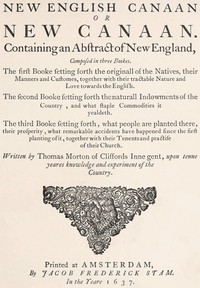
Not much more is known of Morton’s life prior to his coming to America than of Wollaston’s. He had certainly an education of that sort which was imparted in the schools of the Elizabethan period, for he had a smattering knowledge of the more familiar Latin authors at least, and was fond of classic allusion. Governor Dudley, in his letter to the Countess of Lincoln, says that while in England he was an attorney in “the west countries.”[5] He further intimates that he had there been implicated in some foul misdemeanor, on account of which warrants were out against him. Nathaniel Morton in his _Memorial_[6] says that the crime thus referred to was the killing of a partner concerned with him, Thomas Morton, in his first New England venture. Thomas Wiggin, however, writing in 1632 to Sir John Cooke, one of King Charles’s secretaries for foreign affairs and a member of the Privy Council, states, upon the authority of Morton’s “wife’s sonne and others,” that he had fled to New England “upon a foule suspition of murther.”[7] While, therefore, it would seem that grave charges were in general circulation against Morton, connecting him with some deed of violence, it is necessary to bear in mind that considerable allowance must be made before any accusation against him can be accepted on the word of either the Massachusetts or the Plymouth authorities, or those in sympathy with them. Yet Morton was a reckless man, and he lived in a time when no great degree of sanctity attached to human life; so that in itself there is nothing very improbable in this charge. It is possible that before coming to America he may have put some one out of the way. Nevertheless, as will presently be seen, though he was subsequently arrested and in jail in England, the accusation never took any formal shape. That he was at some time married would appear from the letter of Wiggin already referred to, and the allusions in the New Canaan show that he had been a man passionately fond of field sports, and a good deal of a traveller as well. He speaks, for instance, of having been “bred in so genious a way” that in England he had the common use of hawks in fowling; and, in another place, he alludes to his having been so near the equator that “I have had the sun for my zenith.”[8] On the titlepage of his book he describes himself as “of Cliffords Inne gent.,” which of course he would not have ventured to do had he not really been what he there claimed to be; for at the time the New Canaan was published he was living in London and apparently one of the attorneys of the Council for New England.[9] Bradford, speaking from memory, fell into an error, therefore, when he described him as a “kind of petie-fogger of Furnefells Inne.”[10] That in 1625 he was a man of some means is evident from the fact that he owned an interest in the Wollaston venture; though here again Bradford takes pains to say that the share he represented (“of his owne or other mens”) was small, and that he himself had so little respect amongst the rest that he was slighted by even the meanest servants.