Public-domain ebook
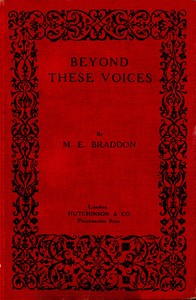
Beyond These Voices
Language: en564 downloads on Project Gutenberg
Subjects
In: Romance·Novels·British Literature
Public-domain ebook sourced from Project Gutenberg #54247.
Public-domain ebook
Language: en564 downloads on Project Gutenberg
Subjects
In: Romance·Novels·British Literature
Public-domain ebook sourced from Project Gutenberg #54247.
The opening · free to read
Lady Felicia Disbrowe was supposed to condescend when she married Captain Cunningham of the first Life--since, although his people lived on their own land, and were handsomely recorded in Burke, there was no record of them before the Conquest, nor even on the muster-roll of those who fought and died for the Angevin Kings. Captain Cunningham was handsome and fashionable, but not rich; and when he had the bad luck to get himself killed in an Egyptian campaign, he left his widow with an only daughter seven years old, her pension, and a settlement that brought her about six hundred a year, half of which came from the Disbrowes, while the other half was the rental of three or four small farms in Somersetshire. It will be seen therefore that for a person who considered herself essentially grande dame, and to whom all degrading economies must be impossible, Lady Felicia's position was not enviable.
As the seven-year-old orphan grew in grace and beauty to sweet seventeen, Lady Felicia began to consider her daughter her chief asset. So lovely a creature must command the admiration of the richest bachelors in the marriage-market. She would have her choice of opulent lovers. There would be no cruel necessity for forcing a marriage with vulgar wealth or drivelling age. She would have her adorers among the best, the fortunate, the well-bred, the young and handsome. Nor was Lady Felicia mistaken in her forecast. When Cara came out under the auspices of her aunt, Lady Okehampton, she made a success that realised her mother's fondest dreams. Youth, rank, and wealth were at her feet. There was no question of riches raked out of the gutter. She had but to say the sweet little monosyllable "yes," and one of the best born and best-looking men in London, and town and country houses, yacht and opera box, would be hers; and her mother would cease to be "poor Lady Felicia."
Unhappily, before Lord Walford had time to offer her all these advantages, Cara had fallen in love with somebody else, and that somebody was no other than Lancelot Davis, the poet, just then the petted darling of dowagers, and of young married women whose daughters were in the nursery, and who had therefore no fear of his fascinating personality. Unfortunately for Lady Felicia, her head was too high in the air for her to take note of the literary stars who shone at luncheon parties, and even when her daughter praised the young poet, and tried to interest her mother in his latest book, Lady Felicia took no alarm. It was only in the beginning of their acquaintance that Cara talked of the poet to her unresponsive mother. By the time she had known him twenty days of that heavenly June, he was far too sacred to be talked about to an unsympathetic listener. It was only to her dearest and only bosom friend, who was also in love with the adorable Lancelot, that Cara liked to talk of him, and to her she discoursed romantic nonsense that would have covered reams of foolscap, had it been written.
"Lancelot!" she said in low, thrilling tones. "Even his name is a poem."
Everything about him was a poem for Cara. His boots, his tie, his cane, and especially his hair, which he took a poet's privilege of wearing longer than fashion justified.
Though educated at the Stationers' School, and unacquainted with either 'Varsity, nobody ever said of Mr. Davis that he was "not a gentleman." That scathing, irrevocable sentence, with the cruel emphasis upon the negative, had not been pronounced upon the man who wrote "The New Ariadne," a work of genius which scared the lowly-minded country vicar, his father, and set his pious mother praying, with trembling and tears, that the eyes of her beloved son might be opened, and that he might repent of using the talents God had given him in the service of Satan.
Lancelot Davis had made up for the lack of 'Varsity training by strenuous self-culture. He was passionate, exalted, transcendental, more Swinburne than Swinburne, steeped in Dante and Victor Hugo, stuffed almost to choking with Musset, Baudelaire, and Verlaine; he was young, handsome, or rather beautiful, too beautiful for a man--Paris, Leander, the Sun God--anything you like; and, at the time of his wooing, his pockets were full of the proceeds of a book that had made a sensation--and he was the rage.
Were not these things enough to fire the imagination and win the heart of a girl of eighteen, half-educated, undisciplined, the daughter of a shallow-brained mother, who had never taken the trouble to understand her, or taken account of the romantic yearnings in the mind of eighteen? If Lady Felicia had cultivated her daughter's mind half as strenuously as she had cultivated her person, the girl would have not been so ready to fall in love with her poet. But the girl's home life had been an arid waste, and the mother's conversation had been one long repining against the Fate that had made her "poor Lady Felicia," and had deprived her of all the things that are needed to make life worth living.
Lancelot Davis opened the gates of an enchanted land in which money counted for nothing, where there was no animosity against the ultra rich, no perpetual talk of debts and difficulties, no moaning over the hardship of doing without things that luckier people could enjoy in abundance. He let her into that lovely world where the imagination rules supreme. He introduced her to other poets, the gods of that enchanted land--Browning, Tennyson, Shelley, Byron. She bowed down before these mighty spirits, but thought Lancelot Davis greater than the greatest of them.
There was nothing mean or underhand about her poet's conduct. He lost no time in offering himself to Lady Felicia. He was not a pauper; he was not ill born; and he was thought to have a brilliant future before him. His suit was supported by some of "poor Felicia's" oldest and best friends; but Lady Felicia received his addresses with coldness and scarcely concealed contempt; and she told her daughter that while she had committed an unpardonable sin when she refused Lord Walford, were she to insist upon marrying Mr. Davis, it would be a heart-broken mother's duty to cast her off for ever.
"I never could forgive you, Cara," she said, and she never did.
Cara walked out of the Weymouth Street lodgings early one morning, before Lady Felicia had rung for her meagre breakfast of chocolate and toast. She carried her dressing-bag to the corner of the street, where Davis was waiting in a hansom. Her trunk, with all that was most needful of her wardrobe, had been despatched to the station over night, labelled for the Continental Express. There was plenty of time to be married before the registrar, and to be at Victoria, ready for the train that was to carry them on the first stage of that wonderful journey which begins in the smoke and grime of South London and ends under the Italian sky.
They went from the registrar's office straight to the Lake of Como, and lived between Bellagio and Venice for four years, years of ineffable bliss, at the end of which sweet summer-time of love and life--for it seemed never winter--the girl-wife died, leaving her young husband heart-broken, with an only child, a daughter three years old, an incarnation of romantic love and romantic beauty.
When he carried off Lady Felicia's daughter, the poet was at the top of his vogue, and his vogue lasted for just those four years of supreme happiness.
Nothing that he wrote after his wife's death had the old passion or the old music. His genius died with his wife. Heart-broken and disappointed, he became a consumptive, and died of an open-air cure, leaving piteous letters to Lady Felicia and his wife's other relations, imploring them to take care of his daughter. She would have the copyright of his five volumes of verse, and two successful tragedies, for her portion; so she was not altogether without means.
Lady Felicia's heart was not all stone; there was a vulnerable spot upon which the serpent's tooth had fastened. Obstinate, proud, and selfish, she had never faltered in her unforgiving attitude towards the runaway daughter; but when there came the sudden news of Cara's death, a blow for which the Spartan mother was utterly unprepared, an agony of remorse disturbed the self-satisfied calm of a mind which thought itself justified in resenting injury.
Perhaps she had pictured to herself a day upon which Cara would have come back to her and sued for pardon, and she would have softened, and taken the prodigal daughter to her heart. One of the girl's worst crimes had been that she had not knelt and wept and entreated to be forgiven, before she took that desperate, immodest, and even vulgar, step of a marriage before the registrar. She had shown herself heartless as a daughter, and how could she expect softness in her mother? But she was dead. She had passed beyond the possibility of pardon or love. That vague dream of reconciliation could never be realised. If there had been anything wrong in Lady Felicia's behaviour as a parent, that wrong could never be righted. Never more would she see the lovely face that was to have brought prosperity and happiness for them both; never more would she hear the sweet voice which the fashionable Italian master had trained to such perfection. The French ballads, and Jensen's setting of Heine, came out of the caverns of memory as Lady Felicia sat, poor and lonely, in a lodging-house drawing-room, on the borderland of West-End London, the last "possible" street, before W. became N.W.
"_Ninon, que fait tu de la vie?_" Memory brought back every tone of the fresh young voice. Lady Felicia could hardly believe that there was no one singing, that the room was empty of human life, except her own fatigued existence.
That last year of remorseful memories softened her, and she accepted the charge that Lancelot Davis left her. He lived just long enough in his bleak hospital on a Gloucestershire hill-top to read his mother-in-law's letter:
"Send the little girl to me. I will be kinder to her than I was to her mother."
Society, and especially Cara's other relations, said that poor Felicia had been quite admirable in taking the sole charge of the orphan. There was no attempt to foist the little girl upon aunts and cousins; and, considering poor Felicia's state of genteel pauperism, always in lodgings, her behaviour was worthy of all praise.
The grandchild brought back the memory of the daughter's childhood, and Lady Felicia almost felt as if she was again a young widow, full of care for her only child. So far as her narrow means permitted she made the little girl happy, and she found her own dreary existence brightened by that young life.
That calm and monotonous existence with Grannie was not the kind of life that childhood yearns for, and there were long stretches of time in which little Veronica had only her picture-books and fancy needlework to amuse her--after the cheap morning governess had departed, and the day's tasks were done. At least Grannie did not torture the orphan with over-education. A little French, a little easy music, a little English history, occupied the morning hours, and then Vera was free to read what books she liked to choose out of Grannie's blameless and meagre library. Lady Felicia's nomadic life had not allowed the accumulation of literature, but the few books she carried about with her were of the best, Scott, Thackeray, Dickens, Byron. Her trunks had room only for the Immortals, and as soon as Vera could read them, and long before she could understand them, those dear books were familiar to her. The pictures helped her to understand, and she was never tired of looking at them. Sometimes Grannie would read Shakespeare to her, the ghostly scenes in Hamlet, which thrilled her, or passages and scenes from the Tempest, or Midsummer Night's Dream, which Vera thought divine. She had no playfellows, and hardly knew how to play; but in her lonely life imagination filled the space that the frolics and gambols of exuberant spirits occupy in the life of the normal child. Those few great novels which she read over and over again peopled her world, a world of beautiful images that she had all to herself, and of which her fancy never wearied--Amy Robsart and Leicester, the Scottish Knight, the generous Saracen, the heroic dog, Paul Dombey and his devoted sister, David Copperfield and his child-wife. These were the companions of the long silent afternoons, when Grannie was taking her siesta in seclusion upstairs, and when Vera had the drawing-room to herself. No visitors intruded on those long afternoons; for Lady Felicia's card gave the world to know that the first and fifteenth of May, June, and July, were the only days on which she was accessible to the friends and acquaintances who had not utterly forgotten "poor Felicia's" existence.
The book keeps going
Reading is free forever. Sign up and watch scenes appear while you read.



Scenes Storieta drew for other classics.
New illustrated classics
Once or twice a month: the latest books to get full character casts, scene art, and free comic editions. No account needed.