Public-domain ebook
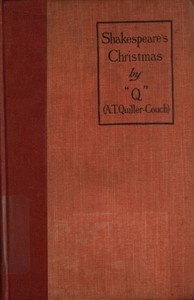
Shakespeare's Christmas, and other stories
Language: en454 downloads on Project Gutenberg
Subjects
In: Christmas·Short Stories·British Literature
Public-domain ebook sourced from Project Gutenberg #54274.
Public-domain ebook
Language: en454 downloads on Project Gutenberg
Subjects
In: Christmas·Short Stories·British Literature
Public-domain ebook sourced from Project Gutenberg #54274.
The opening · free to read
At the theatre in Shoreditch, on Christmas Eve, 1598, the Lord Chamberlain's servants presented a new comedy. Never had the Burbages played to such a house. It cheered every speech--good, bad, or indifferent. To be sure, some of the _dramatis personæ_--Prince Hal and Falstaff, Bardolph and Mistress Quickly--were old friends; but this alone would not account for such a welcome. A cutpurse in the twopenny gallery who had been paid to lead the applause gave up toiling in the wake of it, and leaned back with a puzzled grin.
"Bravo, master!" said he to his left-hand neighbour a burly, red-faced countryman well past middle age, whose laughter kept the bench rocking. "But have a care, lest they mistake you for the author!"
"The author? Ho-ho!"----but here he broke off to leap to his feet and lead another round of applause. "The author?" he repeated, dropping back and glancing an eye sidelong from under his handkerchief while he mopped his brow. "You shoot better than you know, my friend: the bolt grazes. But a miss, they say, is as good as a mile."
The cutpurse kept his furtive grin, but was evidently mystified. A while before it had been the countryman who showed signs of bewilderment. Until the drawing of the curtains he had fidgeted nervously, then, as now, mopping his forehead in despite of the raw December air. The first shouts of applause had seemed to astonish as well as delight him. When, for example, a player stepped forward and flung an arm impressively towards heaven while he recited--
_When we mean to build, We first survey the plot, then draw the model_--
and so paused with a smile, his voice drowned in thunder from every side of the house, our friend had rubbed his eyes and gazed around in amiable protest, as who should say, "Come, come, ... but let us discriminate!" By-and-by, however, as the indifferent applause grew warmer, he warmed with it. At the entrance of Falstaff he let out a bellowing laugh worthy of Olympian Jove, and from that moment led the house. The fops on the sixpenny stools began to mimic, the pit and lower gallery to crane necks for a sight of their fugleman; a few serious playgoers called to have him pitched out; but the mass of the audience backed him with shouts of encouragement. Some wag hailed him as "Burbage's Landlord," and apparently there was meaning, if not merit, in the jest. Without understanding it he played up to it royally, leaning forward for each tally-ho! and afterwards waving his hat as a huntsman laying on his hounds.
The pace of the performance (it had begun at one o'clock) dragged sensibly with all this, and midway in Act IV., as the edge of a grey river-fog overlapped and settled gradually upon the well of the unroofed theatre, voices began to cough and call for lanterns. Two lackeys ran with a dozen. Some they hung from the balcony at the back, others they disposed along both sides of the stage, in front of the sixpenny stools, the audience all the while chaffing them by their Christian names and affectionately pelting them with nuts. Still the fog gathered, until the lantern-rays criss-crossed the stage in separate shafts, and among them the actors moved through Act V. in a luminous haze, their figures looming large, their voices muffled and incredibly remote.
An idle apprentice, seated on the right of the cutpurse, began for a game to stop and unstop his ears. This gave the cutpurse an opportunity to search his pockets. Cantat vacuus: the apprentice felt him at it and went on with his game. Whenever he stopped his ears the steaming breath of the players reminded him of the painted figures he had seen carried in my Lord Mayor's Show, with labels issuing from their mouths.
He had stopped his ears during the scene of King Henry's reconciliation with Chief Justice Gascoigne, and unstopped them eagerly again when his old friends reappeared--Falstaff and Bardolph and Pistol, all agog and hurrying, hot-foot, boot-and-saddle, to salute the rising sun of favour. "Welcome these pleasant days!" He stamped and clapped, following his neighbours' lead, and also because his feet and hands were cold.
Eh? What was the matter? Surely the fog had taken hold of the rogues! What was happening to Mistress Quickly and Doll Tearsheet? Poor souls, they were but children: they had meant no harm. For certain this plaguy fog was infecting the play; and yet, for all the fog, the play was a play no longer, but of a sudden had become savagely real. Why was this man turning on his puppets and rending them? The worst was, they bled--not sawdust, but real blood.
The apprentice cracked a nut and peeled it meditatively, with a glance along the bench. The countryman still fugled; the cutpurse cackled, with lips drawn back like a wolf's, showing his yellow teeth.
"Hist, thou silly knave!" said the apprentice. "Canst not see 'tis a tragedy?"
The rascal peered at him for a moment, burst out laughing, and nudged the countryman.
"Hi, master! Breeds your common at home any such goose as this, that cannot tell tickling from roasting?"
The apprentice cracked another nut. "Give it time," he answered. "I said a tragedy. Yours, if you will, my friend; his too, may be"--with a long and curious stare at the countryman.
Play, epilogue, dance, all were over; the curtains drawn, the lanterns hidden behind them. The cutpurse had slipped away, and the countryman and apprentice found themselves side by side waiting while the gallery dissolved its crowd into the fog.
"A brisk fellow," remarked the one, nodding at the vacant seat as he stowed away his handkerchief. "But why should he guess me a rustic?"
"The fellow has no discernment," the apprentice answered dryly. "He even took the play for a merry one."
The countryman peered forward into the young-old face silhouetted against the glow which, cast upward and over the curtain-rod across the stage, but faintly reached the gallery.
"I love wit, Sir, wherever I meet it. For a pint of sack you shall prove me this play a sad one, and choose your tavern!"
"I thank you, but had liefer begin and discuss the epilogue: and the epilogue is 'Who's to pay?'"
"A gentleman of Warwickshire, Master What-d'ye-lack--will that content you? A gentleman of Warwickshire, with a coat-of-arms, or the College's promise--which, I take it, amounts to the same thing." The countryman puffed his cheeks.
"So-so?" The apprentice chuckled.
"_When we mean to build We first survey the plot, then search our pockets._
How goes it? Either so, or to that effect."
"The devil!" The countryman, who had been fumbling in his breek pockets, drew forth two hands blankly, spreading empty fingers.
"That was your neighbour, Sir: a brisk fellow, as you were clever enough to detect, albeit unserviceably late. I wish we had made acquaintance sooner: 'twould have given me liberty to warn you."
"It had been a Christian's merest duty."
"La, la, master! In London the sneaking of a purse is no such rarity that a poor 'prentice pays twopence to gape at it. I paid to see the play, Sir, and fought hard for my seat. Before my master gave over beating me, in fear of my inches and his wife (who has a liking for me), he taught me to husband my time. For your purse, the back of my head had eyes enough to tell me what befalls when a lean dog finds himself alongside a bone."
He seated himself on the bench, unstrapped a shoe, slipped two fingers beneath his stocking, and drew forth a silver piece. "If a gentleman of Warwickshire will be beholden to a poor apprentice of Cheapside?"
"Put it up, boy; put it up! I need not your money, good lad: but I like the spirit of that offer, and to meet it will enlarge my promise. A pint of sack, did I say? You shall sup with me to-night, and of the best, or I am a Dutchman. We will go see the town together, the roaring, gallant town. I will make you free of great company: you shall hear the talk of gods! Lord, how a man rusts in the country!--for, I will confess it to you, lad, the rogue hit the mark: the country is my home."
"I cannot think how he guessed it."
"Nor I. And yet he was wrong, too: for that cannot be called home where a man is never at his ease. I had passed your years, lad, before ever I saw London; and ever since, when my boots have been deepest in Midland clay, I have heard her bells summon me, clear as ever they called to Whittington, 'London, thou art of townes a per se.' Nay, almost on that first pilgrimage I came to her as a son. _Urbem quam dicunt Romam_--I was no such clodpate as that rustic of Virgil's. I came expecting all things, and of none did she disappoint me. Give me the capital before all! 'Tis only there a man measures himself with men."
"And cutpurses?" the apprentice interjected.
"Good and bad, rough and smooth," the countryman assented, with a large and catholic smile. "'Tis no question of degrees, my friend, but of kind. I begin to think that, dwelling in London, you have not made her acquaintance. But you shall. As a father, lad,--for I like you,--I will open your eyes and teach your inheritance. What say you to the Bankside, for example?"
"The Bankside--hem!--and as a father!" scoffed the youth, but his eyes glistened. He was wise beyond his opportunities, and knew all about the Bankside, albeit he had never walked through that quarter but in daylight, wondering at the histories behind its house-fronts.
"As a father, I said; and evil be to him who evil thinks."
"I can tell you of one who will think evil; and that is my master. I can tell you of another; and that will be the sheriff, when I am haled before him."
"You said just now--or my hearing played a trick--that your mistress had a liking for you."
"And you said, 'Evil be to him that evil thinks.' She hath a double chin, and owns to fifty-five."
The book keeps going
Reading is free forever. Sign up and watch scenes appear while you read.



Scenes Storieta drew for other classics.
New illustrated classics
Once or twice a month: the latest books to get full character casts, scene art, and free comic editions. No account needed.