Public-domain ebook
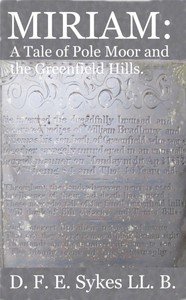
Miriam: A Tale of Pole Moor and the Greenfield Hills
Language: en371 downloads on Project Gutenberg
Subjects
In: Historical Novels·Novels·British Literature
Public-domain ebook sourced from Project Gutenberg #54333.
Public-domain ebook
Language: en371 downloads on Project Gutenberg
Subjects
In: Historical Novels·Novels·British Literature
Public-domain ebook sourced from Project Gutenberg #54333.
The opening · free to read
THE WAKES.
IT was the first morning of the eagerly awaited Saddleworth Wakes in the year of our Lord one thousand eight hundred and twenty-nine, a year so full of great doings in the country, and followed by a year of still greater doings, that there is little marvel that I call it easily to mind. I had been out of bed by cock-crow to steal across the bare, worm-eaten boards of the chamber floor as prattily as my six feet of height and fourteen stone of weight would permit, to peer through the long diamond-paned window of bottle-green glass up the valley towards Greenfield, the quarter whence we folk of Biggie got our weather. It was a glorious sun-rising and promised a glorious day, and so I stole back to bed in great content, glad that though it was not the Sabbath I could stretch my long limbs between the blankets--sheets were an unknown luxury for such folk as myself and fellow chamberer, Jim Haigh, sometimes called Jim o' 'Lijah's, sometimes Jim th' Tuner, but more often simply Th' Tuner.
I suppose so small a bedroom rarely accommodated two men of our inches. For if I was six-feet-nothing in my stocking-feet, Jim o'ertopped me by a good four inches, and, whilst I was still, as it were, in the making, and lank and willowy, Jim, though but four years my senior, which made him four-and-twenty, was broad and deep chested, with the arms and legs of a very son of Anak. The turn-up bed,
"Contrived a double debt to pay, A bed by night, a chest of drawers by day,"
into which Jim insinuated himself very gingerly o' nights, creaked and groaned under his weight, and every morning he woke with cold feet, for the simple reason that they stretched a good half yard out of the bottom of the bedstead. He could not stand upright in our little chamber, and as for yawning and stretching himself, as one does in rousing from insufficient sleep, it was sheer out of the question. A giant truly was my friend Jim, but surely the gentlest and simplest of all created mortals, save when roused to wrath (and that he was not easily), and then let lesser men beware, for Jim in those rare moods knew not his own strength, and I'd as lieve have countered a sledge-hammer in punier hands as met the fall of Jim's clenched fists.
Yet, curiously enough, this man of mighty girth and sinew held me in a sort of wondering reverence. For, despite my protests, Jim insisted to all and sundry of our common acquaintance that I was what he called a "powerful scholard"--I, whom my reverend father, the pastor of Pole Moor Chapel, had wept over and finally despaired of as a hopeless dunce and dullard, unfit for that ministry to which I had been destined from my cradle. Read and write I could 'tis true, nor could I truthfully say "the rule of three did puzzle me, and fractions drove me mad." English history from the great Alfred's time to poor, mad George the Third's I knew fairly well, and could, under compulsion make out from the Latin how Balbus built a wall. But it was when my father set me to the Hebrew, maintaining that a minister of the Gospel should be able to read the Law and Prophets in their original,--it was then, I say that I struck and roundly declared that a parson I would never be. And so it came that I was bound 'prentice at Wrigley Mill to learn the full craft of a master clothier, pledging myself by solemn covenant "my master well and faithfully to serve, his secrets keep, Hurt or Damage to him not to do, Alehouses and ill Company not to frequent, nor Matrimony contract." As if, commented Jim, when I read over to him these articles, a man would be likely to get wed on the "One shilling yearly for Pocket Money" which, with "Meat, Drink, Washing, Lodging, and two good Suits of Apparel as well Linen as Woollen," was all I got for working like a slave for "th' owd felly," as my master was called by his hands. I had been boarded out by Mr. Wrigley with Mary Haigh, who lived in a small cottage in the mill yard, and it was Mary's son who had been my true and constant friend from the first days of my apprenticeship, and who now lay slumbering soundly and snoring in the most determined manner in the turnup bed an arm's length from my side.
I must have dropped off into a morning dose, for when I came back again to consciousness Jim was sat on the side of his couch, a little rickety, spindle-shanked, rush-bottomed chair in front of him, against the back of which was propped a small mirror about the size of a sheet of note-paper, its usefulness and beauty much marred by a crack that ran diagonally across a blotted surface. The half of a cocoanut shell, which served Jim as a shaving pot, rested on the floor, and Jim was alternately stropping a very harsh-scraping razor, lathering his face and throat, and shaving himself as he wielded the razor in the right hand and pinched his nose firmly with the left.
"Did ta' ivver hear tell o' th' lad at th' schooil at th' inspector wer' hearkening to read?" he broke off to ask, when he noticed that I had opened my eyes.
"What about him?" I asked.
"Well he come to one o' them guisehanged long names i' th' Bible, an' baulked at it. 'Say summat sharp,' whispers th' schooilmester. 'Razzer,' says th' lad, 'Razzer'. But it wer' noan this razzer I'll go bail, for I've stropped it till mi shackle warks, an' I'd as soon tha' took a curry comb to me for comfort."
"You're making yourself mighty fine to-day, Jim, and it isn't one of your Sundays for Church," I commented, noticing his knee-breeches, and that he had already donned polished shoon with buckles of nickel silver and a striped and starred linen shirt.
"Church? No, thank God. It's noan Church to-day. I'm off to th' Wakes, and so are ta', mi hearty. Why, man, it's th' Rushbearing, an' aw've n'er missed th' Rushbearing sin' aw wer' a little 'un, an' aw n'er mean to. There'll be some ale stirring to-day at th' Church, aw can tell thee, an' aw'st ha' mi share on 't, tha' may bet thi Sunday booits."
"At the Church?" I queried.
"Aye, th' Church Inn, to be sure. Don't thee act so gaumless. Ger up an' don thee, lad. Aw do believe there's a collop for breakfas', aw hear it sizzlin', an' smell it, too, for that matter. So doant tha be so greedy on th' porridge, leave a corner for th' collop."
And if any assurance were needed that breakfast was well forward it was supplied by the shrill voice of Mother Haigh calling at the bottom of the stairs:
"Are yo' idle good-for-nowts goin' to lig i' bed till th' wheel starts to morn? Th' porridge's bin ready this bit back, an' th' bacon's welly stuck to th' pan bottom Ger up, do."
Was there ever so clean a kitchen as Mary Haigh's, I wonder. Certainly there never was one oftener fettled. Jim's mother had few household gods, but those I verily believe she worshipped. The floor was sanded, the hearth blue-storied, the steel fender shone like burnished silver, you could see your face reflected with queer distortions in the brass knob of the oven door, the oaken press and settle and the deal chairs fairly sparkled with what Mary called elbow grease, the top of the little round three-legged table was white almost as driven snow. And as for Mary herself, sure never was a nattier little woman in all Yorkshire or Lancashire to boot. Nor a harder working. She was a tewer, as all the country-side would tell you, and always had been since she had been left a widow with little Jim still at the breast. She'd kept herself and Jim too, and anyone could see that Jim at all events hadn't wanted. Even yet she did some burling in the house, and many of the hands at Wrigley's paid her no less than a penny a week--bar missings--to heat their dinners for them, and in summer time she brewed for the behoof of the mill-girls a sweet and heady beverage called treacle-drink, of which the great merit was that it cost only a meg, in other words a half-penny, the quart, but which, Jim avowed, more in sorrow than in anger, possessed the fatal drawback that you got no forrader on a bucketful.
We'd an extra spread for this morning's meal in honour of the Wakes. We started on the porridge. This Mary poured from the porringer into a large earthenware bowl, a dull russet colour on the outside, a highly glazed yellow on the inner. It stood in the centre of the table. Before Jim's seat was a basin of "whom-brewed," which he always took with his porridge. Mary and myself preferred buttermilk, which she fetched from Wrigley's big house at Holly Grove every churning day. We helped ourselves from the central dish by long leaden spoons, and I've always attributed the size of my mouth to the fact that in my tenderest years. I had to use these large-bowled spoons or "go bowt."
Mary exhorted us to draw and eat heartily of the porridge she declared made by God a-purpose for growing lads.
"You'll noan start without sayin' grace, Jim," she expostulated as Jim made a flourish over the steaming pottage with his spoon.
"What for water-porridge?" asked Jim. "Aw've n'er said grace for porridge mother, an' aw'st noan begin. Ax Abel, he's noan partickler."
"There's collops when yo'n etten th' porridge up, but not afore."
"Oh, collops. Well, then, here goes: 'Sanctify these blessings--th' collops aw mean, noan th' watter porridge--to our use an' us to Thy service, Amen.' Nah, Abel, fair do's. Eh! aw wish it were th' Wakes six days a week, an' all th' year raand. Aw do like collop wi' haver bread an' plenty o' mustard."
When I look back on those days that seem sometimes so far, far away, and at other times as though but yesterday, I blush to think how much I must be in Mary's debt. For certain sure am I that the sum paid by Mr. Wrigley for my board and lodging never paid Mary. But she never stinted me, and the only times she grieved were the days I was off my food and could not eat my fill of the homely but wholesome fare she set before me. When I grew older and more noticing, as they say, I once hinted that my father should be asked to supplement Mr. Wrigley's payment, though well I knew there was little to spare at the Manse at Pole Moor. But Mary had waxed wroth at this. "A bargain was a bargain," she maintained with warmth. "She'd made hers and she'd stick to it. Besides, she never could abide a finicking eater, picking here an' pishing an' pshawing, as if th' fooid weren't good enough for 'im. Besides, didn't I read th' papper to her every week an' a portion o' th' Scriptures, to say nowt o' th' 'Pilgrim's Progress.' It were as gooid as having a parson i' th' house, wi'out his airs."
"How mich brass has ta?" whispered Jim to me, as he shredded his tobacco, the while his mother cleared the few pots and busied herself with washing--up.
"Three shillings," I confided, fingering the coins lovingly in my breeches' pocket.
"An' I've four--seven shillin' 'atween us. We'st ha' to be careful. There's th' dobby--horses, an' th' swings, an' Tom Wild's show--aw wouldn't miss 'The Pirates' Lair' for owt--an' th' fat woman with a beard, an' the three--legged hen, an' th' hot peas, an' th' brandy--snap, an' th' shooitin' gallery, an' th' aunt sally, an' th weighin' machine, an' th' pig 'at counts up to twenty, an' we 'st want a rattle apiece to scrat dahn th' lasses' shawls to mak' 'em jump an' squeal, an' then there's th' ale, but there's one comfort, tha'rt a poor supper--eh! aw dunnot see how it's to be done wi' th' brass, but we'st happen meet a trump."
The book keeps going
Reading is free forever. Sign up and watch scenes appear while you read.



Scenes Storieta drew for other classics.
New illustrated classics
Once or twice a month: the latest books to get full character casts, scene art, and free comic editions. No account needed.