Public-domain ebook
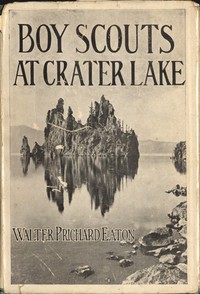
Boy Scouts at Crater Lake A Story of Crater Lake National Park and the High Cascades
English422 downloads on Project GutenbergDownload EPUB
Public-domain ebook sourced from Project Gutenberg #54536.
Public-domain ebook
English422 downloads on Project GutenbergDownload EPUB
Public-domain ebook sourced from Project Gutenberg #54536.
The opening · free to read
It seems to be generally assumed that a story for boys must be crowded full of adventures, and the assumption is doubtless based on experience. This would be all right if the adventures were also based on experience. Unfortunately, however, such is not always the case, and then the result is something that may possibly satisfy an immediate craving of the boy for excitement, but in the long run can only confuse his sense of reality. It is probably more important, in a boy’s development, to clarify his sense of reality than it is to feed his imagination. His imagination, normally, needs very little prodding to carry him away from reality. That is why tales of actual adventure, such as the records of explorers, hunters, and the like, are so worth while for boys. They feed the imagination while, at the same time, keeping touch with the real. They have the lure of fiction, and the solidity of fact.
It has been my steady purpose, in the Boy Scout series of stories which I have written, to bear this in mind. I have not described places with which I was unfamiliar, nor created adventures it was impossible for boys to experience. In the volume preceding the present one, “Boy Scouts in Glacier Park,” I endeavored to give some adequate idea of that beautiful National Park, and hence of a section of the Rocky Mountain wilderness, and the actual adventures one may now encounter therein. Our friend, Bill Hart, of movie fame, may be relied on to supply the other sort of Wild West adventure, without any need of help from me. The response of my young readers was so pleasantly encouraging that I am asking them, in this book, to go still farther West, into another National Park, Crater Lake, and into the Cascade wilderness of Oregon. Whitman’s ride for Oregon was long ago, and today they are building a macadam highway where his horse left a solitary track.
The Cascade Mountains afford numerous opportunities for snow climbing—and anyone who has practiced this noble sport does not need to be told that it supplies plenty of adventure. Snow mountains have a way of withdrawing themselves many miles from human habitation, and a pack train is scarcely to be afforded save by those who have reached years of comparative discretion, so I have no fear of sending youngsters out alone to start up the Roosevelt Glacier. If, however, I can inspire some few of them to persuade their fathers to take them into the high places, I know that both they and their fathers will ultimately thank me.
But chiefly, in the end, I want young America to know and to love and to preserve what is left of the American wilderness.
W. P. E.
Twin Fires, Sheffield, Massachusetts.
Bennie Capen was sitting in the public library reading a book. Miss Lizzie Cox, the librarian, was watching him with some suspicion. Bennie was not what you might call one of her regular customers, and she was surprised to see him come in, ask for a certain book, and take it off to the reading table. She certainly watched him as if she suspected a nigger in the wood-pile somewhere. Bennie had a reputation in Southmead, but it wasn’t exactly a reputation for bookishness. Some people said he was a “bad boy,” some people laughed and said he was “full o’ pep,” and some people, including Mr. Rogers, the scout master of Bennie’s troop, said the trouble with Bennie was that his engine was too powerful for the chassis. Anyway, Miss Lizzie Cox, behind the delivery desk, frowned as she watched him through her gold-rimmed glasses, as if she expected to see him throw the book at little Bob Walters, across the table, or pull the hair of Lucy Smith, who was consulting the encyclopædia preparatory to writing a composition on “The Products of the Philippine Islands.”
However, Bennie did none of these things. He read steadily in his book, after first looking at all the pictures, and emitting several low whistles, each one of which brought a sharp, admonitory rap of her pencil on the desk from Miss Cox, and a loud “Silence!” Bennie grinned cheerfully each time, and went on reading and looking at the pictures. His eyes were bright, and every now and then he ran his fingers excitedly through his brown hair, till it stood straight up on his forehead.
By and by little Bob Walters returned the bound volume of St. Nicholas and went out. Lucy Smith exhausted the products of the Philippine Islands (or her own patience), and took refuge in “Vogue.” From the streets outside came the shouts of a snowball fight. But Bennie kept on reading. Finally the door opened, and another scout came in, a tall, slender boy with two books under his arm. He saw Bennie as he was walking up to the desk, and stopped, surprised. Then he stole over on tiptoe, and looked over Bennie’s shoulder at the book.
“Gosh all hemlock, Bennie,” he whispered, “plugging to get a hundred per cent in physical geography? You don’t care how much of a shock you give your dear teacher, do you?”
Bennie looked up, with his usual grin. “’Lo, Spider,” he said. “Say, this old book is some humdinger, I’ll tell the world.”
“Don’t tell the world so loud, or Miss Cox’ll be out over the desk,” Bob Chandler whispered back, catching a sight of the librarian’s face out of a corner of his eye. “What is the book?”
Bennie turned back to the title page, and Spider read, “On British Crags and Alpine Heights.”
“Say, wait a minute—look at this picture,” said Bennie, turning the pages to find it. “Here it is. Look at that old cliff! And pipe where that guy is climbing. Oh, boy! That’s only one, too. ’Most every picture’s like that, or more exciting, and it tells how somebody fell off most of ’em, and was killed, and——”
“Silence!” from Miss Lizzie Cox.
“Old crab!” whispered Bennie. “Well, I gotter finish this chapter ’fore closing time.”
“Why don’t you take the book out? I’d like to read it, too,” Spider whispered.
“Haven’t got a card,” Bennie confessed. “Guess I don’t read as much as I ought to.”
“Guess you don’t,” said Spider. “Here, give it to me. I’ll take it out for you.”
“How’d you ever know about it, anyhow?” he asked, when they were outside the building, on the snowy sidewalk. “Gave me some shock to see you sitting in the library!”
“Mr. Rogers told me about it,” Bennie answered. “We got to talking about mountains, and climbing, and he said to go ask for this book and see what real climbing is like. Oh, boy! I wish we had something like those old what d’you call ’ems—spitzes—around these diggings.”
“A spitz being what?” Spider laughed.
“Here, give me the book—I’ll show you. It’s a German word, I guess—means spire, maybe—I don’t know. Never studied Dutch—probably wouldn’t know if I had—but anyhow they’re tall, sharp rocky peaks, pretty nearly straight up, in the Alps somewhere, and you climb ’em with your teeth and your toe-nails.”
The two scouts paused in the middle of the sidewalk, while Bennie hunted out a picture of several men, roped together, climbing the precipitous face of one of the Dolomites, and their faces were over the book, looking at the thrilling photograph—when, blam, came a snowball, crashing into Bennie’s side.
He thrust the book into Spider’s hands for safe-keeping, stooped for a handful of snow, and dashed around the corner of the post-office after the vanishing pair of heels.
When he came back he was grinning. “Fresh guy, that Tenderfoot,” he said. “His ma won’t need to wash his face for supper tonight. Come on, let’s go to my house and look at those old pictures some more.”
They were soon curled up on the couch in his father’s library, with the book first on one lap and then on the other. After they had looked twice at every picture, they read aloud to each other parts of the text, especially the most exciting parts they could find, but skipping the descriptions of scenery and the long foreign names. The Welsh names were worse than the German.
What interested them most, however, were the pictures that showed how the rope is used, both in climbing and descending, and the passages about it.
“I wish we had a braided rope!” Spider exclaimed.
“Guess we could get some sort of a rope, all right,” said Bennie. “But where are we going to get the—the spitzes to use it on? Those old mountains make ours look like pimples.”
“Oh, they’re not so bad—they’re something, anyway,” Spider answered. “I bet you’d need a rope to climb the cliffs on Monument Mountain, and maybe, if the snow gets deep, we’d have to cut steps in it to get up to those cliffs. Might try it.”
“Sure, we could try it. But you wouldn’t slide far enough to hurt yourself if you did slip going up to the cliffs, and I bet nobody could climb right up the cliffs themselves.”
“I bet the man who wrote this book could,” said Spider. “We never really tried it. What do you say if we get a rope and have a go at ’em, next Saturday, eh?”
“You’re on!” cried Bennie. “We’ll get the old rope tomorrow, after school. Going to take the troop along?”
“Not on your life! We’ll ask Mr. Rogers, though. We don’t want too many. Those cliffs aren’t going to be a picnic, I’ll tell the town.”
“You’ve said it,” Bennie assented. “Well, so long till tomorrow. Don’t forget to bring some money for that old rope.”
“And don’t you forget that book’s out on my card,” Spider laughed. “Won’t do it any good if you throw it at the cat.”
Bennie made as if to throw it at him, and he ducked quickly out of the door.
CHAPTER II Bennie Takes the Rope Up His First Cliff
The next afternoon the two scouts emerged from Seymour’s store with a hundred feet of brand new half-inch rope, and ran directly into a group of half a dozen of their fellow scouts.
The book keeps going
Reading is free forever. Sign up and watch scenes appear while you read.



Scenes Storieta drew for other classics.
New illustrated classics
Once or twice a month: the latest books to get full character casts, scene art, and free comic editions. No account needed.