Public-domain ebook
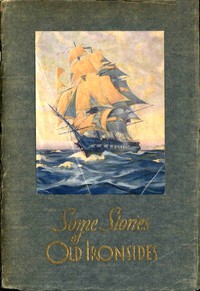
Some Stories of Old Ironsides
Language: en308 downloads on Project Gutenberg
Subjects
In: History - American·History - Modern (1750+)·History - Royalty
Public-domain ebook sourced from Project Gutenberg #54564.
Public-domain ebook
Language: en308 downloads on Project Gutenberg
Subjects
In: History - American·History - Modern (1750+)·History - Royalty
Public-domain ebook sourced from Project Gutenberg #54564.
The opening · free to read
On a September day in 1803 an American frigate bowled along the rocky Spanish coast toward Gibraltar. From her bluff bows curled back a foamy wave. Above the blue waters rose a gracefully proportioned black hull. Around it, halfway up from the water line, ran a broad white stripe. This was broken at regular intervals by the dark squares of the gun ports. Spars tapered aloft. White rectangles of billowing canvas completed a picture of beauty unsurpassed on the Seven Seas. Such was the United States ship Constitution. Joshua Humphreys, naval constructor, had done his work well.
Watchers on the famous Rock might have noted, had the beauty of this strange ship gained their full attention, that from the mizzen truck flew the broad blue pennant of a commodore. His name was then unknown. It is not too well known even now. But as time passes the conviction grows that Edward Preble should be classed in the first rank of our naval commanders. He was soon to prove that he was every inch a commodore. His pennant flew from a splendid ship, but one which had as yet no tradition of victory. Edward Preble was to begin that long series of successful cruises and spectacular sea fights which was to endear “Old Ironsides” to every American.
Countless ships for countless years had passed these far-famed Pillars of Hercules. Some had sailed on errands of peace, but most on the grim business of war. Phoenician traders had sailed out northward to Britain for cargoes of its precious tin. Carthaginian merchants under Hanno had ventured far down the Atlantic coast of Africa. Scipio Africanus with his legions had come this way to complete the conquest of Spain. Moorish galleys had ferried to Europe those fierce Moslem horsemen who overran the Iberian Peninsula and fought for world empire on the battlefields of France. Norse sea kings had sailed on through to Sicily and Constantinople. Stout De Ruyter and his Dutch seamen had followed in their track to make his last campaign in the blue waters of the Mediterranean. And only five years before the greatest sea captain of them all, a certain Horatio Nelson, had hastened by to match his wits with a General Bonaparte and annihilate his fleet at the mouth of the Nile.
The entry of Edward Preble in a Yankee frigate into the great sea which had supported so many war fleets seemed doubtless at that time utterly devoid of historical significance. But now, as we look back over a century and a quarter, it takes on a new importance. It was to bring our young Navy to a new plane of efficiency. It was to demonstrate to Americans in a striking manner the value of an efficient naval service. It was to establish our Navy as a permanent American institution. And, what is more, it signaled to watchful eyes abroad the rise of a new sea power. It indicated, not only to African pirates, but also to astute European statesmen, that this American Republic had become a factor they would have to reckon with in framing their diplomatic policies.
We believe that, as much as any other man of that era, it was bold and forceful Edward Preble who gave the United States that initial impulsion along the path of astounding prosperity, unparalleled commercial power, and world-wide influence.
For two years we had been at war with the Moslem principalities which lined the Mediterranean coast of Africa. For many years before that, their piratical craft had captured our merchant ships and sold their crews into slavery. We had first begged and then bribed these pirates to desist from piracy. And, finally, after all diplomatic measures had failed, that task was given the Navy. That service had been in existence only a few years. It was, we must confess, not properly prepared to conduct a difficult campaign so far from its home bases. So two years of desultory fighting had accomplished little. In despair, our statesmen had descended again to the artifices of bribery. But, fortunately for us, the piratical chieftains did not think our offers worth their while. So the Navy was given a final chance and Edward Preble the command. The backbone of his squadron were the fine frigates Constitution and Philadelphia. For inshore work there were the brigs Argus and Siren and the schooners Enterprise, Nautilus, and Vixen. It is true that seven ships constituted a small force to keep in good humor Morocco, Algiers, and Tunis and bring to a favorable conclusion the war with Tripoli. But the ships were all finely commanded, well officered, and manned with the best sailors in the world. The ships themselves were well built, adequately equipped, and completely stored for a long campaign. So it was with high hopes that Preble commenced his difficult task—one, it may be added, which had baffled Cardinal Ximenes, Charles V, Andrea Doria, Blake, De Ruyter, and Duquesne.
An effective demonstration off Tangiers soon cooled the ardor of the Sultan of Morocco. He reconfirmed the old and highly favorable treaty of 1786. One potential enemy had been removed. On now for Syracuse, the naval base from which our campaign against Tripoli was being conducted.
Off the coast of Sardinia the Constitution hailed H.M.S. Amazon, a frigate attached to the squadron of Lord Nelson. From her Preble received “the melancholy and distressing intelligence of the loss of the U.S. ship Philadelphia.” Here, Commodore, is a problem which will put to the test all your intelligence and stoutness of heart.
At Syracuse Preble learned the full extent of the disaster. The fine frigate had been run aground off Tripoli. Captain Bainbridge, discouraged by his ill fortune, had surrendered too quickly. Three hundred and fifteen of our officers and men had been led ashore in triumph. In his haste Bainbridge had not even taken effective measures to destroy his own ship. She was floated and brought into the harbor of Tripoli. Her guns were fished out of the water and remounted. She was manned with a strong Tripolitan crew. Thus she contributed to the strength of the defenses, and constituted a threat to every merchant vessel in the Mediterranean. Gloomy were the thoughts of poor Bainbridge as he viewed these developments from his prison window.
Preble was not the man to worry over past disasters. He was concerned with future successes. How could he counteract, in part at least, the loss of the Philadelphia? There was no direct method for rescuing the crew. But there might be a chance to regain the ship, or at least destroy her so that the enemy could not use her. Bainbridge, through the connivance of the Danish consul at Tripoli, had suggested that she be attacked by a party of men secreted in the hold of a merchant vessel. The capture of a Tripolitan ketch provided the means of carrying through this daring plan. The next essential item was a cool and daring commander.
The commodore invited to this post of honor and danger Lieutenant Stephen Decatur, then in command of the Enterprise. To this young officer might well be applied a sentence from Plutarch: “Being ever thirsty after honor, and passionate for glory, if anything of a greater or extraordinary nature was to be done, he was eager to be the doer of it himself.” Decatur eagerly accepted his commodore’s invitation.
Once the squadron got wind of the venture and of the commander selected, there was no lack of volunteers. Decatur naturally gave first choice to the people in his own ship. Five of her officers and sixty-two of her sailors shifted over to the ketch. This was formally commissioned and appropriately renamed Intrepid. Five midshipmen from the Constitution completed the complement. Last, but by no means least, was a brave Sicilian pilot, Salvador Catalano.
Edward Preble took upon himself full responsibility for the hazardous enterprise. “It is my order,” he wrote Decatur, “that you proceed to Tripoli, in company with the Siren, Lieutenant Stewart; enter the harbor in the night; board the Philadelphia; burn her; and make good your escape.” The courage it requires to write such an order is seldom appreciated. If the expedition had failed, as certainly it looked very probable, all the blame would have fallen on Preble. He would have been accused of sending officers and men to their death while he remained in safety. And, if the attack should succeed, the credit and honor would belong to Decatur. But Preble was not guarding his own interests. He was striving to further those of the Navy and the country.
For two weeks the Intrepid was battered about by a succession of storms. On this little craft, much smaller than a submarine chaser, seventy-four men were crowded. Their sufferings can scarcely be imagined. But at last the weather moderated and the long-awaited opportunity was at hand. As a reënforcement Midshipman Anderson and nine sailors rowed over in one of the Siren’s cutters. This was towed astern of the Intrepid. She started in.
The sea now was smooth. The wind lulled slowly to a calm. As night came on, a young moon, the enemy’s emblem, diffused a gentle light over the phosphorescent waters. Wary Odysseus might have turned back his prow at sight of such an unfavorable omen, but not all the gods on Olympus could have turned back Stephen Decatur that night.
Slowly and silently steals the Intrepid toward the harbor entrance. This cold wintry night there are no vessels on patrol. Only irregular ranks of jagged rocks keep watch. The moonlight discloses these ever present sentinels. The ship passes through.
Quietly there on deck stand Decatur, Catalano, and ten seamen—all disguised as Sicilians. Close down behind the bulwarks crouch the remainder of the crew. Ahead looms up the great hulk of the Philadelphia. Her foremast has not been replaced, but the main and mizzenmasts, with their network of rigging, trace a spider web of black against the dull red glare of the city’s lights. Fifteen gaping gun ports are dotted with the muzzles of frowning 18-pounders, loaded, shotted, and ready to be touched off. High overhead towers the dark mass of the Bashaw’s castle, its embrasures filled with one hundred and fifteen cannon.
The frigate’s bell rings out the hour. It is ten-thirty in the evening watch. Her sentinel hails. Catalano answers with long-rehearsed lines. He has lost his anchors. May he not secure alongside the frigate for the night? The answer is, “Yes.” Lawrence lowers a small boat. With a line from the Intrepid he pulls for the frigate’s bows. Quickly he secures his end to the fore chains. At the other end crouching seamen haul away.
Watchers on the frigate, if they had not been too sleepy, might have wondered at the hidden power which draws the little craft so steadily upon her prey. It is not until she is almost alongside that they see the crowd of men on her decks. “Americanos!” yells the sentinel. But now it is too late. Another pull brings the Intrepid alongside. Then rises a confused din as her crew begin a wild scramble for the honor of being the first over the enemy’s side. Decatur trips on his scabbard. Morris passes him. Over the high bulwarks, sword in teeth, he disappears. Lieutenants, midshipmen, sailors follow him. Here have ceased the privileges of rank. Those of courage begin.
The book keeps going
Reading is free forever. Sign up and watch scenes appear while you read.



Scenes Storieta drew for other classics.
New illustrated classics
Once or twice a month: the latest books to get full character casts, scene art, and free comic editions. No account needed.