Public-domain ebook
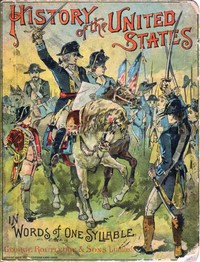
History of the United States in Words of One Syllable
Language: en335 downloads on Project Gutenberg
Subjects
In: Children & Young Adult Reading·History - American
Public-domain ebook sourced from Project Gutenberg #54798.
Public-domain ebook
Language: en335 downloads on Project Gutenberg
Subjects
In: Children & Young Adult Reading·History - American
Public-domain ebook sourced from Project Gutenberg #54798.
The opening · free to read
For a long time, in past years, it was not known that the world was round. If the men in those days had been told that a ship could start from a port and sail straight on for months and come round to the same place, it would have made them laugh as at a good joke. They did not know the real shape of the earth, but thought it was a flat plane.
In those days our land was the home of the In-di-ans, or red men, as we call them, from their dark skins. The red man does not live in a house, but in a sort of tent or hut. The tribes of red men had all this land for their own when Co-lum-bus was born. The great woods, the green plains, the bright streams, were all theirs. They made their wars in a strange and fierce style, and wore at their belts locks of hair, cut from the heads of those slain by their hands. These locks, cut from the head with part of the skin, they call a scalp. It was the pride of an In-di-an to have scalps hung at his belt. No one had taught him that this was wrong, and he did not have the Word of God to show him the right way.
When Co-lum-bus was a mere boy he was fond of the sea and ships. He would go and watch the waves, and think about how ships were made, and the best way to sail them. He was born in Gen-oa, which is by the blue sea; so when he was a small boy he could watch the white sails come in. Such queer ships they had there, with strange high prows! As time went on, and he grew of age, he made trips in these ships, and was in sea-fights, and once or twice he was in a wreck. So you see he had a chance to grow strong and brave for the work he had to do.
What he read in books taught him that the world was round, and not flat, as was thought in those times. So he knew that if he could sail west he would come to a new land. He thought of this a long time, and at last he grew more sure of it, but he could get no one else to think as he did. He spent ten years in this way. He was full of plans; but he could get no help and no gold. He was too poor to do all with no aid from his friends. At last he went to Spain.
There were a King and Queen there who were kind to Co-lum-bus; but at first they would not give their gold to help him. They thought this was a wild dream. At last, with a sad heart, he made up his mind to turn his back on the court of Spain.
While on his way, a man came to him from Queen Is-a-bel-la. She had sent him word that she would help him; "that she would pledge her own gems to give him aid." But she did not have to do this, as means were found when Co-lum-bus went back to the court. His heart was made glad; for they gave him a small fleet of three ships, and on the 3d of August, 1492, the sun rose on the fleet as it went forth on its way to the new land. All was strange to the new crew, and they had all sorts of queer thoughts and fears of the sea. They had not been out of sight of land in all their lives; and when they saw the deep, dark sea on all sides, they were full of fear that they would not see their homes again. The trade-wind which took them west so fast, would keep them, they thought, from their land when they had the wish to go back. At last they grew so full of fear, they swore they would not go on, and Co-lum-bus had hard work to make them. But soon there were signs of land, and some land birds flew by the ship; and one of the crew found a branch of a tree on the waves, which had some fresh red fruit on it.
Oh, how glad they were! Co-lum-bus felt so sure that he was near land, he gave word for the ships to lie by that night. No man thought of sleep. They all kept watch on deck to see this strange new coast for which they had borne so much.
In the night a cry of joy was heard. Co-lum-bus had seen a light far off, and a shout of "Land! land!" soon came from all sides.
When the sun rose they all saw a green strip of shore some five miles long. The men fell at the feet of Co-lum-bus and shed tears of joy. Then they sang a hymn of praise to God, who had kept them and brought them safe and sound to this new place. They got out the small boats and put men and arms in them, with flags, and a band to play a march of joy, and the crews made their way to the shore. Co-lum-bus, in a rich dress with his drawn sword in his hand, sprang on the beach, and then the crew came next. They set up a cross, and all knelt at its foot and gave thanks for their safe trip. Then Co-lum-bus set up the flag of Cas-tile and Le-on, and took the new land for the crown of Spain.
While they stood there with shouts of joy and songs, some strange dark shapes stole up with soft steps to their side. The crew thought these men must have come from a new world, as they saw their dark skins and the gay paint and plumes they wore. Co-lum-bus gave them the name of In-di-ans, for he thought the new coast was part of In-dia. He did not know that he had found a new land. These men with red skins were glad to kiss the feet of the Span-iards, and change their gold chains and rude rings for the beads and pins the crew gave to them.
Co-lum-bus spent some time in the new land he had found, and then he set sail for home to take his friends and the Queen the great news. A wild storm came on the way home, and Co-lum-bus thought that all was lost, so he wrote his tale on a cake of wax and put the cake in a cask and threw it in the sea; so that if he had gone down in the storm, all that he had found would not be lost to the world.
But God took care of Co-lum-bus and his crew. They got back to their homes once more and had a grand time. The King and Queen gave them a new and fine fleet; and in time they came back and saw new points of land on which to build homes, and they found, too, South A-mer-i-ca.
There were some in Spain who did not like Co-lum-bus, for he had won gold and fame, while they had none. So they told false tales of him; and when his friend, Queen Is-a-bel-la, died, he was once brought back from the land he had found in chains. How sad that was!--was it not? At last he had to die old and poor, and this land did not have his name. It had no name for some time; but at last an I-tal-ian, who made a few trips there, and wrote of what he saw, gave his name to the new world. His name was A-mer-i-cus Ves-pu-ci-us. That is a hard name for you to say, but you can all say A-mer-i-ca, and that is the name of our land.
When the news of this land of gold spread over the world, Eng-land and France and Spain all sent ships to see what they could find. They each thought they would like to have a slice. The Eng-lish thought they had some rights, as one of their men, named Ca-bot, had, in truth, been the first to touch this new shore. The next time he came, he made his way down the coast to what we call Vir-gin-ia, and set up a claim for Eng-land.
Then the King of France sent a man to plant his flag here, and he gave the name of New France to part of our coast. But though Eng-land and France both set claim to the land, they did not send men here to live for a long time.
At last Queen E-liz-a-beth gave one of the great men at court, called Sir Wal-ter Ral-eigh, a claim to a large tract of land in A-mer-i-ca. He came with two ships, and found the red skins kind. They brought him gifts, and he went back to tell of all the strange things he had seen, and some came to live on the new shores. But the red skins were hard to live with, and the small group of white men could get no food, and were near death, when a brave man, named Sir Fran-cis Drake, came with a ship and took them off to their homes. The next band that came met a sad fate, for they all fell by the hand of the red men.
There were some in Eng-land who had a great wish to see this new world. They thought they would like to live in a land with no King, and have a church where they could pray to God in their own way. They were called "Pil-grims," for they went from place to place and would sing psalms and pray, and they were full of joy at the thought of their new home.
Do you know the name of the ship they came in? It is a sweet name, and you must keep it in your mind--The May-flow-er. They did not have a smooth trip, and a storm blew them on to the coast of Mass-a-chu-setts. It was bare and cold, but it was nice to see land at all. There were all sorts of fowl there, and they saw a whale; but when they went to shoot it the gun burst. They made their way to a vale where there was a spring, and there they took their first drink in the new land.
There was a rock called Plym-outh Rock, and here they made their homes and built the first house. It was in 1620, in a cold time of the year, that the May-flow-er brought her crew to Plym-outh Rock. There was not much food, and they had from the first a foe whom they could not trust or make a friend. These were a new race of men. They had brown skins; were tall and straight, with long, coarse black hair. They had no books, and got their food in the hunt, or caught fish in the streams. They made boats of birch bark--queer, long things, with a point at each end. They could make bows, and would pound their corn with two stones for their bread. They took the skins of beasts for their clothes, for they knew how to dress them. Each tribe had its head man, called a chief, and their great joy was in war. When their foes took them, they would not pray for their lives. They were brave in their own way, and would show no fear at the sight of the fire that was to burn their flesh.
Their wives, the squaws, would dress the food and do all the hard work at home. They were the ones who dug each small patch of ground and put in the beans and corn. The men had a scorn for work. They were made to fight, they thought. They would say, "The Great Chief gave the white man a plow and the red man a bow, and sent them in the world to gain food, each in his own way."
In this new land there was not a horse, cow, sheep, cat, dog, or hen to be found. You would not like such a place, would you? What did the young people do for pets in those days? No chicks to feed, no puss with her soft, warm fur, for small hands to stroke.
But the new homes were not left in peace. The red men saw that their doom was near. They felt that they would have to move on and on, to give place to these men who knew so much; who read books and had schools, and taught their young ones to pray. So they took the guns that they had bought from the white men and went to war with them. When they took them they would tie them fast to stakes, burn them to death, and all the time the flames were at work, these fierce red men would dance a war dance of joy. They bought rum from the white men, and it made them like brutes.
They knew that the white men had come to take their land, and that was cause for their hate. And so the white men, in their turn, felt no love for the red skin, and thought they did well to push him back more and more, and take all they could from him. The white men were to blame, for they first gave the vile rum to the red men, and that made them wild. They would burn down the white man's house at night, and kill his wife and babes. Think how sad it must be to wake up in the night and find the hot blaze of a fire in your face, and the wild war-whoop of an In-di-an in your ears. But you can lie down in your bed in peace, for there is no one to harm you--you live in good times.
The book keeps going
Reading is free forever. Sign up and watch scenes appear while you read.



Scenes Storieta drew for other classics.
New illustrated classics
Once or twice a month: the latest books to get full character casts, scene art, and free comic editions. No account needed.